
Preventative Botox can soften the muscle movements that contribute to expression lines, but it can’t guarantee that wrinkles won’t develop. For some people considering preventative Botox in your 30s in Summerlin, it may be worth discussing when fine lines remain after squinting, frowning, or raising the eyebrows. The aim is to address repetitive movement early, not to stop every sign of aging.
It’s reasonable to weigh the potential benefit against the temporary nature of treatment and the importance of a natural-looking result. This article explains how Botox works, what candidacy can depend on, and how Summerlin sun exposure, daily habits, facial movement, and medical considerations may shape your decision. You’ll also learn what Botox can and can’t address, so you can approach the choice with clear expectations.
Key Takeaways
- Learn why Botox targets lines linked to repeated facial movement, and why its effects are temporary rather than a guarantee against wrinkles.
- See how sun exposure, daily skincare, lifestyle habits, and family history can shape the appearance of early lines.
- Understand why expression lines may respond differently from changes related to gravity and tissue laxity.
- Explore how medical history and medications factor into a thoughtful candidacy discussion before treatment.
- Discover which facial areas are commonly treated and when Scarlet SRF may be a relevant skin-care option.
Does Preventative Botox Really Work?
Botox can soften expression-related lines by reducing the muscle movement that creates them. Preventative Botox in your 30s in Summerlin may be considered when faint lines linger after expressions.
How Botox Relaxes Wrinkle-Causing Muscles
Botox temporarily blocks nerve signals that tell targeted facial muscles to contract. With less contraction, the skin above them folds less during expressions such as frowning or squinting. This may matter when movement-related lines are becoming noticeable, but Botox doesn’t address every cause of wrinkles. Sun damage, gravity, and changes in soft tissue call for different considerations.
Repeated Movement and Dynamic Wrinkles
Dynamic wrinkles appear when facial muscles contract, such as forehead lines when you raise your eyebrows and crow’s feet when you smile. Repeated movement can make these creases more noticeable over time, especially when lines linger after your face relaxes. Starting Botox before deep wrinkles form aims to moderate repeated movement, but it doesn’t erase established creases or prevent all signs of aging.
Injection Timing and Results
Botox results are temporary, with effects generally lasting about three to four months. It may take 3-5 days to start working, with full results visible in 10-14 days. Maintenance is commonly considered every three to six months, based on how muscle movement returns and the desired effect. If injections stop, facial muscles gradually regain function over 3 to 6 months.
Are there Nevada rules about who can administer Botox? Nevada’s requirements relate to professional licensing and scope of practice. The injector’s license and any supervision required by that license are relevant considerations.
How much does Botox cost in Summerlin, Las Vegas, per unit or treatment area? The price depends on the individual case and is provided after a quote request. Cost factors include the areas treated, the amount used, and the treatment plan.
How many Botox units are typically used for forehead lines, frown lines, and crow’s feet? Preventative dose ranges listed for these areas are 4 to 10 units for forehead lines, 8 to 15 units for frown lines, and 4 to 6 units per side for crow’s feet. The amount varies with the treatment area and muscle activity.
What should I expect before, during, and after a Botox appointment? Before treatment, discuss your goals, medical history, and medications. The injection session takes 10-15 minutes. Temporary redness, minor swelling, or a small bump can occur; avoid strenuous exercise and direct sun exposure for 24 hours.
Can Botox cause resistance, muscle atrophy, or dependence? A weaker response doesn’t by itself establish resistance; treatment response and muscle changes need to be considered separately. Botox’s effects are temporary, and muscles return to normal activity over time after treatment stops. It doesn’t permanently weaken muscles or make skin worse when it wears off.
How lifestyle, genetics, and skincare affect results
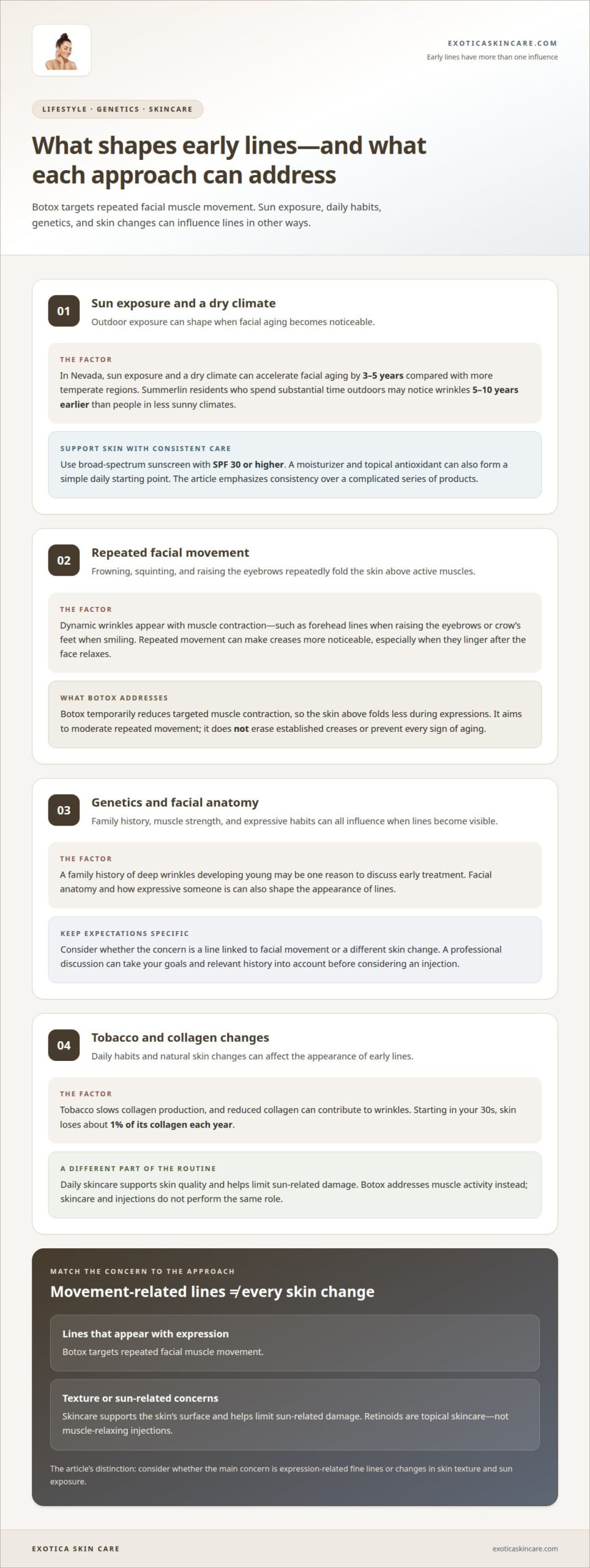
Preventative Botox addresses muscle activity, while sun exposure and daily habits influence skin in other ways. In Nevada, sun exposure and a dry climate can accelerate facial aging by 3-5 years compared with more temperate regions. Summerlin residents who spend substantial time outdoors may notice wrinkles 5-10 years earlier than people in less sunny climates. These figures make sun protection especially relevant alongside any cosmetic treatment.
Genetics and facial anatomy shape when lines become visible. A family history of deep wrinkles developing young can be one reason to discuss early treatment, while muscle strength and expressive habits also influence how lines form. Tobacco slows collagen production, and reduced collagen can contribute to wrinkles. Starting in your 30s, skin loses about 1% of its collagen each year, so daily habits matter as skin changes.
Daily skincare supports skin quality, but it does not perform the same role as an injection. Use broad-spectrum sunscreen with SPF 30 or higher to help protect against early aging. A moisturizer and topical antioxidant can also form a simple daily starting point. For example, apply sunscreen as part of your morning routine, then maintain that habit during outdoor activities in Summerlin. Consistency matters more than adding a complicated series of products.
How does preventative Botox compare with skincare, retinoids, and other treatments? Botox targets repeated facial muscle movement, while skincare supports the skin’s surface and helps limit sun-related damage. Retinoids are topical skincare, not muscle-relaxing injections, so they address a different part of an aging routine. Neither replaces the other. The useful distinction is whether your main concern is expression-related fine lines or changes in skin texture and sun exposure.
Consider what is causing your concern before choosing a cosmetic approach. Lines that appear when you frown point to a movement-related concern; roughness or uneven tone after years outdoors points to skincare needs. A qualified professional can discuss your goals and relevant history, including sun habits and tobacco use, before an injection. That conversation helps set expectations about what each approach is intended to address.
Pairing sun protection with a consistent skincare routine supports a smoother-looking complexion, while Botox addresses a separate source of lines. For readers considering how skin-focused care may complement their routine, explore personalized skincare options as part of a broader approach to early aging.
Facial expressions, gravity and wrinkle formation
A forehead crease can have different causes depending on whether it appears during movement or remains at rest. That distinction matters because Botox targets dynamic wrinkles linked to facial muscle activity, not every line associated with aging. In your 30s, observing how a crease changes when your face relaxes can help clarify what is contributing to its appearance.
Dynamic wrinkles form as facial muscles repeatedly contract. For example, raising your eyebrows can create horizontal forehead lines, while frowning draws the brows together and smiling can crease the outer eye area. Early on, these lines may show mainly during expression. With repeated movement, a crease may remain visible after the muscle relaxes. Botox may be considered in the mid 30s when lines appear only during facial expression.
Static wrinkles are visible when your face is at rest. Their formation can reflect several factors, including sun damage, changes in skin quality, gravity, and soft-tissue laxity. A line that remains across your forehead after you stop raising your brows differs from one that appears only during that movement. This distinction helps set a realistic goal: relaxing muscle activity may soften movement-related lines, but it cannot reverse every cause of a permanent crease.
Gravity and tissue descent create concerns that muscle relaxation does not address. Deep nasolabial folds and jowls, for example, can result from soft-tissue descent and laxity. Botox can help with lines caused by repetitive facial muscle movements, but it does not correct those folds or jowls. Matching the concern to its cause avoids expecting an injection to lift tissue or restore lost support.
Assess each area separately. Notice whether a forehead line appears when you raise your brows, whether frown lines show between them, and whether either remains after your face settles. Compare these movement-linked creases with changes visible at rest, such as deeper folds beside the nose. These examples help distinguish muscle movement from changes involving skin or underlying tissue.
That distinction also shapes conversations about preventative treatment. If a line appears only with expression, the focus may be preserving a natural range of facial movement while reducing repetitive contraction. If a crease remains at rest, relaxing the muscle alone may not address its full cause. The pattern, location, and behavior of each line matter more than age alone. In Summerlin, sun exposure can also contribute to skin aging, so movement-related lines and sun-related changes may occur together but call for different approaches.
Medical contraindications and medication considerations
Age alone doesn’t establish whether treatment is appropriate. A useful assessment considers your goals, facial movement, health history, and medications together. Preventative treatment is often considered in the early 30s, while some people discuss it in their mid-to-late 20s when faint expression lines appear. Others may wait until their 30s or choose no injections.
Medical screening helps identify factors that could make an injection unsuitable or call for a different plan. Share relevant diagnoses, allergies, past reactions to injections, and current symptoms during the assessment. For example, describe an unexpected response to a previous cosmetic treatment rather than assuming it has no bearing on future care. These details help the treating professional assess safety and suitability.
Bring a current list of medications, including prescriptions, nonprescription medicines, and supplements. Include the dose and reason for each, along with any recent changes you know about. Medications can matter when a clinician reviews an injection plan, so don’t omit a product because it seems unrelated to skincare. Don’t stop or change a prescribed medicine on your own; discuss the full list during screening.
Be specific about your treatment history. Note previous Botox injections, when you received them, which areas were treated, and how you responded. If you’ve had another cosmetic procedure, name it and share any complications or lingering effects. These details help distinguish a new concern from a reaction or result that should inform future planning.
Timing also depends on the concern being addressed. In the early 20s, preventative Botox may be discussed for a very expressive face or a strong family history of early lines. In the mid-to-late 20s, faint lines during expression can prompt a conversation. In the 30s, lingering lines after squinting or frowning may be more relevant than age by itself.
A careful appointment includes time to explain your goals and answer questions about expected effects. Describe what you want to preserve, such as natural eyebrow movement, and point out the exact line that concerns you. If a medical condition, medication, or past treatment raises a concern, the professional can consider that information before proceeding. This is different from choosing a dose based only on age or a photograph.
Before scheduling, prepare three things: your medication list, a concise health history, and examples of the expressions that bring out your lines. This makes the discussion more precise. Preventative treatment is an elective cosmetic choice, not a requirement for maintaining a youthful appearance. A thoughtful decision may mean waiting, focusing on skincare, or discussing an injection when dynamic wrinkles are a clear concern.
What areas are commonly treated with preventative Botox?
Preventative Botox most commonly targets forehead lines, crow’s feet, and frown lines between the brows. These areas crease with familiar expressions: raising the brows, smiling, and concentrating. The relevant question is whether movement repeatedly creates lines in a specific area, not whether every facial line needs treatment.
Forehead lines form as the frontalis muscle lifts the eyebrows. A preventative dose range listed for forehead lines is 4 to 10 units. The goal is to soften repetitive creasing while preserving natural expression. Raising the brows during assessment shows where movement creates horizontal lines, and helps distinguish them from creases visible at rest.
Frown lines, also called glabellar lines, appear between the eyebrows as someone frowns or concentrates. The listed preventative dose range is 8 to 15 units. These lines involve muscle activity in the area between the brows, so the pattern and strength of the movement inform treatment planning. A relaxed face and a deliberate frown can reveal how the lines change.
Crow’s feet form beside the eyes, often becoming visible when smiling or squinting. The listed preventative range is 4 to 6 units per side. Treatment planning considers both sides of the face and the way each area moves. A natural result should account for expression, rather than simply trying to eliminate every crease around the eyes.
Other areas can also be discussed. The listed ranges include 2 to 4 units for bunny lines along the nose and 2 to 4 units per side for smile lines around the mouth. These are distinct from the three commonly treated areas, and the specific expression matters. For instance, lines that appear when scrunching the nose differ from those visible while smiling.
These ranges are reference points, not a universal dose for every face. Preventative doses are typically 30 to 50% smaller than traditional Botox doses, and muscle strength, facial anatomy, and treatment goals influence the plan. Units should not be chosen from an area name alone. A small, expressive forehead and a stronger frown pattern can require different assessment, even when both people are seeking a subtle effect.
Before treatment, identify the expression that brings out the line and whether it remains when your face rests. That simple comparison helps focus an aesthetic discussion on the area that concerns you. To explore skin-focused care alongside your goals, review facial treatment options.
Exotica Skin Care: Scarlet SRF
At Exotica Skin Care in Las Vegas, Scarlet SRF offers a skin-focused option for concerns Botox does not target, such as skin texture. Scarlet SRF is radiofrequency microneedling, while Botox addresses muscle movement linked to expression lines. The distinction matters: if your concern is skin quality rather than forehead or frown movement, Scarlet SRF may be more relevant to discuss.
A personalized approach can consider your main concern and the difference between expression-related lines and changes in skin texture. Exotica Skin Care also offers BioRePeelCl3® Peel, PRX Derm Perfexion, and AquafirmeXS. Each option belongs in a conversation about your skin goals, not as a substitute for assessing dynamic wrinkles. Contact Exotica Skin Care to discuss whether Scarlet SRF may fit your skincare goals.
Make your next step personal
Your next step can begin with a clear goal, not a commitment to treatment. Decide what you hope to change, what you want to preserve, and which concerns matter most to you. If you’re weighing preventative Botox in your 30s in Summerlin, keep the conversation focused on your own priorities and the distinction between muscle-related lines and broader skin goals.
For skin-focused care, Exotica Skin Care offers Scarlet SRF, BioRePeelCl3® Peel, and PRX Derm Perfexion. These options can be part of a conversation about your aesthetic goals alongside the questions you’ve considered here. Whether you’re exploring an approach or simply refining your skincare plan, a thoughtful discussion can help you decide what feels appropriate for you.
Contact Exotica Skin Care to discuss your goals and possible next steps. Move forward at your own pace, with a plan that feels considered and personal.
Frequently Asked Questions
Who Makes a Good Candidate for Botox?
A good candidate has a specific concern involving expression-related lines and understands that treatment effects are temporary. Adults aged 18-65 may be candidates, with most candidates between 25-55. Age alone doesn’t determine suitability. For example, someone focused on lines that appear when smiling has a different concern from someone seeking help with skin texture or sun-related changes.
Is It Safe and Worth It?
Botox is FDA-approved when performed by a trained provider, but that doesn’t make every treatment appropriate for every person. Temporary redness or swelling can occur, and improper administration can rarely cause drooping eyelids or eyebrows. Whether Botox is worth considering depends on your concern, desired effect, and willingness to maintain temporary results. Your health history and realistic expectations belong in that decision.
Myth vs reality: Does starting early actually prevent wrinkles?
Starting early may reduce repetitive muscle activity, but hard data doesn’t confirm that preventative Botox prevents wrinkles. A twin case study compared different treatment histories over 13 years, but one example can’t establish a guaranteed outcome for everyone. Wrinkles also reflect sun damage, gravity, and skincare habits, which muscle-relaxing injections don’t prevent. Treat claims of wrinkle prevention as stronger than the evidence supports.
What About “Baby Botox”?
“Baby Botox” usually refers to using smaller amounts of Botox for a softer effect, rather than a separate treatment category. Preventative doses are typically 30 to 50% smaller than traditional Botox doses. The goal is not to freeze every expression. A useful discussion includes which movement you want softened and which expressions you want to retain, such as raising your brows or smiling naturally.
Why Consider Botox in Your 20s or 30s?
Some people consider treatment when faint lines appear during expression, especially with frequent squinting or frowning. A strong family history of early wrinkles can also inform the discussion. For someone considering preventative Botox in your 30s in Summerlin, the practical question is whether a particular line remains after the expression ends. If not, focusing first on sun protection and skincare may better match the concern.
Will I need more Botox as I get older?
Not necessarily. Age alone doesn’t determine dose or schedule, and treatment effects wear off over time. Some patients who begin earlier may need smaller doses over time than those who start later, but that isn’t guaranteed for everyone. Facial muscle strength, the areas treated, and your preferred effect all shape future decisions. Reassess your goals rather than assuming treatment must increase.
What is preventative Botox and how does it work in your 30s?
Preventative Botox uses small doses before deep wrinkles appear, aiming to reduce muscle activity linked to dynamic lines. In your 30s, a practical way to assess the concern is to notice whether a line appears with an expression and then fades, or remains visible at rest. That distinction helps clarify whether the concern is movement-related or reflects other changes in skin or tissue.
Who is a good candidate for Botox in their 30s?
A person in their 30s may be a candidate when dynamic lines are becoming noticeable, particularly if they linger after repeated expressions. Consider a clear example, such as a frown line that remains after you stop concentrating. Goals should focus on a specific area and a natural range of expression. Health history, medications, previous injections, and expectations also matter in deciding whether treatment fits.