
For Botox for forehead lines in Las Vegas, results typically last around three to four months, and treatments are often repeated a few times a year to maintain the effect. BOTOX® Cosmetic temporarily relaxes targeted muscles that create expression lines, softening their appearance without permanently changing how those muscles work.
It’s natural to want smoother-looking skin and still wonder what happens when treatment wears off. You can stop sessions at any time: the effect gradually fades, and forehead movement returns. Continuing treatment is a personal choice, not a lifelong commitment.
Here, you’ll learn what BOTOX® Cosmetic is, how it works on forehead muscles, when results develop, and what influences how long they last. We’ll also explain how treatment timing is individualized and what to expect if you decide to pause or stop, so you can consider your options with a clear understanding of the process.
Key Takeaways
- Learn how to distinguish expression lines that appear with movement from folds that remain visible when your face is at rest.
- Understand why results develop gradually, with the full effect usually appearing around two weeks after treatment.
- Explore what to consider when discussing forehead movement and treatment goals with an injector.
- See how pausing sessions allows muscle movement to return as the effect gradually fades.
Treatment frequency
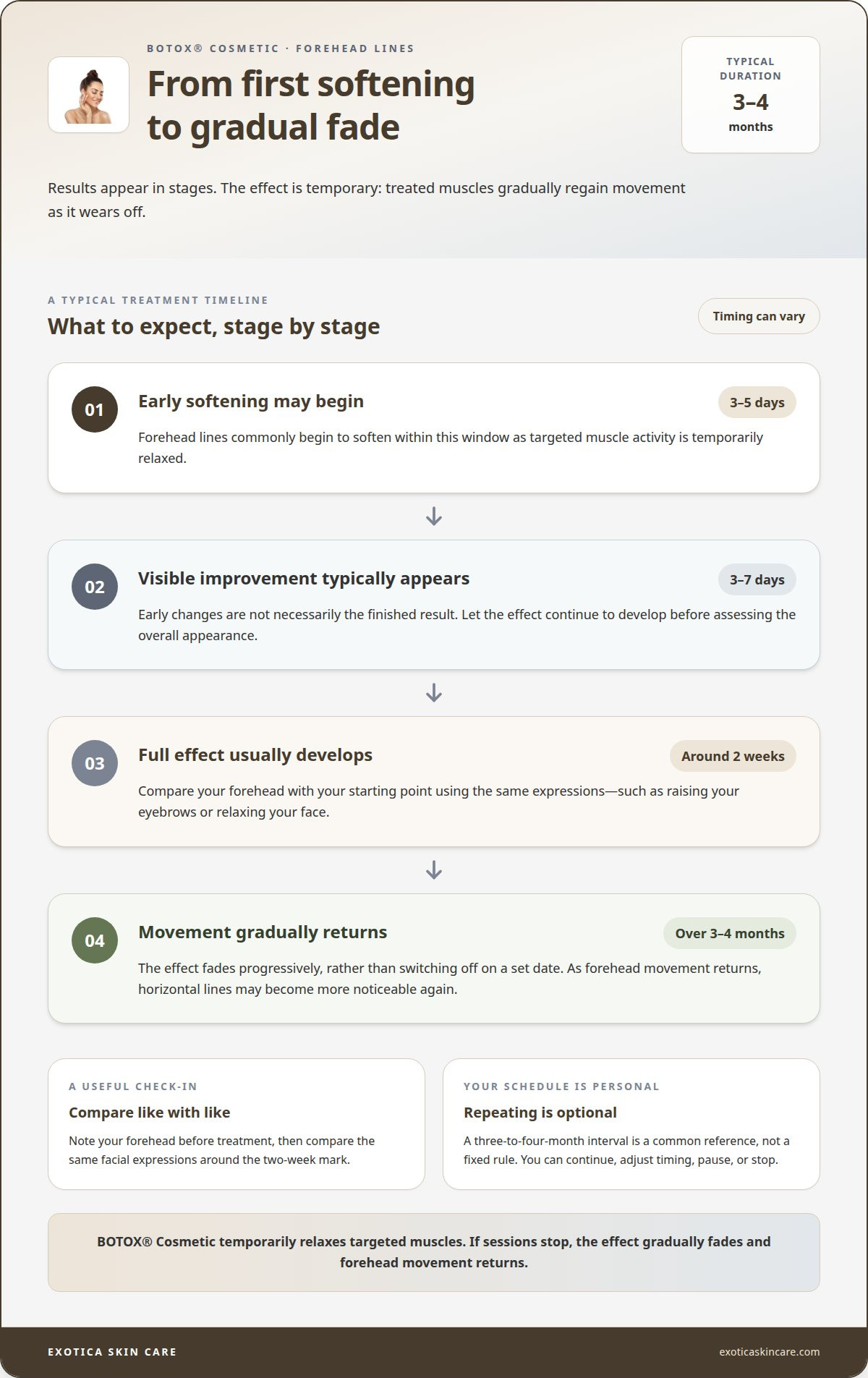
For Botox for forehead lines in Las Vegas, treatments are commonly repeated a few times a year to maintain a preferred result. A typical maintenance interval is three to four months, though timing depends on how quickly muscle movement returns and how much softening you want. The effect fades gradually rather than switching off on a set date. As movement returns, horizontal forehead lines may become more noticeable again.
That interval is a planning guide, not a fixed calendar rule. For example, someone who wants a subtle reduction in movement may choose a different schedule from someone seeking more consistent smoothing. The treated area matters, too. Forehead lines, frown lines between the brows, and lines around the eyes involve distinct muscles and expression patterns. Treatment frequency should reflect the areas addressed, not a routine copied from another person.
Facial anatomy is the foundation of treatment planning. During an assessment, the practitioner can observe how your forehead moves when you raise your brows, relax your face, or frown. These movements help distinguish dynamic lines, which appear with expression, from lines that remain visible at rest. A thoughtful plan also considers your priorities, such as softening horizontal lines while preserving comfortable brow movement. The goal is a considered approach, not a one-size-fits-all schedule.
For patients considering Botox for forehead lines in Las Vegas, a conservative first treatment can make the process easier to assess. Start with a clear discussion of the change you want, including which lines matter most and how much expression you wish to retain. The practitioner can then consider the relevant muscles and facial anatomy when planning treatment. After results develop, you can compare the change with your original goals before deciding whether to repeat treatment or adjust the approach.
Useful points to discuss before choosing a maintenance rhythm include:
- Your main concern: Identify whether forehead lines, frown lines, or both affect your expression most.
- Your preferred movement: Describe how much brow movement you want to keep after treatment.
- Your treatment history: Share prior results, including how long the effect felt suitable.
- Your timing: Consider a three-to-four-month interval as a common reference, then assess how movement returns.
Botox is a temporary injectable option, not a surgical change. Repeating treatments a few times a year to maintain the effect is a choice, not a requirement to continue indefinitely. If you pause, muscle movement returns as the treatment wears off. The schedule is flexible: you can continue, change the timing, or stop based on your goals and experience.
How Long Do BOTOX® Cosmetic Results Last?
BOTOX® Cosmetic results develop gradually, then fade as the treated muscles regain movement. Tracking when you first notice softening and when lines begin to return can help you understand your own treatment timeline.
Result Onset and Peak Timing
Forehead lines commonly begin to soften within three to five days after treatment. Visible improvement typically appears within three to seven days, while the full effect usually develops around two weeks after treatment. These stages differ: early softening is not the same as the finished result. Give the treatment time to develop before judging its overall appearance.
For a useful comparison, note how your forehead looks before treatment, then assess it again around the two-week mark. Compare the same expressions, such as raising your eyebrows or relaxing your face. This makes changes in movement and line visibility easier to observe. BOTOX® Cosmetic is administered to targeted muscles, and the result develops as their activity is temporarily relaxed.
Typical Results Duration
Results typically last around three to four months. The effect fades progressively, so movement and expression return as the treatment wears off. The end of the result is not a sudden switch. Use the three-to-four-month range as a practical reference for when visible movement may return.
Keep track of when your forehead begins moving more freely and when lines become noticeable again. That record can help you describe the result at a future appointment and decide whether its duration suited your preferences. Because the treatment is temporary, you can choose whether to repeat it as the effect fades.
A natural-looking result focuses on softening lines while preserving facial expression. Before treatment, describe the look you want clearly, such as reducing horizontal forehead lines without feeling that your brows look unusually still. The practitioner can consider your movement patterns and treatment area when planning where BOTOX® Cosmetic is administered. Numbing is not a measure of how natural the final appearance will be; the outcome depends on the treatment plan and the movement you want to retain.
Forehead lines that appear with expression differ from deeper folds that remain visible when the face is relaxed. BOTOX® Cosmetic works on muscle activity, while fillers address different aesthetic concerns. Identifying what causes a line helps set a realistic goal for softening it. If a line remains visible at rest, muscle relaxation may not address every part of its appearance.
Use these checkpoints to assess your result:
- At three to seven days: Notice early softening without treating it as the final result.
- Around two weeks: Compare your expressions and line visibility with your starting point.
- Over three to four months: Observe how movement returns and whether you want another treatment.
For a personalized discussion of aesthetic goals, explore individualized skin-care guidance.
Can You Stop BOTOX® Cosmetic Sessions After You Start?
Yes. You can stop BOTOX® Cosmetic sessions at any time; forehead movement gradually returns as the temporary effect fades. Choosing an injector carefully, understanding the appointment, and discussing your health history can help you make an informed decision before treatment.
Botox pricing depends on the treatment plan and amount administered; pricing is provided after a quote request. There is no single unit count for forehead lines. The amount depends on forehead anatomy, muscle activity, and the degree of movement you want to retain.
In Las Vegas, choose an injector who evaluates your facial anatomy and listens to your goals before recommending injections. During a consultation, notice whether they discuss dynamic wrinkles, your preferred appearance, and how treatment may affect natural brow movement. Ask how they plan to address your specific forehead concerns. A careful explanation should connect the proposed treatment area with your desired result, rather than treating every face alike.
A consultation should include your medical history, prior cosmetic treatments, and current goals. BOTOX® Cosmetic injections generally don’t require anesthesia, and a typical session takes 10 to 15 minutes. The injector assesses the forehead at rest and during expression, then administers injections to the selected muscles. If you are also considering dermal fillers, discuss that separately; fillers address different concerns and aren’t interchangeable with muscle-relaxing injections.
Safe handling matters. Opened and diluted BOTOX® Cosmetic must be used within four hours. Ask the injector to explain the product preparation and treatment plan clearly. A focused conversation about the vial, intended areas, and amount administered helps you understand the procedure before it begins.
Downtime is usually limited, though mild redness, swelling, or bruising may occur and typically fades within a day. Minor tenderness can also occur. After injections, avoid rubbing or massaging the treated area for 24 hours, and remain upright for several hours. Avoid strenuous exercise for a few hours after treatment.
People who are pregnant or breastfeeding should avoid Botox. Those with certain medical conditions, including myasthenia gravis or ALS, should avoid treatment or discuss their health with a doctor first. Share relevant diagnoses and medications during the consultation so the treatment decision accounts for your circumstances.
Stopping doesn’t require tapering sessions. As the effect wears off, muscle movement and dynamic forehead lines gradually return toward their previous appearance. You can choose not to schedule another appointment or reconsider later based on your goals. That flexibility is part of choosing a temporary cosmetic treatment.
Botox for forehead lines and other facial wrinkles
Botox is used to soften dynamic facial wrinkles that appear with repeated expression. The treatment area and your aesthetic goals determine which lines are addressed.
Targeted Forehead Muscles and Wrinkles
Horizontal forehead wrinkles form as forehead muscles repeatedly lift the brows. Frown lines appear between the brows when muscles contract during expressions such as concentrating or squinting. These movement-related lines are called dynamic wrinkles. Botox temporarily relaxes selected muscles, reducing the repeated pull on the skin that contributes to them.
During an assessment, observe which lines appear when you raise your eyebrows, frown, and relax your face. A line visible only during movement differs from a fold that remains at rest. Botox targets muscle activity, so it does not treat deep folds caused by lost volume or lines already etched into the skin. This distinction helps clarify whether the treatment matches your concern.
Wrinkle Reduction and Prevention
Reducing muscle movement can soften existing dynamic wrinkles and may help limit the repeated creasing that contributes to their appearance over time. Facial muscles involved in expression pull the skin in the same direction thousands of times a day. Botox does not stop every expression; treatment is planned around the muscles and movement relevant to your goals.
For example, someone concerned about horizontal forehead lines can discuss preserving comfortable brow movement while softening those lines. Early fine lines that show during expression differ from static wrinkles visible when the face is relaxed. Botox addresses the movement component, not every cause of facial aging. Matching the treatment to the wrinkle type keeps expectations focused and specific.
Insurance Coverage and Treatment Cost
Insurance generally does not cover Botox for cosmetic forehead lines because injectable cosmetic treatments are typically elective. Coverage may differ for other medical uses, such as treatment for excessive underarm sweating, but that is separate from cosmetic forehead treatment.
The cost of forehead Botox in Las Vegas depends on the treatment plan and is provided after a quote request. Relevant factors include the areas treated, the amount administered, and the patient’s desired degree of muscle softening. There is no single cost that applies to every forehead, since muscle activity and treatment goals vary.
Before deciding, identify the lines you want to address and note whether they appear during movement or remain visible at rest. Share those observations during a consultation, then discuss how the proposed treatment targets your concern. This connects the treatment plan to your aesthetic goals without assuming Botox will resolve every facial wrinkle.
How Botox relaxes muscles to reduce forehead lines
BOTOX® Cosmetic temporarily relaxes selected muscles that create expression lines. Understanding its targeted action can help you discuss a refreshed, natural-looking aesthetic goal.
Muscle Relaxation Mechanism
Forehead muscles lift the eyebrows and crease the skin during repeated expressions. BOTOX® Cosmetic temporarily reduces activity in selected muscles, softening the repeated pull that contributes to horizontal forehead lines. The procedure targets movement, not the skin itself. As muscle activity eases, the overlying skin is pulled less strongly during that expression.
Consider what happens when you raise your eyebrows, then relax your face. Lines that appear with movement are dynamic, so targeted muscle relaxation can soften their appearance. The treatment plan considers which muscles create the lines and how much movement you want to preserve. This distinction also helps separate movement-related lines from folds that remain visible at rest.
Botox and Dysport Effects
Botox and Dysport are injectable treatments used to address dynamic wrinkles caused by facial movement. Both temporarily relax targeted muscles. Dysport tends to take effect slightly faster and spread more, which can make it suitable for larger areas such as the forehead. The treatment and placement should reflect the area being addressed and your facial movement.
For example, forehead lines may involve a broader area than a small line between the eyebrows. Around the eyes, expression-related lines involve another set of muscles. Each area calls for attention to facial anatomy and how the muscles work together. Discuss the specific lines you notice, rather than assuming one pattern or treatment approach suits every facial area.
Targeted relaxation is not the same as eliminating expression. During planning, describe how you want your eyebrows to move and which lines concern you most. A practitioner can assess your forehead at rest and in motion, then use that observation to guide the procedure. This connects the treatment area with your aesthetic goals, rather than treating the forehead as an isolated surface.
Keep these considerations in mind during a treatment discussion:
- Expression: Identify which movements make the lines more visible, such as raising your eyebrows or frowning.
- Location: Distinguish forehead lines from lines between the eyebrows or around the eyes.
- Desired movement: Explain whether you want noticeable softening while retaining natural expression.
- Line type: Note whether a line appears during movement or remains visible when your face is relaxed.
BOTOX® Cosmetic works on muscle activity, so it may not address every kind of wrinkle. A line caused by lost volume or etched into skin at rest has a different cause than a dynamic line. Clarifying that difference helps set a focused goal for treatment. To discuss your aesthetic goals and facial-care approach, start with the concerns you see during everyday expressions.
Exotica Skin Care: Scarlet SRF
Exotica Skin Care offers Scarlet SRF, a radiofrequency microneedling treatment to consider when your skin-care goals extend beyond expression lines. BOTOX® Cosmetic temporarily relaxes targeted muscles, while Scarlet SRF is a distinct option for broader skin rejuvenation. These approaches address different concerns, so your next step depends on what you want to improve and whether muscle movement or overall skin appearance is your priority.
During a conversation about your goals, you can also discuss BioRePeelCl3® Peel, PRX Derm Perfexion, or AquafirmeXS as other skin-care options. Each should be considered in relation to your individual concerns, rather than as a substitute for muscle-relaxing treatment. Contact Exotica Skin Care to discuss which approach best aligns with your skin-care goals.
Make Your Next Step Personal
Your next step can begin with a simple question: what would you like your expression to communicate? For Botox for forehead lines in Las Vegas, bring that goal into a conversation about the look you want, the movement you wish to preserve, and how treatment fits your broader approach to skin care. Clear priorities make it easier to explore options thoughtfully, without feeling committed to a particular treatment schedule.
Consider writing down the specific concern that prompted your search, such as a line that catches your attention in photographs or a change you notice during everyday expressions. That personal context can shape a more useful discussion than focusing on a treatment name alone. Your preferences matter, and the right next step is the one that feels aligned with them.
Contact Exotica Skin Care to discuss Botox and share the results you hope to achieve. Take the time you need to make a decision that feels informed and comfortable.
Frequently Asked Questions
What is BOTOX®?
BOTOX® Cosmetic is an injectable treatment that temporarily relaxes selected muscles responsible for expression lines. For example, forehead muscles contract when you raise your eyebrows, repeatedly creasing the overlying skin. Relaxing targeted muscle activity can soften these movement-related lines while the treatment is active. It doesn’t address every kind of wrinkle, so the cause and location of your concern matter when deciding whether it fits your goals.
How long does it take to see results?
Some people notice softening within three to five days, with visible improvement commonly appearing within three to seven days. The full effect usually develops around two weeks after treatment. To assess your appearance, compare the same expressions before treatment and around the two-week point, such as raising your brows or relaxing your forehead. Looking too early can make gradual changes harder to judge.
Which injectable should I get?
Botox and Dysport are both used for dynamic wrinkles, but their onset and spread can differ. Dysport tends to take effect slightly faster and spread more, which can suit broader areas such as the forehead. The area you want treated, your expression patterns, and your preferred look are useful discussion points. Rather than choosing by brand name alone, describe your goals and ask how the option matches them.
Does Botox Hurt, and What Does the Recovery Look Like?
Botox injections generally don’t require anesthesia, and a typical session takes 10 to 15 minutes. Afterward, mild redness, swelling, or bruising may occur and typically fades within a day. Plan to stay upright for several hours, avoid strenuous exercise for a few hours, and leave the treated area untouched rather than rubbing or massaging it for 24 hours. Following these steps supports straightforward aftercare.
Does it leave scars?
Botox is administered through injections rather than surgical incisions, and scarring isn’t generally expected after routine treatment. Temporary redness, swelling, or bruising can occur around injection sites and typically fades within a day. If you have a personal history of raised or persistent scars, mention it before treatment. You can also ask what temporary skin changes to watch for and how to care for the injection areas.
How Do I Choose a BOTOX® Cosmetic Doctor?
Choose a qualified medical professional who discusses your goals, examines your facial movement, and explains the proposed treatment area. In a Las Vegas consultation, notice whether the conversation covers your health history and the difference between expression lines and folds visible at rest. A clear explanation should help you understand the approach and its limits. Bring questions about the treatment plan, expected changes, and aftercare before deciding.
How Long Will It Last?
Results typically last around three to four months, though the effect fades gradually as muscle movement returns. You may notice your forehead moving more freely before lines become as visible as they were before treatment. Keeping a simple note of when movement returns can help you evaluate whether the result suited your preferences. That observation gives you useful context if you later discuss repeating treatment.
How Often Can I Receive BOTOX® Cosmetic Injections?
Patients commonly schedule treatments a few times a year to maintain their preferred effect, with three to four months often used as a reference interval. Timing depends on when muscle movement returns and which areas were treated. For instance, note when forehead movement becomes noticeable again, then use that observation when considering future appointments. Continuing is optional; the effect gradually fades if you stop.