
Botox isn’t the only way to address lines and wrinkles, and non-injection options can involve different recovery needs. In Las Vegas, the right approach depends on the concern: skin-focused treatments may improve the look of lines and texture, while recovery and results vary by treatment.
It’s reasonable to want smoother-looking skin without surprises about recovery or how long results may last. This guide explains what to consider when comparing non-Botox options, including downtime, results, and treatment goals. You’ll also learn how approaches differ for forehead lines, frown lines, neck bands, and jawline concerns, so you can decide what to discuss with a qualified professional.
Key Takeaways
- Botox results develop over time, and maintenance is typically repeated every three to four months; compare that timeline with the recovery and result expectations for other approaches.
- Choose an option based on whether your concern is linked to facial movement, skin texture, or another aesthetic goal.
- Consider forehead lines and frown lines separately from neck bands and jawline concerns, since treatment suitability depends on the area and cause.
- Explore non-Botox skin treatments, including Scarlet SRF, and learn how each approach may fit your goals and comfort with downtime.
- If Botox hasn’t addressed your concern, identify what remains and use that distinction to guide a more targeted conversation about alternatives.
Onset and duration of results
Botox results are gradual, not immediate. Full cosmetic results generally develop within 10-14 days, as the treated muscles respond and movement softens. That means wrinkles caused by repeated facial expressions may look less pronounced over time, rather than disappearing at the appointment. Plan around that adjustment period if you have a major event approaching.
The first change may appear before the final effect, but the 10-14-day window is the useful point for assessing the result. A treatment works by temporarily reducing muscle activity in targeted areas. As that effect develops, expressions such as frowning or raising the forehead may create less movement in the treated muscles. Your personalized outcome depends on the area treated and the treatment plan.
Botox results typically last three to four months, and maintenance treatments are commonly repeated on that schedule. The effect fades as muscle activity returns, so wrinkles linked to movement may gradually become more noticeable again. This is a usual maintenance interval, not a guarantee of smoothness. Keeping a treatment record can help you compare how long the effect lasts between appointments.
For planning, allow 2 weeks before a major social event. That gives results time to reach their maximum effect and any bruising time to disappear. The timeline is useful whether it’s your first botox treatment or a repeat appointment. Avoid judging the final appearance immediately afterward; the intended effect develops over days.
In Nevada, who may administer cosmetic injectables depends on professional licensure, scope of practice, and applicable medical oversight. Consider both the injector’s role and the clinical oversight governing the treatment.
The cost of wrinkle relaxers in Henderson depends on the treatment area, product, and planned amount. A per-unit figure alone may not reflect the full treatment plan, so ask what the proposed treatment includes before deciding.
To evaluate results, compare the same area at rest and during movement, using similar expressions and lighting. For example, note whether forehead lines soften when you raise your brows, then compare again after the 10-14-day response period. This makes the assessment more useful than relying on memory or checking repeatedly during the first few days.
Botox effects and duration vary with the treatment area and individual muscle activity. Keep the timeline in perspective: results build over 10-14 days, then commonly last three to four months. Those milestones help you plan appointments and judge whether the outcome aligns with your goals.
Alternatives if Botox is ineffective
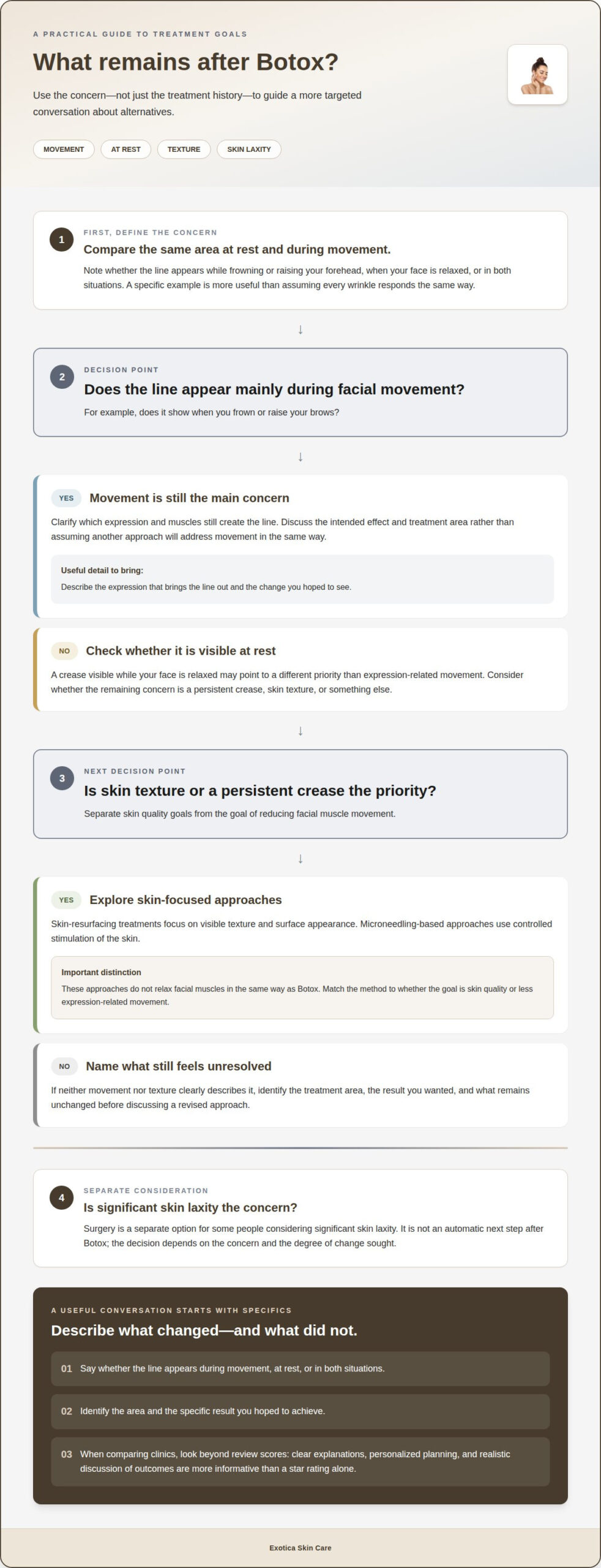
If Botox hasn’t achieved the change you wanted, first identify what remains unchanged. Lines that appear mainly during facial movement differ from creases visible when your face is relaxed. For example, compare a frown at rest with one made while concentrating. That distinction clarifies whether your goal is less muscle movement, smoother-looking skin, or broader facial rejuvenation.
Patients can discuss a revised approach rather than assuming every wrinkle responds the same way. A focused review should consider the treatment area, the intended effect, and whether the concern is dynamic or present at rest. For example, persistent texture concerns may call for a skin-focused strategy, while pronounced movement remains a muscle-related issue. A natural-looking result starts with matching the method to the concern.
Non-Botox approaches differ in what they aim to improve. Skin-resurfacing treatments focus on visible texture and surface appearance, while microneedling-based approaches use controlled stimulation of the skin. Neither relaxes facial muscles in the same way as Botox. This distinction matters if your original goal was to reduce expression-related movement rather than improve skin quality.
Some people consider surgery for significant skin laxity, but surgery is separate from nonsurgical wrinkle treatments. The decision depends on the concern and the degree of change sought. It isn’t an automatic next step after Botox. First define what remains, such as a crease at rest, uneven texture, or movement that still feels prominent.
When comparing Las Vegas med spas or dermatology clinics for Botox alternatives, don’t rely on review scores alone. Comments describing clear explanations, personalized treatment planning, and realistic discussion of outcomes are more useful than a star rating by itself.
To make your next discussion productive, bring a specific example of what Botox didn’t change. Note whether the line appears during movement, at rest, or in both situations. Describe the result you hoped to achieve, such as softer frown lines without changing your natural expression. These details help distinguish a treatment mismatch from a goal that needs a different approach.
- Movement remains the main concern: clarify which muscles and expressions still create the line.
- The line is visible at rest: discuss whether skin texture or a persistent crease is the priority.
- Texture is the concern: explore skin-focused rejuvenation approaches separately from muscle-relaxing treatments.
- Considering surgery: treat it as a distinct option, not the default response to an unsatisfactory Botox result.
Botox risks, limitations, and alternatives
Botox changes facial muscle activity, so it may not address every concern affecting appearance. A crease visible at rest, uneven texture, and skin laxity involve different aesthetic goals. Someone seeking softer forehead movement, for example, may have different priorities from someone focused on rough skin texture. Identifying the concern helps distinguish movement-based treatment from skin-focused or surgical approaches.
Common temporary effects after Botox include redness, swelling, bruising, and tenderness. These may last for a couple days after the appointment. Even a short recovery window matters when planning work, photographs, or a social event. Consider the treatment area and your schedule, and discuss specific health concerns with the qualified professional providing care.
Botox also has limits beyond its cosmetic use. Its use for TMJ disorder is off-label, meaning Botox isn’t FDA-approved specifically to treat that condition. Physical therapy, stress management, and other therapies may form part of a comprehensive TMJ approach. Jaw discomfort calls for a broader discussion than choosing a cosmetic treatment based only on facial appearance.
When comparing providers in Henderson, ask whether they offer Dysport, Xeomin, or Jeuveau as alternatives to Botox. Dysport is an FDA-approved botulinum toxin type A neuromodulator, like Botox. A product name alone doesn’t establish which options a provider offers.
Alternatives depend on what you want to address. If movement creates the line, another muscle-relaxing approach may be relevant to discuss. If texture or surface appearance is the priority, skin-focused treatments may better match your goal. Neither category should be assumed to produce the same effect as Botox. Surgery is distinct and addresses concerns beyond a temporary change in muscle movement.
- For expression lines: describe the movement that creates them, such as squinting or frowning.
- For lines visible at rest: note whether texture or a persistent crease is the main concern.
- For jaw symptoms: separate a cosmetic goal from TMJ discomfort and discuss the broader care approach.
- For treatment planning: clarify the intended effect, recovery considerations, and whether the option is surgical or nonsurgical.
Choose an aesthetic treatment based on the concern, not the product label. Bring a clear example, such as a line that remains when your face is relaxed, and describe the change you hope to achieve. That gives the discussion a practical starting point and helps align the approach with your appearance goals.
Forehead lines and frown lines
Forehead lines and frown lines can look similar, but they form during different expressions. Raising your eyebrows creates horizontal forehead creases; drawing your brows together creates vertical lines between them. During a consultation, describe which movement brings each line forward. That distinction helps shape a treatment plan around your expression, rather than treating the whole upper face as one concern.
Botox addresses movement-related lines by reducing activity in selected facial muscles. The goal may be a softer appearance while preserving some natural expression. For example, you may want less visible frown lines while keeping forehead movement when you raise your brows. Explain which expressions you want to retain and which lines you most want to soften.
Lines that remain visible when your face is relaxed call for a different discussion from creases seen only during expression. Check your forehead at rest, then raise your brows; repeat while frowning. If a crease remains in both positions, mention that pattern during the medical consultation. It can help distinguish a movement-related goal from a skin-texture concern.
Skin-focused treatments may suit people whose priority is overall surface appearance, while wrinkle relaxers address movement. These approaches have different purposes, so one isn’t a direct substitute for the other. If you’re concerned about both forehead movement and uneven texture, discuss each goal separately. A personalized plan can consider whether treatments should remain separate or be combined.
Bring clear examples to your appointment. Describe whether you notice the line while reading, concentrating, or looking into bright light. These activities may reveal different expression patterns, but focus the treatment discussion on what you observe rather than assuming a cause. A photo of your face at rest and during a frown can help make your priorities specific.
- Forehead: identify horizontal lines that appear when raising your brows.
- Between the brows: note vertical lines that become visible while frowning.
- At rest: record whether either crease remains without an expression.
- Desired result: explain which movements you want to preserve.
Repeat treatments may be part of maintaining a wrinkle-relaxing effect, while skin-focused care follows a different plan. Discuss the expected effect, recovery, and how each option fits your activities before deciding. A measured approach is useful if both forehead and frown lines concern you, because treating one area doesn’t automatically address the other. Clear priorities help guide the next step.
What non-Botox wrinkle treatments are available in Henderson, Nevada?
Some non-Botox approaches may focus on skin appearance rather than facial muscle movement. At Exotica Skin Care, options include radiofrequency microneedling, chemical peels, and skin-rejuvenation treatments. Each has a distinct purpose. Start by identifying your main concern, such as uneven texture, dullness, or lines visible when your face is relaxed.
People comparing alternatives to Botox in Henderson can also consider specialized skin-focused treatments available through Exotica Skin Care. Radiofrequency microneedling combines microneedling with radiofrequency energy, but it isn’t a wrinkle relaxer. Someone concerned about overall texture may explore this approach, while someone focused on forehead movement has a different treatment goal.
Chemical peels are another option for concerns involving the skin’s surface, including uneven-looking texture or tone. The peel selected and the treatment plan shape the experience and recovery. When comparing alternatives to Botox in Henderson, consider what each option is intended to address rather than assuming every peel or skin treatment works the same way.
Skin-rejuvenation treatments offer another route when the goal is refreshed-looking skin. They don’t limit muscle movement. At Exotica Skin Care, a useful consultation can distinguish expression lines from texture and overall skin appearance. This helps you compare treatment categories according to your priorities, rather than choosing based only on a familiar treatment name.
Recovery depends on the treatment method and plan for your skin. Before scheduling your visit, discuss aftercare and how recovery fits your routine. If you have an upcoming event, factor the treatment’s aftercare guidance into your timing. Results also follow different timelines across treatment categories, so assess each approach on its own terms.
- For movement-related lines: distinguish expression concerns from skin-texture goals.
- For uneven texture: ask how microneedling-based treatments or peels address the area.
- For overall refreshment: compare skin-rejuvenation options by purpose and recovery needs.
- Before scheduling at Exotica Skin Care: discuss aftercare and timing alongside your intended outcome.
Bring a clear example to your consultation at Exotica Skin Care, such as a line visible at rest or rough texture across the cheeks. This keeps the discussion focused on your goals and helps compare non-Botox approaches effectively.
Botox can be a point of comparison, but its treatment details do not describe peels, microneedling, or skin-rejuvenation treatments. The page reports that approximately 70% of patients experience significant symptom improvement after Botox treatment for TMJ, and most people treated with Botox for TMJ start noticing improvement within 1 to 2 weeks. Most Botox treatments for TMJ use 30 to 60 units total, divided between the masseter and temporalis muscles on both sides of the face.
The directory lists 147 Botox results near Henderson, Nevada, but that count does not compare non-Botox treatments. Patients are advised to delay strenuous exercise until the following day after Botox treatment. Botox cosmetic improvements and therapeutic effects develop over time rather than immediately, and repeat treatments may be needed to maintain results. For skin-focused alternatives at Exotica Skin Care, keep the consultation centered on your concern, intended outcome, and recovery plan.
Exotica Skin Care: Scarlet SRF
Exotica Skin Care offers Scarlet SRF, a skin-focused alternative for people exploring options beyond Botox. It may be relevant if your priority is skin rejuvenation rather than reducing facial muscle movement. Start by clarifying the concern you want to address, such as texture or overall skin appearance, then discuss whether Scarlet SRF fits that goal.
Other available skin-treatment options include BioRePeelCl3® Peel, PRX Derm Perfexion, and AquafirmeXS. These treatments are distinct from Botox, so compare them according to your concerns and preferences rather than expecting the same effect. A personalized discussion can help you understand which option aligns with your goals.
For a conversation about Scarlet SRF and other skin-focused treatments, contact Exotica Skin Care.
Choose a Treatment Path That Fits Your Goals
Choosing among alternatives to Botox in Henderson starts with defining the change you want, not selecting a treatment by name. Consider what matters most: softer-looking lines, a refreshed complexion, or a skin-focused approach. That clarity makes your next conversation more specific and helps you express your preferences with confidence.
Exotica Skin Care offers Scarlet SRF, BioRePeelCl3® Peel, and PRX Derm Perfexion. These options give you distinct treatment paths to discuss according to your aesthetic priorities. Bring your questions about your goals, comfort, and preferred approach, then use the conversation to decide what feels aligned with you.
Your next step can be simple and personal. Contact Exotica Skin Care to discuss your treatment goals and explore an option that feels right for your skin. A considered choice can be the beginning of feeling more at ease in your appearance.
Frequently Asked Questions
Is there downtime?
Downtime depends on the treatment. BioRePeelCl3® Peel is described as a no-downtime peel, while microneedling-based treatments involve a different process and recovery can depend on the treatment plan. If you’re arranging care around work, travel, or an event, discuss timing and aftercare before choosing an option. This helps you plan without assuming every non-injection treatment has the same recovery experience.
What non-injection alternatives to Botox are available in Henderson, such as lasers or microneedling?
Skin-focused options include radiofrequency microneedling, chemical peels, and other rejuvenation treatments. Scarlet SRF combines radiofrequency and microneedling, while BioRePeelCl3® Peel and PRX Derm Perfexion are peel options. These options may suit skin-related goals, though their effects differ from treatments aimed at facial muscle movement. Laser treatments are a separate category, so don’t assume they work like microneedling or address the same concerns. Match the method to your goal, such as skin texture or expression lines.
What are the risks and side effects of Botox alternatives?
Possible effects depend on the treatment method and area. A peel, for example, differs from radiofrequency microneedling in how it interacts with skin, so aftercare needs won’t be identical. Before choosing, discuss your skin history, current routine, and any products or treatments that may affect preparation. Ask for specific aftercare instructions for the selected option, then plan around them rather than assuming all treatments share the same risks.
How long do Botox alternatives take to work, and how often are repeat treatments needed?
There isn’t one timeline for every alternative because treatments address different concerns and work through different processes. A skin-focused plan may involve assessing texture or overall appearance, while a wrinkle relaxer targets movement. Compare the goal of improving skin quality with the goal of softening an expression line. Ask how progress will be assessed and what repeat schedule suits the specific plan, rather than applying Botox’s timing to another method.
Which Henderson med spas or dermatology clinics have strong reviews for Botox alternatives?
Look for reviews that describe clear explanations, personalized treatment planning, and realistic discussions of outcomes. A star rating alone can’t establish which clinic is right for your goals.