
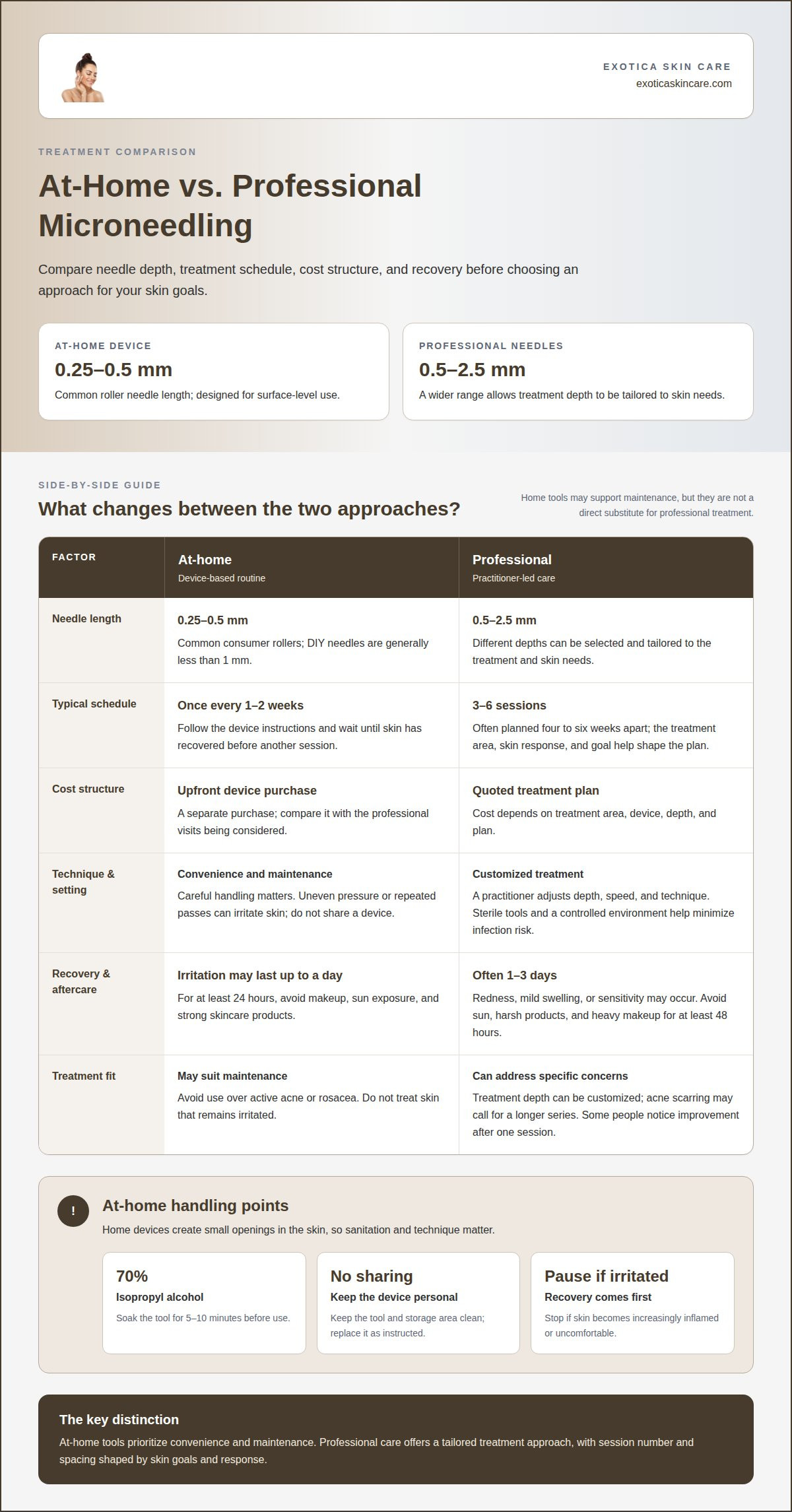
The lowest upfront cost may not suit your skin goals. For at-home microneedling vs. professional treatment in Las Vegas, the main difference is that a home device is a one-time purchase, while professional care is often planned as a series of three to six sessions, typically spaced four to six weeks apart.
It makes sense to weigh convenience and cost alongside safety and results. At-home rollers commonly reach 0.25 to 0.5 millimeters, while professional needles can range from 0.5 to 2.5 millimeters, allowing treatment to be tailored more precisely to skin needs. Home tools can support maintenance, but they aren’t a direct substitute for professional treatment.
This comparison looks at device costs, needle length, effectiveness, recovery, and session needs. It can help you decide whether at-home microneedling fits your routine or whether professional treatment is a better match for your skin goals.
Key Takeaways
- Use the typical professional treatment schedule as a planning guide, then weigh how your skin goals may affect the number and spacing of sessions.
- Understand why home-device needle length and technique matter when considering irritation, infection risk, and skin sensitivity.
- Compare the upfront cost of a home device with the different treatment approach and tailored settings of professional care.
- Think of at-home microneedling as a possible maintenance approach, not a direct replacement for professional treatment.
- Match your choice to your skin concerns, comfort with at-home technique, and desired level of professional guidance.
How many professional microneedling sessions are typically needed?
A professional treatment plan often includes three to six sessions, usually spaced four to six weeks apart. Some people notice improvement after one session, while acne scarring may call for a longer series. The treatment area, skin response, and goal all help shape the plan. When comparing at-home microneedling with professional treatment in Las Vegas, consider the number of sessions as well as the approach.
Nevada rules determine who may perform microneedling and which needle depths are permitted. The appropriate practitioner and depth depend on the treatment and applicable state requirements.
Professional microneedling costs in Las Vegas depend on the treatment area, device, depth, and treatment plan; pricing is provided after a quote request. Home devices are a separate purchase, so compare their upfront cost with the number of professional visits being considered.
A typical procedure starts with skin preparation and may include topical numbing cream to reduce discomfort. The practitioner adjusts needle depth, speed, and technique to the person’s skin needs. Redness, mild swelling, or sensitivity may last 1-3 days. After treatment, avoid sun exposure, harsh skincare products, and heavy makeup for at least 48 hours.
Professional treatments can be customized for specific concerns, while home devices prioritize convenience and maintenance. For example, acne scarring may call for a different treatment depth than general skin maintenance. If you have active skin concerns or sensitivity, consider how these factors may affect the approach and recovery.
| Option | Schedule | Cost structure | Consideration |
|---|---|---|---|
| Professional series | Three to six sessions, four to six weeks apart | Quoted for the treatment plan | Customized depth and technique |
| Single professional session | One visit, with changes developing over following weeks | Quoted for the treatment | May suit an initial treatment goal |
| At-home device | Home use according to device instructions | Upfront device purchase | Convenience and maintenance |
| Non-needling alternative | Depends on the selected treatment | Quoted for the treatment | A different approach to skin concerns |
If you’re weighing at-home microneedling against professional treatment in Las Vegas, consider whether convenience or customized treatment depth matters more for your skin goals.
Is at-home microneedling safe to use regularly?
At-home microneedling carries infection and irritation risks, so limit use to once every one to two weeks. Before use, soak the tool in 70% isopropyl alcohol for 5 to 10 minutes, and follow its manufacturer’s replacement instructions.
Infection and Technique Risks
Home microneedling devices need careful handling because they create small openings in the skin. An improperly cleaned tool can introduce contaminants, while uneven pressure or repeated passes can irritate the treated area. Don’t share a device. Professional treatment uses sterilized tools in a sterile environment to help minimize infection risk.
Technique affects how your skin responds. Pressing harder won’t make a home treatment more effective, and repeatedly treating one spot can increase irritation. Avoid using a device over active acne or rosacea, since improper microneedling may worsen these concerns. Existing inflammation or sensitivity can also make a routine harder to tolerate.
Sanitation and Skin-Barrier Risks
Safe handling involves more than cleaning. Keep the device and its storage area clean, avoid touching the needles, and replace the tool according to the manufacturer’s instructions. Stop using a device if it appears damaged. Professional care differs because sterile tools and a controlled treatment environment help reduce contamination risks.
Microneedling temporarily disrupts the skin barrier. Applying retinol or strong acids immediately afterward can compromise that barrier further, increasing the chance of irritation. For at least 24 hours after an at-home session, avoid makeup, sun exposure, and strong skincare products. Redness or irritation may fade within a few hours, but it can last up to a day.
Frequency should reflect recovery, not convenience alone. Leave one to two weeks between home sessions, and don’t treat skin that remains irritated. Stop if the area becomes increasingly inflamed or uncomfortable. Regular use isn’t automatically appropriate for every skin type, especially when acne or rosacea is active. For concerns that need a tailored approach, professional skin treatment guidance can help distinguish a home routine from supervised care.
Keep aftercare simple: protect the skin from sun exposure, skip makeup during the first 24 hours, and avoid strong actives during that period. Don’t add several new skincare products immediately after treatment, since that can make it harder to identify what is irritating your skin. If your skin hasn’t returned to its usual condition, postpone another session rather than following a calendar automatically.
At-home device needle lengths and cost
At-home microneedling devices are designed for surface-level use, with shorter needles and lower upfront costs than professional treatments. Needle length helps explain the difference, but it doesn’t determine results on its own.
At-Home Device Needle Lengths
Consumer microneedling rollers typically reach 0.25 to 0.5 millimeters, while DIY needles are generally less than 1 millimeter long. These devices affect the epidermis, the skin’s outermost layer. Professional needles range from 0.5 to 2.5 millimeters, allowing different treatment depths. The two approaches therefore differ in how deeply they’re designed to work.
A printed needle measurement describes its length, not how deeply it will penetrate with every pass. Pressure, angle, and device design affect how needles contact the skin. Don’t press harder to pursue deeper treatment. More force can increase irritation without making a home device equivalent to professional equipment. Redness or irritation may fade within a few hours, but can last up to one day.
Shorter needles also shape expectations. At-home tools are intended for maintenance, not as a direct substitute for professional treatment. They may cause temporary surface effects, but deeper concerns call for a different approach. Consider needle length alongside your goal, skin response, and comfort with the device. A measurement alone can’t show whether a tool suits a particular concern.
At-Home Device Costs
The setup estimate can include more than the roller itself, so compare the complete kit rather than its headline device price. A lower purchase cost makes home use more accessible, but doesn’t include professional technique or individualized treatment planning.
Budget for the device and any recurring supplies or replacement parts specified by its manufacturer. Don’t assume the lowest-priced option has the right needle length, construction, or instructions for your needs. Cost alone doesn’t establish effectiveness. Compare the specifications and intended use before deciding whether the upfront expense suits your routine.
Think beyond the checkout total. Home use is convenient, but requires consistent care, safe handling, and restraint between sessions. Professional microneedling has a per-session cost rather than a one-time device purchase, and a plan may involve multiple visits. For a practical comparison, weigh the initial device expense against your intended frequency, comfort with technique, and the concern you hope to address.
At-home kit costs and effectiveness
A home kit’s low purchase price doesn’t tell you what changes to expect. Compare the example roller cost with what at-home microneedling can realistically do for concerns such as acne scars.
At-Home Kit Costs
That price represents the device, not its effectiveness or a complete treatment plan. Kits and rollers differ in design and included components, so check what the product contains and how it’s intended to be used. The key comparison is upfront convenience versus the limits of home treatment.
Cost needs context. A single inexpensive roller may seem straightforward, but repeated home use requires following its instructions and handling it safely. Professional care, by contrast, is structured around a treatment plan and an individual concern. Buying a kit doesn’t mean you’ll achieve the same result as treatment by a trained professional. The price tag describes the purchase, not the depth or precision of treatment.
At-Home Kit Effectiveness
Microneedling works by creating tiny, controlled injuries in the skin. These micro-injuries stimulate growth-factor release, new tissue formation, and skin repair. At-home devices affect the epidermis, the outermost layer, so their effect is more limited than professional treatment designed to reach deeper layers. Home devices are intended for maintenance, not as a direct replacement for professional care.
That distinction matters for collagen and acne scars. Professional microneedling may improve the appearance of shallow rolling or boxcar scars by stimulating collagen remodeling in deeper skin layers. A home kit’s shorter reach makes it a different approach, and repeated use doesn’t make its penetration equivalent to professional treatment. Some people may need many weekly sessions before seeing even a slight result from home use.
Microscopic channels created during microneedling can increase the absorption of topical treatments into the skin. That doesn’t mean every skincare product is appropriate after a session or that a kit will deliver a particular outcome. Follow the device instructions and keep expectations in line with its intended surface-level use.
Consider your goal before choosing a kit. At-home use may appeal for basic maintenance; for acne scars or concerns involving deeper skin layers, treatment depth matters more. A trained professional can tailor needle depth, speed, and technique to your skin’s needs. The practical choice is between a home tool’s limited reach and professional treatment’s ability to address specific concerns.
At-home and professional microneedling
Both approaches use controlled skin injuries, but they differ in depth, oversight, and intended role. Compare them by matching your concern and desired texture changes with your comfort performing treatment yourself.
Microneedling creates tiny, controlled micro-injuries that prompt growth-factor release, tissue formation, and skin repair. At-home devices affect the epidermis, while professional needles can reach deeper layers. This matters for concerns such as shallow rolling or boxcar acne scars, whose appearance may improve with collagen remodeling.
Professional treatments allow a practitioner to tailor needle depth, speed, and technique to your skin’s needs. This can target specific areas rather than applying the same approach across the face. Home devices are convenient, but you control the pressure and passes. Inconsistent technique can increase irritation without delivering the intended effect.
| Option | Primary role | Customization | Key consideration |
|---|---|---|---|
| At-home device | Maintenance | User-controlled technique | Limited depth and self-managed sanitation |
| Professional microneedling | Targeted skin concerns | Depth, speed, and technique can be tailored | Requires a treatment plan and recovery care |
| Skincare without needling | Routine skin support | Products selected for individual concerns | Doesn’t create microneedling channels |
| Combination approach | Professional care with home maintenance | Different roles for each method | Timing and products must suit skin recovery |
Results also develop differently. Changes after professional microneedling occur over the following weeks as the skin repairs itself. A home device is intended for maintenance, not as a direct substitute for professional treatment. More frequent home sessions won’t reproduce a practitioner’s control over penetration or technique. Avoid treating freshly irritated skin, and follow aftercare instructions before resuming active skincare.
Let your main concern guide your decision. For mild texture maintenance, a home device may appeal if you can follow its cleaning and use instructions carefully. For acne scarring or a goal involving deeper collagen remodeling, professional assessment offers the advantage of tailored technique. Active acne or rosacea also calls for caution, as improper home use may worsen these conditions.
The practical takeaway: choose home use for convenience and maintenance, and consider professional care when treatment depth, technique, or a specific concern matters more. If you’re weighing a professionally guided approach, discuss your skin treatment options and how they align with your goals.
Exotica Skin Care: SQT Bio-Microneedling
Exotica Skin Care offers SQT Bio-Microneedling as an in-clinic option for those who prefer professional care to using a home device. It may be a relevant next step if you want to discuss your skin goals and explore treatment in a professional setting.
The right choice depends on the concern you want to address and the approach you feel comfortable pursuing. Exotica Skin Care also offers Scarlet SRF, BioRePeelCl3® Peel, and PRX Derm Perfexion, giving you additional treatment options to discuss. Each is a distinct offering, so a conversation can help clarify which approach aligns with your priorities.
For a professional conversation about SQT Bio-Microneedling and your skin goals, contact Exotica Skin Care.
Choose a next step that fits your skin goals
Let your specific concern guide what you explore next. If you’re deciding between at-home microneedling and professional treatment in Las Vegas, consider which approach suits your comfort, routine, and desired level of guidance. A conversation about your goals can help you understand the options without committing to a one-size-fits-all plan.
Exotica Skin Care offers SQT Bio-Microneedling, as well as Scarlet SRF, BioRePeelCl3® Peel, and PRX Derm Perfexion. These distinct services create room to discuss approaches beyond an at-home device and identify what best aligns with your skin priorities. Share the concern you’d like to address and the type of treatment experience you prefer.
Contact Exotica Skin Care to discuss your options and take a thoughtful next step toward care that feels right for you.
Frequently Asked Questions
What is Microneedling?
Microneedling uses fine needles to create controlled microscopic injuries in the skin. The skin responds through repair processes, including new tissue formation. It can be performed with consumer devices or professional equipment, but the approaches aren’t interchangeable. A home roller, for example, is intended for maintenance, while professional treatment can be tailored to a specific concern and treatment area.
Are There Any Side Effects Associated With Microneedling?
Yes. Temporary redness, mild swelling, sensitivity, or irritation can occur after microneedling. At-home use adds risks from poor sanitation or inconsistent technique, and improper use may worsen active acne or rosacea. Follow aftercare guidance, avoid strong skincare products immediately after treatment, and don’t treat irritated skin. If inflammation or discomfort increases, stop home use and seek appropriate medical advice.
Can professional microneedling help with acne scars?
Professional microneedling may reduce the appearance of shallow rolling or boxcar acne scars by supporting collagen remodeling in deeper skin layers. The treatment can be tailored to the area and skin concern, unlike a home device intended for surface-level maintenance. Active acne differs from scarring: improper microneedling may aggravate active breakouts, so treatment should account for the skin’s current condition.
How Do At-Home Devices Compare to Professional Treatments?
Home devices prioritize convenience and maintenance, while professional treatments allow closer control over depth, speed, and technique. If you’re deciding between these options in Las Vegas, start with your goal: maintaining a routine differs from addressing a specific concern such as scarring. Professional care also uses sterilized tools in a sterile environment, while home users manage device cleaning and handling themselves.
How Many Sessions Do I Need to See Results?
Professional plans commonly involve three to six sessions, with four to six weeks between visits. Some people notice improvement after one session, but visible changes can develop over the following weeks. Acne scarring may require a longer course than general maintenance. Rather than judging progress immediately, consider the concern being treated and allow time for the skin’s repair process between appointments.
Is Microneedling Safe for All Skin Types?
No single schedule or technique suits every skin type. Sensitive or dry skin may need six to eight weeks between treatments, while oily or combination skin may tolerate treatment as often as once monthly. Active acne and rosacea call for particular caution because improper microneedling may worsen them. Skin condition, sensitivity, and treatment area all matter when choosing an approach.
What Kind Of Results Can I Expect From Microneedling?
Results depend on the concern and the method used. Professional microneedling may improve the appearance of shallow rolling or boxcar scars, while home devices are intended for maintenance rather than replacing professional care. Full professional results develop over the following weeks as the skin repairs itself. To assess change, compare the same skin area under similar lighting over time.
What Sets Professional Microneedling Apart?
Professional microneedling combines sterilized tools and a sterile environment with adjustable treatment settings. A practitioner can tailor depth, speed, and technique to your skin’s needs, and topical numbing cream may be used beforehand to reduce discomfort. At home, you handle sanitation and technique yourself. Professional treatment is especially relevant when a concern calls for more than surface-level maintenance.