
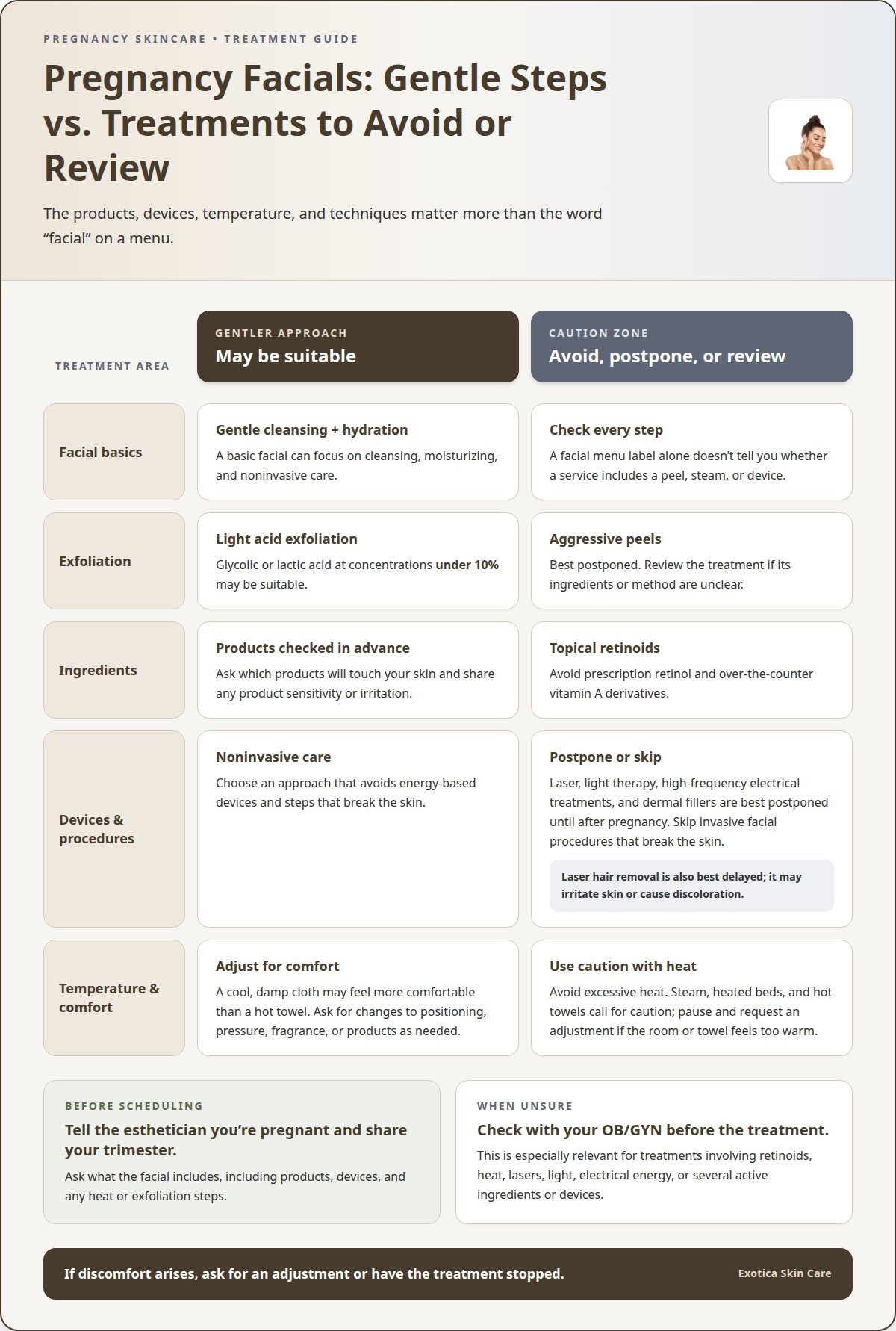
A facial isn’t automatically off-limits during pregnancy, but the exfoliant, ingredients, and treatment steps matter. Safe facials during pregnancy in Las Vegas may include gentle, noninvasive options tailored to avoid topical retinoids, aggressive peels, and treatments that break the skin. Glycolic or lactic acid exfoliation at concentrations under 10% may be suitable, while heat-based steps such as steam call for caution.
It’s understandable to want clear guidance before booking, especially when pregnancy can make skin feel different or more reactive. Before scheduling a facial in Las Vegas, tell the esthetician you’re pregnant and share your trimester. If you’re unsure whether a treatment is appropriate, consult your OB/GYN.
This guide explains which facial approaches and exfoliation methods may be suitable, which ingredients and procedures are best avoided or postponed, and how a prenatal facial can offer a gentler form of care. Use these points to choose a treatment that prioritizes comfort and thoughtful skin care.
Key Takeaways
- Choose a gentle, noninvasive facial approach that can be adjusted to your skin’s comfort during pregnancy.
- Understand why light exfoliation may be considered differently from aggressive peels, which are best postponed.
- Review product ingredients carefully, especially treatments containing vitamin A derivatives.
- Share your pregnancy and trimester before scheduling so the facial can be planned with relevant precautions in mind.
- A prenatal facial can offer a soothing opportunity for skin care and relaxation when treatment choices are thoughtfully tailored.
What’s Safe for Pregnancy?
A facial’s suitability depends on its ingredients, devices, temperature, and techniques. Gentle, noninvasive care differs from procedures that heat the body, use energy-based devices, or break the skin.
Treatments to Avoid or Review
Some facial treatments are best avoided or postponed during pregnancy because of concerns about their ingredients or devices. Avoid topical retinoids, including prescription retinol and over-the-counter vitamin A derivatives. Laser, light therapy, and high-frequency electrical treatments are best postponed until after pregnancy because safety data are insufficient. Laser hair removal is also best delayed, as it may irritate skin or cause discoloration.
Skip invasive facial procedures that break the skin, and postpone dermal fillers until after pregnancy. If a treatment’s ingredients or method are unclear, discuss its suitability with your OB/GYN before scheduling. This is especially important when a facial combines several active ingredients or devices.
Comfort During a Facial
For comfort, avoid excessive heat and ask for adjustments to the treatment setup as needed. Use caution with steam, heated beds, and hot towels to avoid overheating. If the room feels too warm or a towel uncomfortably hot, pause the treatment and request an adjustment.
Positioning matters, too. Tell the esthetician if lying back feels uncomfortable, or if pressure, fragrance, or a product irritates your skin. A treatment should be adapted or stopped if discomfort arises, rather than continued through an uncomfortable position or sensation.
Basic Facial Treatments
A basic facial can focus on gentle cleansing, hydration, and noninvasive care without retinoids or energy-based devices. Suitability depends on the specific products and steps, not simply the word “facial” on a menu. A cleansing and moisturizing treatment, for example, differs from one that includes a peel, steam, or electrical device.
Before the treatment begins, ask what it includes, especially which products will touch your skin. If any step involves heat, strong exfoliation, or a device, discuss that detail with your OB/GYN if you’re unsure. This helps distinguish a simple skincare session from a more intensive procedure.
A prenatal foot treatment is separate from a facial, so discuss it as its own service. Share your pregnancy and trimester, describe any discomfort with positioning, and ask your OB/GYN about elements you’re unsure are appropriate. Avoiding excessive heat remains important if the foot service includes heated towels or warming equipment.
How much do pregnancy facials cost in Las Vegas? Prices vary by treatment, products, duration, and additional services. Choose based on whether the treatment is appropriate for you before comparing cost.
Ask your OB/GYN before a facial if you’re unsure whether its ingredients, devices, or techniques are appropriate during pregnancy. This is particularly relevant for treatments involving retinoids, heat, lasers, light, or electrical energy.
Which Las Vegas providers offer pregnancy-safe facials? Look for a provider who can explain each treatment step and discuss adjustments related to pregnancy, trimester, heat, and ingredients. Share your pregnancy and trimester before booking so the treatment can be discussed with those details in mind.
Benefits of prenatal facials
A prenatal facial can give skincare and personal care a dedicated place in a pregnancy routine. Its value comes from thoughtful choices: gentle cleansing, comfortable positioning, suitable products, and a manageable pace. A facial focused on cleansing and hydration, for example, offers a different experience from an intensive peel or device-based treatment. The specific steps shape both the skincare experience and the time spent resting.
Gentle care for changing skin
Pregnancy can bring changes in how skin feels, so a facial provides an opportunity to tailor basic care to the day’s needs. An esthetician may focus on cleansing away surface oil, applying moisturizer, and avoiding unnecessary friction. If a product stings or feels uncomfortable, that response is useful information; the product or step can be stopped instead of pushed through.
Hydration is another practical focus. Moisturizer can ease the feeling of tightness after cleansing, while a cool, damp cloth may feel more comfortable than a hot towel. These simple choices support a soothing skincare session without promising to prevent breakouts, pigmentation, or other pregnancy-related skin changes.
A restorative pause
A facial can also offer a pause in a busy schedule. Quiet surroundings, a comfortable treatment bed, and gentle facial massage may make the session feel restorative. Massage should remain comfortable and light; it is not a substitute for medical care or a treatment for pregnancy symptoms. Clear communication helps the esthetician adjust pressure, positioning, or products as needed.
Comfort is personal and can change from one moment to the next. You may prefer minimal fragrance, a different pillow arrangement, or shorter periods lying back. Mentioning these preferences before cleansing begins gives the esthetician a chance to shape the experience around your needs.
Personalized attention and realistic expectations
A prenatal facial offers time to discuss skin goals in person, such as dryness, surface congestion, or sensitivity to a familiar cleanser. That conversation can guide the choice of gentle steps and help avoid treatments that don’t fit your goal. A useful appointment leaves you understanding which products were applied and how the facial was adapted.
Keep expectations focused on immediate care: skin that feels clean and moisturized, and a relaxing pause. A facial cannot guarantee lasting changes to pigmentation, acne, or hormonal skin shifts. It can, however, make routine skincare feel more considered during a time when preferences and sensitivities may change.
For a more personalized skincare experience, explore facial treatment options and consider which gentle approach best matches your comfort and goals.
Chemical peels and exfoliation
Exfoliation removes surface buildup, but the method and strength matter during pregnancy. Glycolic acid and lactic acid are alpha hydroxy acids, or AHAs, used in some chemical peels. These acids are described as potentially suitable because they have low penetration levels. A lighter exfoliating step is not the same as an aggressive peel, which should be postponed during pregnancy and breastfeeding.
Concentration gives useful context. AHAs such as glycolic or lactic acid may be suitable in concentrations under 10%. That threshold is not a blanket approval for every product or facial: the specific acid, strength, and treatment steps still matter. A peel can combine ingredients or techniques, so the name “AHA facial” alone doesn’t explain what will be applied.
Ask for the acid name and concentration before treatment. For example, find out whether the exfoliant contains glycolic acid or lactic acid, and whether its concentration is under 10%. Also clarify whether the service includes additional active products or an aggressive peel step. Those details help distinguish a lower-strength exfoliation from a more intensive treatment that should wait.
- Glycolic acid: Ask whether it is used in an AHA concentration under 10%.
- Lactic acid: Confirm the product’s concentration and whether it is part of a gentle exfoliating step.
- Aggressive peels: Postpone these during pregnancy and breastfeeding.
Share your trimester and the planned peel ingredients before booking. This gives the esthetician important context for discussing the proposed treatment. If you’re uncertain whether an acid or peel is appropriate, consult your OB/GYN before the appointment. A low concentration does not replace a review of the full treatment plan.
At home, take the same ingredient-focused approach with exfoliating products. Check labels for glycolic acid, lactic acid, and other active ingredients, and avoid layering several exfoliants into one routine. Don’t assume a cleanser, toner, and peel are interchangeable simply because each promises smoother skin. A simple routine makes it easier to identify which product or step may be causing irritation.
After pregnancy, including during breastfeeding, aggressive chemical peels should still be postponed. The distinction is practical: a gentle AHA product under 10% may be considered differently from a stronger or more intensive peel. Discuss the exact formulation and method before choosing exfoliation, rather than relying on the broad label “chemical peel.”
Facial ingredients for expectant mothers
Ingredient names matter more than broad labels such as “gentle” or “prenatal.” A facial can involve several products, so review cleansers, exfoliants, masks, and any topical anesthetic as separate parts of the treatment. Pregnancy also makes it important to be cautious about certain ingredients. A clear product list makes it easier to discuss the facial’s actual formulation.
Topical retinoids are the main ingredient group to avoid. This includes prescription-strength retinol and over-the-counter vitamin A derivatives. Check each product’s ingredient list for retinol or other vitamin A derivatives, and ask for those products to be removed from the facial plan. The label “anti-aging” does not tell you what a product contains, so check its ingredients.
Glycolic acid and lactic acid are alpha hydroxy acids used for exfoliation. Concentrations under 10% may be suitable during pregnancy, but the acid name and concentration both matter. For example, a product listing glycolic acid without its concentration leaves an important treatment detail unclear. Review the entire formula and the full facial sequence, rather than considering one ingredient in isolation.
If you are unsure whether a topical anesthetic is appropriate during pregnancy, discuss it with your OB/GYN before treatment. A topical anesthetic containing 2.5% lidocaine and 2.5% prilocaine is described as safe when no additional prilocaine is used. Benzocaine and tetracaine are not considered safe during pregnancy by the FDA. These details matter if a facial plan includes numbing products, although invasive facial treatments that break the skin should be avoided.
Use a simple review before treatment:
- Identify: Name each active ingredient, including retinol, glycolic acid, and lactic acid.
- Clarify: Ask for the concentration of any glycolic or lactic acid product.
- Remove: Exclude topical retinoids from the planned facial.
- Review: Discuss numbing ingredients and the complete treatment plan with your OB/GYN when uncertain.
What pregnancy facial services and ingredients do Las Vegas spas advertise? Menus may use labels such as “prenatal facial” or describe an organic facial; one advertised package includes a 50-minute organic facial. Those labels don’t establish which ingredients or steps are used, so the product names and formulas provide more useful detail.
Make the conversation specific. Share your trimester, mention known product sensitivities, and review the proposed ingredients before the facial begins. If a product contains a retinoid, ask for it to be removed from the treatment. If the plan includes an exfoliant, ask whether it uses glycolic or lactic acid and what its concentration is. This keeps the discussion focused on the actual ingredients, not just the treatment’s marketing description.
What should pregnant clients tell an esthetician before a facial?
Share your pregnancy and trimester before booking, so the treatment discussion starts with essential context. Talk through the planned facial, its ingredients, and any devices or exfoliation steps. These details are more useful than relying on a menu label such as “gentle” or “prenatal,” and they help clarify what the appointment involves before you arrive.
Tell the esthetician about your current skin concerns and how your skin responds to products. For example, mention dryness, sensitivity, or irritation from a cleanser or moisturizer. If a fragrance or texture bothers you, say so before products are applied. These details can guide choices during the appointment and help avoid repeating an uncomfortable experience.
Ask what the treatment includes, step by step. A facial might involve cleansing, a mask, exfoliation, steam, or an electrical device, and those steps have different considerations during pregnancy. Clarify the active ingredients and methods, especially if the service includes acids, topical retinoids, laser, light, or high-frequency treatment. A clear description lets you discuss the actual plan rather than a broad service name.
- Pregnancy details: State that you’re pregnant and identify your trimester before booking.
- Skin response: Describe known sensitivities and give an example product or ingredient that caused discomfort.
- Treatment steps: Ask which products, exfoliants, devices, and heat elements are included.
- Comfort needs: Explain if lying back, warmth, pressure, or fragrance causes discomfort.
Discuss comfort, too. Mention if lying back feels difficult or if you prefer a cooler room and no hot towels. During the facial, speak up if a product stings or a step feels uncomfortable. The esthetician can pause and adjust the treatment instead of continuing with a step that doesn’t feel right.
If you’re unsure whether an ingredient or procedure is appropriate, consult your OB/GYN before scheduling. Bring the treatment name and ingredient information to the discussion. For instance, “a facial” is less specific than “a peel containing glycolic acid” or “a treatment using high-frequency current.” These details make it easier to address your actual question.
Before the appointment begins, restate any important information that could affect the treatment. Confirm the facial steps and mention any changes in skin sensitivity since booking. Pregnancy-related preferences can shift, so a product that felt comfortable before may not feel the same now. Keeping the esthetician informed supports a considered treatment experience without assuming every facial uses the same products or methods.
Exotica Skin Care
At Exotica Skin Care in Las Vegas, you can discuss your skincare goals and how pregnancy affects treatment planning. Share your trimester, sensitivities, and any ingredients or procedures you’re avoiding. The conversation can focus on your current skin concerns and distinguish routine skincare from treatments that may need to wait. Pregnancy safety comes first, so don’t assume an advanced treatment is appropriate simply because it addresses a familiar concern.
Exotica Skin Care offers options including Scarlet SRF, BioRePeelCl3® Peel, PRX Derm Perfexion, and AquafirmeXS. These are distinct treatments, not interchangeable prenatal facials; discuss their ingredients and methods in relation to pregnancy before considering them. For a thoughtful discussion of your skincare needs and treatment planning, contact Exotica Skin Care.
Make your next skincare decision with care
Finding safe facials during pregnancy in Las Vegas means considering comfort and the treatment plan together. Pregnancy can change how your skin feels, so your next step doesn’t have to be a more intensive procedure. You can start with a focused discussion about your current skincare goals, the products you use, and what you’d like to address after pregnancy.
Keep your priorities clear: comfortable care now and a thoughtful plan for treatments at the right time. At Exotica Skin Care in Las Vegas, you can discuss your skin concerns and available aesthetic options. Any treatment decision should account for pregnancy and the specific products or procedures involved.
When you’re ready to talk through your skincare goals, contact Exotica Skin Care. A considered next step can help you feel informed, comfortable, and confident in your care.
Frequently Asked Questions
Are facials dangerous while you are pregnant?
Not every facial is dangerous, but the steps and ingredients matter. Gentle cleansing and moisturizing differ from procedures using retinoids, energy-based devices, or techniques that break the skin. For safe facials during pregnancy in Las Vegas, focus on the specific products and methods involved, not the menu label. Share your pregnancy and trimester before booking, and discuss uncertain treatments with your OB/GYN.
Ready to Glow (the Safe Way)?
Start with a skincare goal that suits your current comfort, such as cleansing away surface buildup or easing dryness. Then discuss the treatment’s products, devices, and setup before it begins. A straightforward cleansing session, for example, differs from a treatment involving exfoliation or electrical energy. A measured approach keeps the focus on comfort rather than a dramatic or immediate change.
Which facial treatments are generally considered safe during pregnancy?
Gentle, noninvasive treatments centered on cleansing and moisturizing are usually the simplest options to discuss. A facial using mild products without heat, energy-based devices, or steps that break the skin differs from an intensive procedure. Suitability depends on the actual ingredients and method. If the treatment includes an unfamiliar active product, a peel, or a device, discuss it with your OB/GYN before proceeding.
Which facial ingredients should be avoided during pregnancy, including retinoids and salicylic acid?
Avoid topical retinoids, including prescription retinol and over-the-counter vitamin A derivatives. Glycolic or lactic acid may be suitable under 10%, while aggressive peels should wait. Salicylic acid requires a separate conversation about the product and its use; don’t assume it has the same guidance as those alpha hydroxy acids. Share the ingredient name and formulation with your OB-GYN if you’re unsure.
Are chemical peels, microdermabrasion, LED therapy, or extractions safe during pregnancy?
These treatments shouldn’t be treated as one category. Glycolic or lactic acid at concentrations under 10% may be suitable, but aggressive chemical peels should be postponed. Postpone LED therapy because it uses light, and safety data for light therapy are insufficient. Avoid invasive procedures that break the skin. For microdermabrasion or extractions, discuss the specific technique with your OB-GYN before treatment.
What precautions help prevent irritation, overheating, or infection during a pregnancy facial?
Choose a treatment plan that avoids topical retinoids and procedures that break the skin. Use caution with steam, heated beds, and hot towels to avoid overheating. Tell the esthetician promptly if a product stings or a step feels uncomfortable, so the treatment can be paused. Discuss any procedure involving skin penetration with your OB/GYN rather than assuming it’s appropriate because it is part of a facial.
How do Las Vegas spas accommodate pregnancy, including positioning and fragrance sensitivity?
Discuss your comfort needs directly, since they vary from person to person. Before booking, share your pregnancy and trimester, then explain preferences such as avoiding fragrance or needing a different position. During the appointment, speak up if lying back, a product scent, or treatment pressure feels uncomfortable. These details help shape the session. If a planned adjustment involves a new product or procedure, discuss its suitability with your OB/GYN.