
Smile lines don’t have to mean filler is your only option. If you want to reduce smile lines without filler in the Las Vegas and Henderson area, the right approach at Exotica Skin Care can help improve their appearance, depending on what makes them noticeable. Nasolabial folds are influenced by factors such as collagen loss, repeated facial movement, sun exposure, weight changes, and shifts in cheek volume.
It’s understandable to want a natural-looking result without adding volume directly to the folds. The right approach depends on whether your main concern is skin texture, sun damage, or a deeper crease related to facial volume changes. This article explains how cheek support affects smile lines, which daily habits may help, and what non-filler treatments can and can’t address, so you can make an informed decision about your next step.
Key Takeaways
- Recognize how collagen changes, sun exposure, facial movement, and other factors can contribute to nasolabial folds.
- Understand why changes in cheek volume may make folds more noticeable, and why treating the fold alone may not address the underlying concern.
- Distinguish surface texture concerns from deeper creases when considering non-filler treatment options.
- Learn which daily habits may help protect skin and delay the appearance of smile lines.
- Explore how a professional can match a non-filler treatment approach to your skin concerns and desired outcome.
What Causes Nasolabial Folds?
Nasolabial folds are the lines running from the sides of the nose to the corners of the mouth. Their appearance reflects more than one process: collagen and elastin loss, repeated facial movement, sun damage, weight changes, genetics, and environmental exposure can all contribute. In Henderson Nevada, non-filler treatment cost depends on the individual case and is provided after a quote request; treatment type and plan shape the quote.
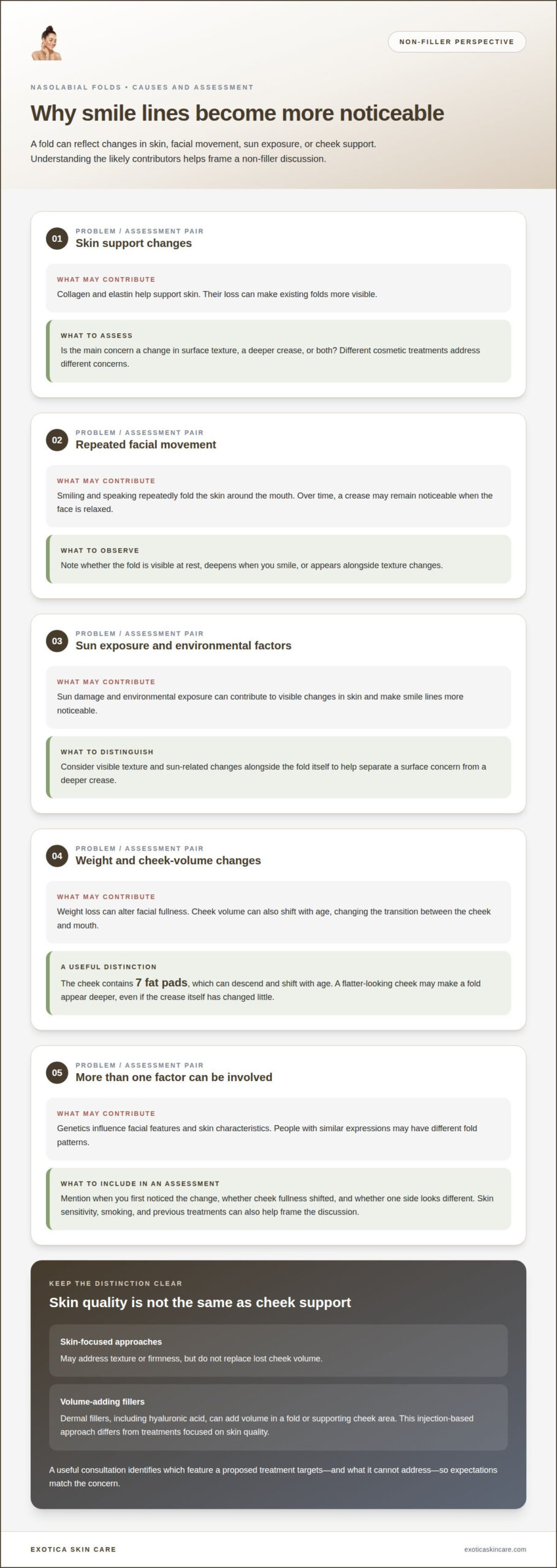
- Consider how skin structure changes over time. Collagen and elastin help support the skin, and their loss can make existing folds more visible. A professional assessment can distinguish a change in surface texture from a deeper crease. That distinction matters because cosmetic treatments address different concerns, and a treatment focused on wrinkles may not resolve every cause of a fold.
- Include repeated facial movement in the assessment. Smiling and speaking move the muscles around the mouth, repeatedly folding the skin in the same area. Over time, a crease may remain noticeable even when your face is relaxed. The movement itself is normal; the useful step is identifying whether expression-related lines, skin texture, or another factor is most prominent.
- Account for sun exposure when discussing lines and wrinkles. Sun damage can contribute to changes in skin appearance, including more noticeable smile lines. A professional can consider visible texture and sun-related changes alongside the fold itself. This helps distinguish a surface concern from a crease that appears more pronounced because of underlying facial changes.
- Consider weight changes as part of the picture. Weight loss can alter facial fullness, which may change how folds look; the effects vary from person to person. During an assessment, describe when you first noticed the change. That context helps distinguish a recent shift in facial appearance from gradual changes in skin support or repeated movement.
- Recognize the role of inherited and environmental factors. Genetics influence facial features and skin characteristics, while environmental exposure can contribute to visible aging. Two people with similar expressions may therefore have different fold patterns. A careful assessment considers both rather than assuming one cosmetic treatment or injection addresses every cause.
- Describe the concern precisely before discussing treatment. Note whether the fold is visible at rest, deepens when you smile, or appears alongside texture changes. These observations help a professional identify likely contributing factors and discuss suitable options. Dermal fillers add volume through injection, but understanding what contributes to the fold is essential when considering approaches without filler.
Nasolabial folds and cheek volume
Use these assessment points to understand how facial volume can influence the appearance of folds:
- Assess the cheek and fold as connected areas. The cheek contains seven fat pads, which can descend and shift with age. As support changes, the transition between cheek and mouth may become more pronounced. A professional assessment considers the whole midface, rather than treating the crease as an isolated line.
- Notice where facial fullness has changed. A flatter-looking cheek can make a fold appear deeper, even if the skin crease itself has not changed much. A professional can consider cheek contour, fold depth, skin texture, and how your face looks at rest and during expression. These observations help identify whether volume shifts or surface changes contribute more.
- Separate support from skin quality. Collagen production and elasticity affect how well skin maintains its structure, while cheek volume influences the facial framework beneath it. A skin-tightening approach may address texture or firmness, but it does not replace lost cheek volume. This distinction helps set realistic expectations for non-filler options.
- Understand what filler would change, even if you want to avoid it. Dermal fillers containing hyaluronic acid can add volume in a fold or supporting cheek area. That injection-based approach differs from treatments focused on skin quality. Knowing the difference clarifies which concern matters most and keeps a non-filler plan aligned with your desired outcome.
- Describe how your face has changed over time. Mention whether cheek fullness shifted after weight loss, whether the fold became more visible gradually, or whether one side looks different. Specific examples help a professional distinguish volume changes from skin laxity, repeated movement, or naturally uneven facial structure.
- Include relevant health and lifestyle details in the consultation. Smoking, previous treatments, skin sensitivity, and when you noticed visible changes can help frame the assessment. These details do not determine a treatment by themselves; they give the professional a fuller picture before discussing suitable options.
- Set a goal based on the cause, not just the crease. If cheek descent contributes to the fold, treating surface texture alone may have limited effect on its depth. If texture is the main concern, a skin-focused approach may be more relevant. The assessment should explain what feature a proposed treatment targets and what it cannot address.
This distinction helps people seeking a non-filler approach understand why cheek support matters, without assuming that every visible fold needs added volume or an invasive procedure.
Dermal fillers such as hyaluronic acid or calcium hydroxyapatite can be injected into folds or supporting structures, such as the cheeks, to add volume and smooth wrinkles.
Treatment suitability and consultation
Use a consultation to match treatment to your concern, skin characteristics, and desired change. Ask how the approach addresses the fold itself, surface texture, or both.
-
Assess Treatment Suitability
Describe what you want to change and how the fold appears at rest and during expression. Include relevant medical history, skin sensitivity, previous treatments, and reactions to skincare ingredients. Genetics and skin condition can influence the assessment, while the location and depth of the crease help distinguish surface concerns from deeper folds.
Ask what the proposed treatment targets and whether it supports collagen formation, improves texture, or addresses another concern. Peels and microneedling are generally better suited to superficial texture irregularities than deeper smile lines. A suitable plan explains this difference clearly and does not promise that a surface-focused treatment will erase a deeper fold.
-
Discuss Sessions and Results
Ask how many appointments the selected modality involves and when results are expected. Most people need three to six microneedling treatments in total, and the American Academy of Dermatology Association says full results are expected within 9 months. These details apply to microneedling, not every non-filler treatment.
For other methods, the treatment type, skin concern, and individual response guide the schedule. Results also vary in duration depending on the method and the changes being addressed. Ask how the plan supports collagen and skin quality, whether maintenance is part of the approach, and which visible changes count as progress. Expect gradual improvement rather than immediate correction.
-
Review Risks and Recovery
Ask the treating professional to explain likely side effects, specific risks, aftercare, and signs that need follow-up for the exact procedure. These considerations vary with treatment method, intensity, ingredients, and individual skin characteristics. Clarify how the plan accounts for sensitive skin or prior reactions, and don’t proceed without understanding the consent information.
Recovery also depends on the modality. Laser treatment recovery time is 1 to 3 weeks, according to the American Society for Dermatologic Surgery. That timeframe applies to laser treatment; it should not be assumed for peels or microneedling. Request procedure-specific guidance on normal recovery and when regular skincare can resume.
- When choosing a Henderson Nevada provider for cosmetic treatment, consider their experience with the specific procedure, assessment practices, and clarity about risks and expected outcomes. For deeper smile lines, experience with subcision is relevant; the procedure can elevate and smooth folds without additional filler. Ask how the provider distinguishes deeper folds from surface texture concerns and explains alternatives. A clear consultation connects the treatment choice to your skin, goals, and medical history.
Professional ways to help delay or reduce laugh lines
A professional plan can focus on prevention, skin texture, or deeper folds. Match each procedure to the concern it can address.
- Ask a skincare professional to review your routine and sun protection. Daily sunscreen can help prevent sun damage that may deepen laugh lines. Topical skincare may help prevent lines and improve fine lines, but it cannot completely erase smile folds. Bring the products and ingredients you use to the discussion, especially if your skin reacts easily.
- Discuss retinoids as part of an individualized plan. A study reported significant results for fine lines and wrinkles with treatments containing 0.4 percent retinol. Participants used the lotion three times per week for 6 months. Topical tretinoin can be 10 to 100 times more powerful than over-the-counter retinol, so a professional can help assess which ingredients suit your skin.
- Ask whether laser resurfacing fits your specific concern. Laser treatment can improve skin texture, reduce deep laugh lines, and address sun damage. It targets skin quality rather than restoring cheek volume, so the expected change depends on what contributes to the fold. Laser treatment may need to be repeated within a few months; discuss the schedule and recovery before choosing it.
- For a deeper crease, discuss subcision with a dermatologist experienced in the procedure. Subcision can elevate and smooth smile lines without additional filler. It differs from resurfacing: rather than focusing primarily on surface texture, it addresses the fold through a professional treatment technique. Ask how the clinician assesses suitability and what outcome is realistic for your concern.
- Set a prevention goal alongside treatment. A professional can identify whether sun damage, fine lines, or a deeper fold is the main priority, then explain how the plan addresses it. For example, sunscreen supports prevention, while resurfacing targets texture and sun damage. Don’t expect a topical product to completely erase a pronounced nasolabial groove.
- Review the treatment plan as a whole before proceeding. Ask which visible feature each method targets, whether multiple approaches are being considered, and how progress will be assessed. A professional should distinguish goals related to collagen production and skin texture from structural volume changes. This discussion helps align the procedure with your priorities, rather than selecting a treatment solely because it is marketed for wrinkles.
If facial exercises are also part of your routine, keep their instructions distinct from the professional treatments discussed above. The first facial exercise described for laugh lines around the mouth recommends holding the mouth-muscle contraction for 5 to 10 seconds and completing 10 to 25 repetitions. The second recommends holding a smile for 5 to 10 seconds, with 15 to 30 repetitions. The third recommends holding the smile for about 10 seconds and completing 10 to 25 repetitions.
Bring these instructions to a skincare professional and ask how they fit your individual plan. Keep track of which hold and repetition range belongs to each exercise, and don’t treat exercise guidance as a replacement for an assessment of skin texture, sun damage, or a deeper fold. A professional can help clarify your goals and distinguish an at-home routine from the purpose of any procedure you’re considering.
What causes smile lines (nasolabial folds), and can they be reduced without fillers?
Yes, non-filler approaches may soften smile lines or help delay their appearance, but the right option depends on your main concern. Use these discussion points to distinguish surface changes from deeper folds and understand what each approach can address.
- Identify how the lines appear before discussing treatment. Nasolabial folds run from the sides of the nose to the corners of the mouth. Note whether they remain visible at rest, deepen with expression, or appear alongside uneven texture. These distinctions help a professional assess whether the priority is skin quality, sun damage, or a more pronounced crease.
- Ask what topical skincare can realistically change. Products may help prevent smile lines and improve some surface concerns, but they cannot completely erase folds. One physician says topical products are usually not useful for deeper nasolabial grooves. This distinction sets a clear goal: supporting skin appearance is different from removing a deep crease.
- Discuss sun protection as part of prevention. Daily sunscreen can help prevent sun damage that may deepen smile lines. Ask how sun-related changes affect the treatment plan, particularly if uneven texture or visible damage accompanies the folds. Prevention supports skin health, while established creases may need a separate professional approach.
- Ask whether a skin-focused procedure matches your concern. Laser skin resurfacing is an option for improving texture, reducing deep laugh lines, and addressing sun damage. The treatment may need to be repeated within a few months. Discuss the proposed schedule, recovery, and target area before deciding whether resurfacing fits your goals.
- Clarify whether a deeper fold calls for a different technique. Subcision can elevate and smooth smile lines without additional filler. It differs from treatments aimed primarily at skin texture. If a provider discusses this option, ask how the method relates to your fold’s depth and what changes it is intended to produce.
- Set expectations around gradual skin changes. Microneedling results develop over time; the American Academy of Dermatology Association says full results are expected within 9 months. Most people need three to six microneedling treatments in total. These details apply to microneedling, not every non-filler option, so ask how the proposed procedure’s timeline differs.
- Choose a plan based on the cause, not the treatment name. Ask the professional to explain whether the approach targets texture, sun damage, or the crease itself. A clear plan should connect the treatment to your main concern and describe expected changes without promising that every fold can disappear.
For a professional assessment of skin-focused options, explore treatment options suited to your concerns.
Exotica Skin Care
Exotica Skin Care in Henderson Nevada can help you consider non-filler options when smile lines accompany concerns about skin texture or overall appearance. A personalized assessment can distinguish surface changes, which skin-focused treatments may address, from deeper folds that call for a different approach.
Depending on your skin concerns and goals, the discussion may include Scarlet SRF, BioRePeelCl3® Peel, PRX Derm Perfexion, or AquafirmeXS. The focus is on matching an appropriate option to your skin, not treating every smile line the same way. These treatments are not a substitute for filler when the goal is to add volume directly.
To discuss non-filler options for your skin, book a consultation with Exotica Skin Care.
Choose a next step that fits your goals
If you’re considering ways to reduce smile lines without filler in Henderson Nevada, start with a clear discussion of what you want to change. Bring your priorities to a professional assessment, whether you’re focused on skin texture, visible sun damage, or a deeper fold. The most useful next step is a plan that explains which concern a treatment addresses and how it aligns with your preferences.
Exotica Skin Care offers Scarlet SRF, BioRePeelCl3® Peel, and PRX Derm Perfexion among its skin care options. These offerings can be discussed in the context of your skin concerns and goals, without assuming that one approach suits every smile line. A thoughtful conversation can help you understand the options and decide how you’d like to proceed.
Take the next step at your own pace. Contact Exotica Skin Care to discuss your non-filler skin care goals and explore a considered path forward.
Frequently Asked Questions
How Can I Get Rid of My Smile Lines?
You can soften smile lines by matching treatment to what makes them noticeable. If you want to reduce smile lines without filler in Henderson Nevada, a professional can assess whether your main concern is skin texture, sun-related changes, or a deeper crease. Daily sunscreen supports prevention, while professional treatments address specific skin concerns. A useful first step is describing when the lines show most, such as while smiling or at rest.
What are my treatment options?
Options include daily sunscreen, topical skincare, laser resurfacing, microneedling, and subcision for suitable cases. These approaches have different aims: skincare supports prevention, while procedures target particular texture or fold concerns. Exotica Skin Care offers Scarlet SRF, BioRePeelCl3® Peel, and PRX Derm Perfexion. A consultation can help connect your priority, such as uneven texture or visible laxity, with an appropriate skin-focused option and clarify what it is designed to address.
What non-filler treatments reduce smile lines, such as laser resurfacing, microneedling, or radiofrequency?
Laser resurfacing can address skin texture, sun damage, and deep laugh lines; microneedling is generally better suited to surface-texture irregularities. Scarlet SRF combines radiofrequency and microneedling, increasing skin density, reducing sagging, and improving firmness. These methods don’t add filler volume. The key distinction is the concern being treated: surface changes, firmness, and a deeper fold may call for different approaches.
How do Botox, laser treatments, microneedling, and fillers compare for smile lines?
Each approach targets different concerns. Botox injections for facial wrinkles last approximately 3 months. Laser resurfacing addresses texture and sun damage, with recovery taking 1 to 3 weeks, according to the American Society for Dermatologic Surgery. Microneedling is usually directed at surface texture. Hyaluronic acid fillers can improve smile lines with immediate results that typically last several months. Comparing these options means weighing the target concern, recovery, and whether adding volume fits your preference.