
What if the same filler lasts longer in one area of the face than another? If you’re asking how long do fillers last, conflicting estimates can make it difficult to know what to expect. The answer depends on more than the product: where it’s placed and how your body responds also matter.
It’s understandable to want a clear timeline before choosing treatment, especially if you’re hoping for natural-looking results and want to plan for possible maintenance. But there isn’t one duration that applies to every filler or every person. Product type, treatment area, facial movement, metabolism, and lifestyle can all influence how long results remain noticeable.
This guide explains why longevity varies across common filler types and treatment areas, which factors may affect your results, and why published estimates are ranges rather than promises. You’ll also find practical questions to ask a qualified provider about your goals, likely timeline, and approach to maintenance.
Key Takeaways
- “How long do fillers last” depends on the filler category and treatment area. Use duration estimates as guides, not guarantees.
- Facial movement and placement can influence how results change over time.
- Before treatment, clarify your goals, the specific product being considered, and the expected range of results with a qualified provider.
- Keep treatment details and provider instructions so you can make informed decisions about follow-up and maintenance.
- Use the questions in this guide to prepare for a personalized conversation about realistic expectations.
How Long Do Fillers Last? Why There Is No One-Size-Fits-All Answer
Dermal filler results can last for different lengths of time depending on the product, where it’s placed, and how your body responds. So, how long do fillers last? There isn’t one timeline that applies to everyone. A published estimate can help you plan, but it can’t predict exactly when your individual results will change.
Filler longevity refers to how long you can still see the improvement you sought, such as added volume or a softened contour. It isn’t a guaranteed expiration date. Injectable fillers use different materials for different applications, as outlined in this overview of injectable filler.
For another perspective on how duration is discussed in practice, watch this conversation:
What does “how long do fillers last” actually mean?
Results often change gradually as the filler changes and the face continues to move. You may notice a slow reduction in the original effect rather than waking up one day with no improvement. The change can be subtle, which may make it hard to identify an exact endpoint without comparing your appearance over time.
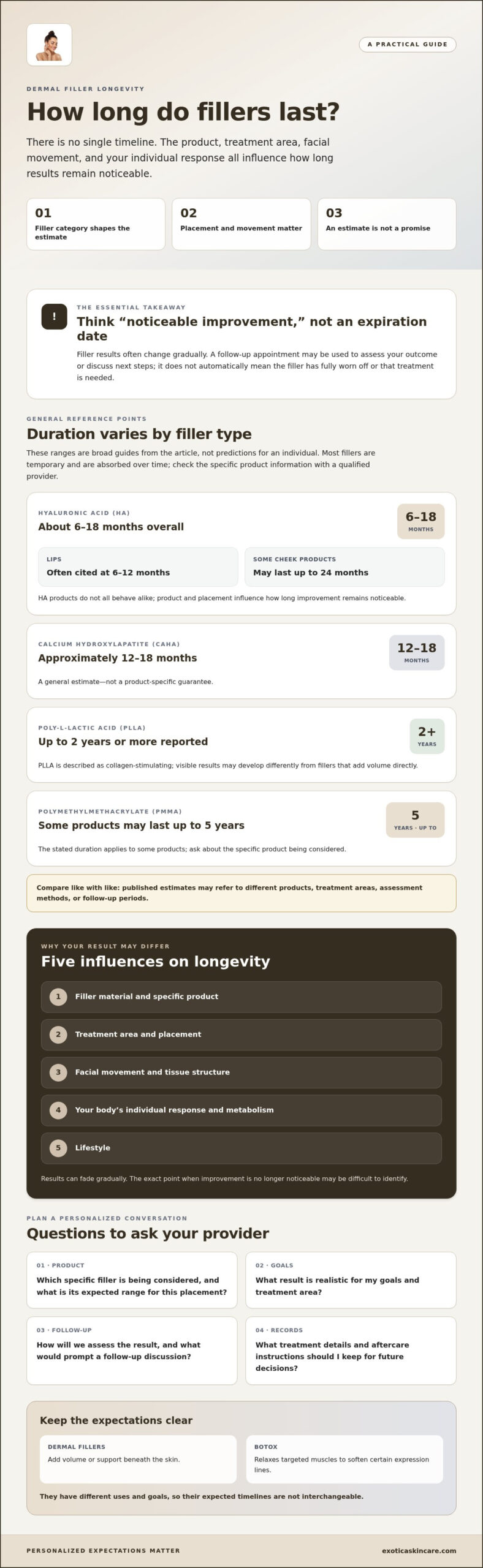
The duration of noticeable improvement is different from the timing of a follow-up appointment. A follow-up may be recommended to assess your outcome or discuss next steps. It doesn’t mean the filler has fully worn off or that treatment is automatically needed. Don’t use a general estimate as your personal maintenance schedule.
Why do filler duration estimates differ?
Formulation and placement matter. Different filler materials are designed for different purposes, and facial areas vary in movement and tissue structure. Individual response can also affect how long an effect remains visible. These differences help explain why one person’s experience may not match another’s, even when similar treatments are discussed.
Estimates may differ because studies and product information assess results in different ways, use different follow-up periods, or refer to specific products and treatment areas. Check whether a quoted timeframe applies to the product and placement being considered. Then ask a qualified provider how that estimate relates to your goals.
Filler duration is an estimate, not a guarantee. The product, placement, and individual response all shape how long results remain visible.
Dermal fillers also aren’t the same as Botox. Fillers add volume or support beneath the skin, while Botox relaxes targeted muscles to soften certain expression lines. They have different uses, so their treatment goals and expected timelines shouldn’t be treated as interchangeable.
How Long Different Dermal Filler Types May Last
To answer “how long do fillers last,” start with the material, then consider the specific product and treatment area. The ranges below are general reference points, not predictions for an individual. The U.S. Food and Drug Administration notes that most fillers are temporary and are absorbed over time. Its Dermal Fillers guidance is a useful starting point, but product-specific information is needed for a more precise estimate.
Hyaluronic acid (HA) is a water-binding substance used in some fillers. HA products don’t all behave alike, and the treatment site can affect how long improvement remains noticeable. The estimates below draw on the named sources shown. Confirm the specific product’s current documentation with a qualified provider.
| Filler category | Commonly discussed duration | Key caveat |
|---|---|---|
| Hyaluronic acid (HA) | About 6 to 18 months overall; lips are often cited at 6 to 12 months, while some cheek products may last up to 24 months. | Ranges vary by product and placement. General estimates cited by Advanced Dermatology (July 2024) don’t establish how long results will last for you. |
| Calcium hydroxylapatite (CaHA) | Approximately 12 to 18 months. | This estimate, reported by Dermacare Medical Aesthetics (November 2025), is not a product-specific guarantee. |
| Poly-L-lactic acid (PLLA) | Up to 2 years or more is reported. | Prime Healthcare of Cypress (September 2026) describes this as collagen-stimulating; visible results may develop differently from fillers that add volume directly. |
| Polymethylmethacrylate (PMMA) | Some products may last up to 5 years. | Venice Avenue Dermatology describes PMMA as semi-permanent. Product indications and individual outcomes require careful discussion. |
How long can hyaluronic acid fillers last?
HA fillers vary in formulation and intended use, so one product’s estimate shouldn’t be applied to all others. A frequently cited overall range is 6 to 18 months, but duration can differ by area. Ask which product is being considered, what its documentation says for the planned treatment site, and how your results will be assessed over time.
Do other filler materials have different timelines?
CaHA and PLLA differ from HA in composition and in how they produce visible effects. The approximate ranges in the table are educational starting points, not interchangeable timelines. Longer-lasting claims, including those for PMMA, deserve careful discussion of the exact product, intended use, and supporting documentation.
These categories are general information, not confirmation that every material is offered at Exotica Skin Care. If you’re considering treatment, personalized aesthetic care can be a starting point for discussing your goals and realistic expectations.
What Affects How Long Your Filler Results Last?
Filler longevity reflects several factors working together, not a single personal trait. The material’s properties, treatment area, placement, amount used, and your individual anatomy can all affect how results look and change over time. The different dermal filler types are designed for different purposes, so estimates for one material or product shouldn’t automatically be applied to another.
Placement matters, too. A provider considers the area’s structure and the result you’re seeking when developing a treatment plan. The same amount of filler may not create the same appearance in different areas or in different people. Asking how long do fillers last for a specific product and treatment site is more useful than relying on a broad estimate alone.
Does the treatment area change filler longevity?
Areas that move frequently, including the lips, are sometimes discussed differently from less-mobile areas. Repeated facial movement may influence how results appear over time, but it doesn’t establish a universal rule that filler will always disappear faster in a particular location. Product choice, placement, anatomy, and how visible improvement is assessed all matter.
Ask your provider how movement in the planned area may affect your expected outcome. A helpful answer should connect the estimate to the product and placement being considered, rather than promise a fixed timeline for that site.
Can lifestyle or personal biology affect results?
Yes, individual anatomy and response can contribute to variation. Age, facial structure, the area being treated, and how your body responds to the material may all be relevant, but none can predict an exact duration on its own. Metabolism is one possible consideration, not a complete explanation for why one person’s results may differ from another’s.
Be cautious about claims that a specific lifestyle factor will reliably shorten or extend results unless they’re supported by evidence relevant to your product and treatment. Instead, ask which personal factors matter for your plan and what changes to monitor. Your provider can help distinguish a gradual change in visible effect from other concerns that may need assessment.
Does more filler mean longer-lasting results?
Not necessarily. The amount and placement are decisions for the treating provider, guided by your anatomy and goals. A larger amount shouldn’t be treated as a longevity guarantee, and adding filler solely to extend results may not be appropriate for the appearance you want. Discuss the proposed treatment plan, the reasoning behind it, and how follow-up will be approached. Clear expectations support a considered decision without assuming that more product means a better or longer-lasting outcome.
How to Set Realistic Expectations and Maintain Filler Results
A clear plan starts before treatment. Rather than relying on a general timeline to decide when to return, use your consultation to understand the proposed product, what changes to expect, and how your results will be reassessed. That makes the question “how long do fillers last” part of a personalized discussion, not a fixed maintenance schedule.
Keep the information you receive, including the product name, treatment area, date, and provider instructions. These details can help guide future conversations, especially if you see a different provider later. Follow-up timing should reflect your treating provider’s guidance and individual treatment plan. A general duration estimate passing doesn’t, by itself, mean you need another treatment.
What should you ask before treatment?
Bring questions that connect the treatment to your goals. Ask which filler category and specific product are proposed, why they may suit the area and outcome you have in mind, and what duration estimate applies to that product and placement. Ask how results may change, when reassessment is appropriate, and whom to contact if you have concerns. These answers can clarify both the likely benefits and the limits of a general estimate.
- What product is being considered, and why?
- What changes should I expect, and how will we assess them?
- What follow-up guidance should I follow, and who should I contact with concerns?
How can you assess whether results are changing?
Changes can be gradual, so day-to-day impressions may not reveal a clear trend. If your provider considers it useful, take photos under similar lighting and from similar angles, and note what you observe. Keep any tracking simple and follow the provider’s instructions. Photos and notes can support a conversation, but they don’t replace a professional assessment or determine on their own whether another treatment is appropriate.
Reassessment is a chance to discuss how your results look, whether they still align with your goals, and what options, if any, make sense. Avoid scheduling repeat treatment solely because a typical estimate has elapsed. Your plan should reflect your individual outcome and the treating provider’s guidance.
For a personalized conversation about aesthetic goals and realistic expectations, discuss your goals with Exotica Skin Care in Las Vegas, Nevada.
Discussing Filler Longevity With a Provider in Henderson, Nevada
There’s no single answer to how long do fillers last. The product selected, where it’s placed, and your individual response all influence how long improvement remains noticeable. A thoughtful conversation can connect general information to your goals, clarify what’s available, and set expectations without promising a particular result.
What to expect from an individualized filler discussion
Start by describing the changes you hope to see and what a natural-looking outcome means to you. Share relevant health information and any previous aesthetic treatments, including the product and treatment area if you know them. These details help a provider understand your starting point and discuss whether a treatment may suit your needs.
Ask which filler product or category is being considered, why it may be appropriate for your goal, and what duration estimate applies to that specific option and placement. You can also ask how results may change, what follow-up may involve, and whom to contact if you have questions or concerns. Recommendations should follow an individual assessment, and you should confirm that the relevant service is available. Don’t assume a clinic offers every filler category or brand mentioned in general educational resources.
Before deciding, verify the treating provider’s qualifications and ask how they’ll explain the potential benefits, limitations, and risks of the proposed treatment. Make sure you have room to consider the information and ask questions. A consultation is a discussion, not a commitment to proceed.
How to take the next step locally
Exotica Skin Care is a boutique medical spa in Las Vegas serving clients from Las Vegas, Summerlin, and Henderson. Dermal fillers are among the clinic’s services, but confirm current treatment options and provider details directly. Ask what’s available, who would provide the treatment, and how your goals and medical history would inform the discussion.
Bring your questions and take the time you need to decide whether treatment feels right for you. A clear conversation about the proposed product, expected changes, and realistic duration can help you make an informed choice without assuming your results will match a general estimate.
To take a first step, contact Exotica Skin Care to ask about a consultation and discuss your aesthetic goals. Explore the options, get your questions answered, and decide at your own pace.
Make Your Next Step an Informed One
There’s no universal answer to how long do fillers last. The product, treatment area, and your individual response all shape how long results remain noticeable, so published timelines are best used as estimates rather than promises. Your treatment plan and follow-up should be based on your goals and a conversation with a qualified provider, not a calendar alone.
Before deciding, ask which product is being considered, why it may suit your goals, and what changes or follow-up to expect. Keeping treatment details and provider instructions can also make future discussions clearer. A measured, personalized approach helps you consider natural-looking results and maintenance with realistic expectations.
Exotica Skin Care is a boutique medical spa in Las Vegas serving clients from Las Vegas, Summerlin, and Henderson, with personalized aesthetic services that include dermal fillers. To explore your options and discuss your goals, explore aesthetic care at Exotica Skin Care. A thoughtful conversation can help you take your next step with greater confidence.
Frequently Asked Questions
How long do fillers last?
There’s no single timeline for how long do fillers last. Expected duration depends on the filler material and product, where it’s placed, and how your body responds. Visible improvement may fade gradually rather than stop on a particular date. Ask your provider for an estimate tied to the exact product and treatment area, and treat it as guidance, not a prediction or a schedule for repeat treatment.
Do lip fillers last as long as cheek fillers?
Not necessarily. Lips and cheeks differ in movement, anatomy, and how changes in volume appear, so results may follow different timelines. The specific product and treatment plan matter, too. A general estimate you find online may not apply to your treatment. Ask a qualified provider to explain the expected duration for the product and area being considered, and what changes you may notice over time.
Can filler results last longer than expected?
Yes, visible improvement may remain noticeable beyond a commonly quoted estimate, but that isn’t guaranteed. Product type, placement, individual response, and how results are assessed can all affect the apparent timeline. If you’re unsure whether your results are changing as expected, ask your provider whether reassessment is appropriate. Don’t schedule repeat treatment just because a general estimate has passed. Base next steps on an individual assessment.
What happens if filler wears off?
As the visible effect changes, your appearance may gradually move closer to how it looked before treatment, though the change can be subtle. If results seem to be fading, ask your treating provider whether an assessment is appropriate rather than assuming you need more filler. Follow the aftercare and contact instructions you were given. Seek prompt medical advice for symptoms that concern you rather than relying on online guidance.
Are all dermal fillers temporary?
No. Filler materials differ, and their persistence can vary. Some are described as temporary, while other materials may have longer-lasting effects. Longer duration doesn’t automatically make a product the right choice. Ask which material and product are being considered, what evidence supports the expected duration, and whether it suits your goals and treatment area. Confirm that any estimate applies to the specific product, not just its general category.
Can a provider dissolve filler if I do not like the result?
Whether filler can be addressed or reversed depends on the material used, so don’t assume this is possible for every product. Before treatment, ask your provider what options may apply to the specific filler and what limitations exist. If you’re concerned about a result, contact a qualified medical professional for assessment instead of trying to manage it yourself. Las Vegas-area patients can also confirm current filler options and provider qualifications with any clinic they’re considering.
How can I make filler results last longer?
There’s no universal method that guarantees longer-lasting results. Follow your provider’s aftercare instructions and attend follow-up appointments when recommended. Ask whether the specific product, placement, or your personal circumstances affect the expected timeline. Be cautious of online advice promising to extend results, and don’t seek additional treatment without a professional assessment. Exotica Skin Care in Las Vegas serves clients from the surrounding area and lists dermal fillers among its services. Confirm current availability and discuss your questions directly with the clinic.