
Could combining treatments be more useful than relying on one approach alone? Sometimes, yes: a tailored plan at Exotica Skin Care may pair SQT Bio-Microneedling with a resurfacing treatment when the scar pattern, skin condition, and desired changes make that appropriate. For people considering SQT for back acne scars in Las Vegas, the first distinction is whether marks are indented or raised, since different scar types call for different considerations.
Atrophic scars involve tissue loss, and icepick and boxcar scars are examples; hypertrophic and keloid scars are raised. This guide explains how SQT Bio-Microneedling may fit into care for atrophic scarring, what resurfacing can address, and when a combination approach may suit your concerns. Texture and post-acne discoloration are distinct issues, so a thoughtful plan can focus on the changes you most want to address without assuming one treatment suits every scar.
Key Takeaways
- Learn how indented icepick and boxcar scars differ from raised acne scars, and why identifying the scar type matters when considering care.
- Explore how resurfacing may support smoother-looking texture and why post-acne discoloration can take a different course.
- Understand why back and shoulder scars may call for a plan tailored to the area and the mix of scar types.
- See what to consider when weighing SQT alone or alongside another treatment, and where the Face Reality Acne Clinic may fit into your next steps.
- Recognize why active acne and established scarring are separate concerns when planning treatment.
Atrophic scars, including icepick and boxcar types
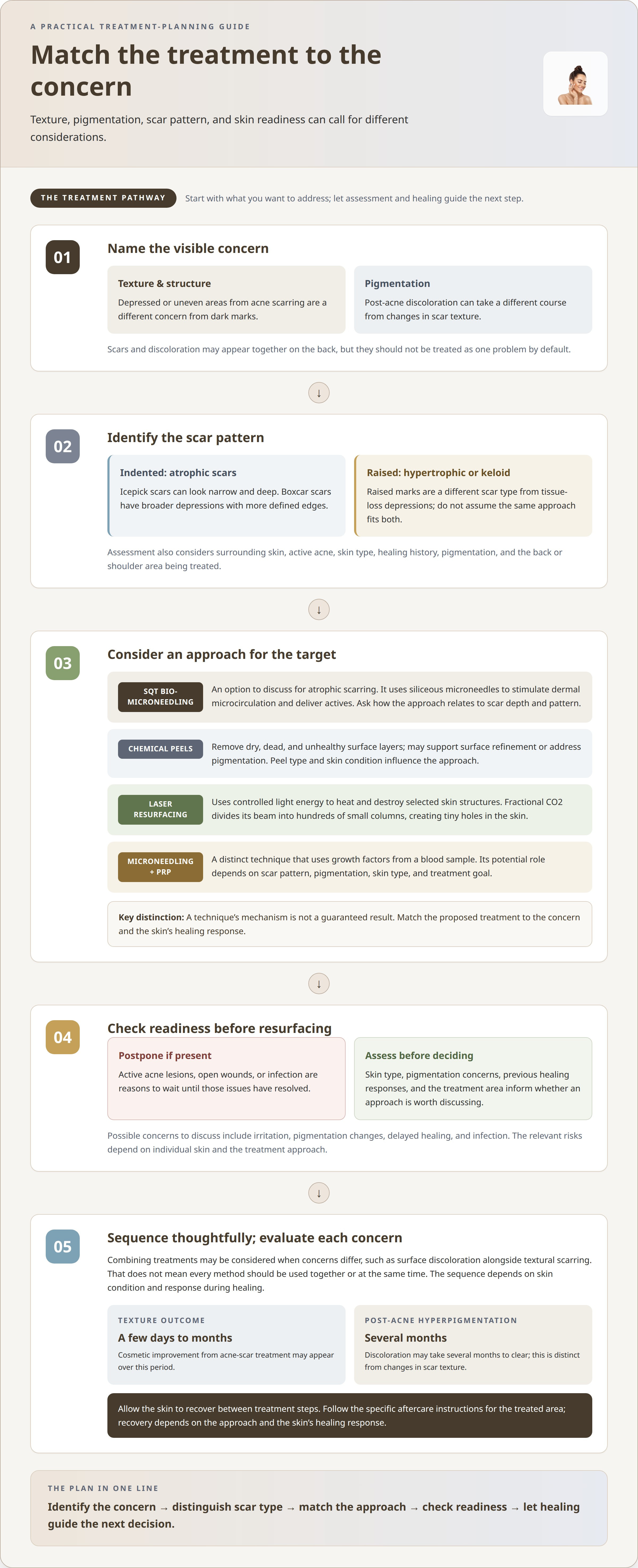
Atrophic acne scars form when healing leaves a loss of tissue beneath the skin. They are the most common acne-scar type and can follow follicle damage. On the back, an icepick scar may appear narrow and deep, while a boxcar scar has a broader depression with more defined edges. Recognizing these patterns helps distinguish indented scars from raised marks.
Scar shape matters because one approach may not address every depression equally. A narrow icepick scar and a shallow, wide boxcar scar differ in depth and outline. An assessment considers those features alongside the surrounding skin, active acne, skin type, healing history, and pigmentation. These details help set realistic goals rather than treating every mark as identical.
SQT Bio-Microneedling is one option to discuss for atrophic scarring. It uses siliceous microneedles to stimulate dermal microcirculation and deliver actives. Ask how the proposed approach relates to the depth and pattern of your scars and how progress will be assessed. Chemical peels may be considered for surface texture or pigmentation, while microneedling approaches are evaluated against the scar’s structure.
Possible concerns to discuss include irritation, changes in pigmentation, delayed healing, and infection. Skin type, active lesions, and the treatment approach influence which risks matter most for an individual back. A sound assessment considers those factors before treatment and explains possible skin responses clearly.
A potential candidate has atrophic scars, a clear treatment goal, and skin that can be assessed before treatment. Active acne lesions, open wounds, or infection are reasons to postpone skin resurfacing until those issues have resolved. Skin type, pigmentation concerns, and previous healing responses also inform whether SQT Bio-Microneedling is worth discussing.
Recovery time depends on the treatment approach and the skin’s healing response. Follow the specific aftercare instructions for the treated back, and avoid improvising with products or friction while the skin recovers. If the area develops a concerning reaction, contact the treating professional for guidance rather than adding another treatment.
When assessing a Henderson Nevada provider’s qualifications and experience with SQT Bio-Microneedling, review their stated credentials and ask about treating back scars, not only facial skin. Request a clear explanation of the technique, expected healing process, risks, and how results will be evaluated. A useful plan addresses your scar pattern and skin type instead of promising a uniform outcome.
Keep the treatment goal specific. If the main concern is a depressed boxcar scar, discuss its depth and edges; if pigmentation is more visible, clarify that distinction. Scar treatment may involve multiple sessions or techniques, so the plan should connect each step to a defined concern and let healing guide the next decision.
Potential skin resurfacing benefits
Resurfacing treatments address different visible concerns, so let the intended benefit guide the choice. Uneven texture from acne scarring, for example, is not the same concern as lingering pigmentation. A treatment plan can distinguish depressed areas, rough surface changes, and dark marks rather than treating them as one problem. That distinction matters on the back, where scars and discoloration may appear together but respond differently.
Chemical peels remove dry, dead, and unhealthy skin layers to help smooth acne scars. Their potential benefit is surface refinement, not a promise to erase every depression. The peel type and the skin’s condition influence the approach. A useful discussion identifies whether texture, pigmentation, or both are the primary concern, then considers how treatment could address each without assuming one peel suits every skin type.
Laser resurfacing uses controlled light energy to heat and destroy selected structures in the skin. The wavelength and energy determine which structures are targeted. Fractional CO2 treatment divides its beam into hundreds of small columns, creating tiny holes in the skin. This describes the mechanism, not a guaranteed result. The proposed treatment should match the concern being addressed and account for the skin’s healing response.
Collagen matters in resurfacing discussions because acne scars can involve changes in skin structure. Different methods address that structure in different ways. Microneedling with platelet-rich plasma uses growth factors from a blood sample, while chemical peels remove surface layers. These are distinct techniques; their potential roles depend on the scar pattern, pigmentation, skin type, and treatment goal.
Timing also varies by concern. Cosmetic improvement from acne-scar treatment may appear over a period ranging from a few days to months. Post-acne hyperpigmentation may take several months to clear. These timelines describe different outcomes, so fading discoloration should not be confused with changes to scar texture. Healing is part of the process, and treatment steps should allow the skin to recover.
Before choosing resurfacing, define the outcome you want to evaluate. Someone focused on dark marks might track pigmentation, while someone concerned about uneven texture might assess the appearance of scarred areas. An assessment can separate those goals and weigh skin type, active skin concerns, and previous healing. This makes treatment selection more specific than choosing a method by name alone.
Combining treatments may be considered when concerns differ, such as surface discoloration alongside textural scarring. That does not mean every method should be used together or at the same time. The sequence depends on the skin’s condition and response during healing. A considered plan explains the purpose of each step, the change it targets, and how progress will guide the next decision.
For back acne marks, keep the distinction clear: resurfacing may support smoother-looking texture, while pigmentation can follow its own timeline. Discuss the intended benefit, treatment method, and healing expectations before proceeding. These details help you understand whether the proposed approach addresses your main concern or whether another combination deserves consideration.
Acne scars on the back and shoulders
Back and shoulder acne scars can involve different tissue changes across the same area. Atrophic scars leave indentations, while hypertrophic and keloid scars are raised because excess collagen forms as an acne wound heals. A treatment plan should distinguish these patterns before selecting a technique. A shallow depression and a raised mark are different concerns, even when both followed acne in the same area.
SQT Bio-Microneedling may be considered for atrophic acne scars, but its suitability should not be assumed for raised scars. The scar type, skin condition, and intended change all matter. A consultation should establish whether the primary concern is indented texture, raised tissue, or discoloration. It should also identify active acne or open wounds, which should resolve before laser resurfacing.
How effective is SQT Bio-Microneedling for atrophic or raised back scars? Its potential role is best considered in relation to the specific scar pattern; raised scars involve excess collagen and require a distinct assessment. No single approach should be presumed to address both types in the same way.
There is no single session count that applies to every SQT plan. Acne-scar treatment usually requires 3 to 6 recurring treatments, while a broader plan may use one or more sessions and techniques. The number and sequence depend on the scar pattern, treatment method, and how the skin responds as it heals. A practical plan connects each session to a defined goal, such as changes in texture or appearance.
Back and shoulder treatment planning also accounts for the area’s size and distribution of marks. A few scars near one shoulder, for instance, may call for a different focus than widespread scarring across the upper back. The plan should identify the areas being addressed and distinguish scar texture from discoloration. This makes progress easier to evaluate without treating every mark as identical.
Which Henderson Nevada providers offer SQT Bio-Microneedling for back acne scars? A useful comparison focuses on whether the provider treats back scars with this approach, rather than discussing only facial treatment. Ask how the consultation addresses scar type, treatment area, healing, and the intended outcome. A mention of SQT Bio-Microneedling alone does not explain whether the approach fits raised scars or atrophic scarring.
During a consultation, describe where the scars are and what they look like, including whether marks are raised or indented. Mention active acne, open areas, or a history of unusual healing. Those details help shape the assessment and treatment plan. Active lesions may affect timing, for example, while raised tissue calls for a different discussion than shallow depressions.
Set a clear goal before treatment begins. You might prioritize smoother-looking texture across the shoulders or focus on discoloration alongside scars on the back. The treating professional can explain which concern each proposed step addresses and how healing will inform the next session. This keeps decisions tied to the tissue changes present, not simply the body area being treated.
Acne scars on the face, neck, and back
Acne scarring can appear on the face, neck, back, and shoulders, so assessment should account for every affected area. Scarring may affect up to 11% or more of the general population. The appearance can vary by location: for example, a depressed mark on the cheek may be easier to see than a similar change across the back. Different areas also call for treatment planning that reflects the skin’s condition and the concern being addressed.
Start by separating texture from discoloration. A shallow indentation changes the skin’s surface, while post-acne pigmentation changes its color. These concerns can coexist, but they are not the same skin change. Someone may have uneven texture on the back and dark marks along the jawline, for example. Naming each goal helps clarify what a treatment is intended to address.
Location also shapes how the treatment area is assessed. The face, neck, and back differ in size and contour, so an approach for a small facial area does not automatically translate to broader back coverage. A useful plan identifies the precise areas of concern, the scar pattern in each, and whether active acne or open lesions are present. Open wounds, including acne lesions, and active infections should resolve before laser resurfacing.
Resurfacing methods work through different mechanisms. A chemical peel removes dry, dead, and unhealthy skin layers, which may help smooth acne scars. Laser resurfacing uses controlled light energy to heat and destroy selected structures, according to the wavelength and energy used. Fractional CO2 treatment divides the beam into hundreds of small columns that create tiny holes in the skin. These methods should not be treated as interchangeable simply because each is called resurfacing.
Collagen-related approaches also differ. Red light therapy targets deeper skin layers, treats inflammation, promotes collagen production, and enhances skin-cell regeneration. That does not mean every scar or pigmentation concern will respond in the same way. Treatment selection should connect the method with the visible concern, location, and skin response during healing.
Ask what change each proposed step is meant to address. A plan for back texture may differ from one focused on facial pigmentation, for instance. Cosmetic improvement may take from a few days to months, while post-acne hyperpigmentation may take several months to clear. These timelines describe potential change, not a promise of permanent correction. Clear goals make progress easier to assess without confusing fading discoloration with smoother texture.
A practical assessment records the areas being treated and the concern being tracked. The face, neck, and back can each show different patterns, even when acne caused them. Keeping those distinctions visible supports a more precise discussion of treatment, healing, and the appearance you want to address.
What is SQT skin treatment and how does it work for back acne scars?
SQT is offered as SQT Bio-Microneedling, which uses siliceous microneedles to stimulate dermal microcirculation and deliver actives. For people considering SQT for back acne scars in Henderson Nevada, the first step is understanding the specific technique being proposed and how it relates to their scar pattern. The treatment name alone does not predict how an individual’s skin will respond.
Begin by identifying the scars. A clinician assesses whether marks are indented, raised, or mainly changes in pigmentation. An icepick depression differs from a raised keloid, for example, so the treatment goal and method should not be assumed to be identical. The assessment should also note active acne, open skin, and the area of the back being considered.
Next, clarify the proposed procedure. Ask what SQT Bio-Microneedling involves, which parts of the back it would address, and how it relates to your specific scars. A clear explanation should describe the treatment steps, expected skin response, aftercare, and how healing will be considered before another session. These details make the plan understandable without assuming every protocol is identical.
For an atrophic scar, the goal may be to improve the appearance of uneven texture. A raised scar has a different tissue pattern and needs a distinct discussion. Pigmentation is another concern: dark marks after acne are not the same as a depression in the skin. Naming your priority, such as texture across the shoulders or discoloration on the upper back, helps keep the proposed treatment focused.
Back skin also presents practical considerations. The treatment area may span a small patch or a broader section, and the clinician needs to assess its condition before proceeding. Active acne lesions, open wounds, and infections should resolve before laser resurfacing. Any proposed plan should address current skin concerns and healing rather than treating an affected area as uniform.
During a consultation about SQT for back acne scars in Henderson Nevada, focus on three points: scar type, intended change, and procedure. Ask how progress will be evaluated, which aftercare instructions apply, and what signs should prompt follow-up. If the plan targets texture, for example, clarify how that differs from addressing pigmentation. Specific answers make each treatment step easier to understand.
SQT Bio-Microneedling may be one option within a broader acne-scar discussion, but suitability depends on matching the approach to the concern. A useful conversation connects the treatment method with your scar pattern, skin condition, and goals. If the explanation does not make those links clear, ask for a clearer discussion before deciding. For back scars, informed decisions begin with a precise assessment, not the treatment name alone.
Exotica Skin Care: Face Reality Acne Clinic
Exotica Skin Care’s Face Reality Acne Clinic can be a next step when active acne and lingering marks both need attention. A consultation can help clarify whether your priority is managing current breakouts, addressing uneven texture, or discussing discoloration. That distinction matters because acne care and scar-focused treatment address different concerns.
For resurfacing discussions, Scarlet SRF, BioRePeelCl3® Peel, and PRX Derm Perfexion are among the available treatment options. The appropriate conversation depends on your skin’s condition and the concern you want to address, rather than assuming one approach suits every scar pattern.
Contact Exotica Skin Care to discuss your back acne concerns and possible next steps.
Make Your Next Step Specific
Move forward with a clear priority: the change you want to address first. For SQT for back acne scars in Henderson Nevada, keep the discussion focused on your own goals, whether they concern texture, raised marks, or discoloration. A focused consultation can help connect the treatment approach to the area and concern that matter most to you.
Exotica Skin Care offers Scarlet SRF, BioRePeelCl3® Peel, and PRX Derm Perfexion. These options can be part of a conversation about skin treatment, alongside the Face Reality Acne Clinic for acne concerns. The right discussion begins with your skin and the outcome you hope to pursue, not with a promise of a particular result.
Take the next step at your pace. Contact Exotica Skin Care to discuss your concerns and possible treatment options. A thoughtful plan starts with a clear conversation, and you can begin there.
Frequently Asked Questions
Can I combine treatments for better results?
Combining treatments can address different concerns, but adding procedures does not automatically improve an outcome. For SQT for back acne scars in Henderson Nevada, discuss how any proposed combination fits your goals and the skin’s recovery. Active acne care may need a different place in the plan than treatment focused on established marks, for example. Each step should have a clear purpose, with timing guided by the treatment approach and skin response.
What Treatments Help With Acne & Scarring?
Acne care and scar-focused treatments address distinct concerns. The Face Reality Acne Clinic is an option for acne-related care, while SQT Bio-Microneedling, Scarlet SRF, BioRePeelCl3® Peel, and PRX Derm Perfexion are available skin-treatment options. If you’re considering SQT for back acne scars in Henderson Nevada, clarify whether your priority is active breakouts, texture, or discoloration. That distinction can help focus a discussion about treatment goals.
How do SQT, microneedling, laser resurfacing, and chemical peels compare for back acne scars?
These approaches use different methods, so compare their mechanisms and intended roles rather than assuming they work identically. SQT Bio-Microneedling uses siliceous microneedles to stimulate dermal microcirculation and deliver actives. Microneedling with platelet-rich plasma uses growth factors from a blood sample. Laser resurfacing uses controlled light energy, while chemical peels remove surface layers. The scar concern and treatment goal help frame which method to discuss.