
Facial balance doesn’t require both sides of the jaw to look identical. At Exotica Skin Care, non-invasive jawline contouring in Summerlin with liquid filler may soften asymmetry caused by differences in contour or volume, but it won’t change an underlying bite or bone structure.
It’s understandable to want a more even-looking profile without surgery or a prolonged recovery. The key is matching treatment to the cause of the asymmetry. An assessment considers bone shape, bite alignment, and soft-tissue thickness before determining whether filler is suitable.
This guide explains how liquid jawline contouring may refine facial balance, what to expect as swelling or bruising settles, and which safety considerations matter around nerves and blood vessels. It also outlines filler’s limits, so you can approach treatment with realistic expectations and decide whether it aligns with your goals.
Key Takeaways
- Liquid filler can refine contour-related asymmetry, but it won’t correct differences caused by bite alignment or underlying bone structure.
- Personalized planning considers jaw shape, soft-tissue thickness, and facial balance to guide treatment decisions.
- Temporary swelling and bruising can occur after injections; understanding the expected recovery helps you plan around treatment.
- Filler placement requires careful attention to facial anatomy, including nearby nerves and blood vessels.
- Learn how to distinguish goals suited to non-surgical contouring from changes that filler cannot achieve.
Can liquid jawline contouring correct left-right jawline asymmetry?
Liquid jawline contouring may soften asymmetry caused by differences in contour or soft-tissue volume. It cannot correct an underlying bite problem or change the shape of the jawbone.
Facial Anatomy and Personalized Planning
A careful assessment compares both sides of the face, including bone shape, bite alignment, and soft-tissue thickness. These features help determine whether dermal fillers can add definition where needed or whether the asymmetry has a structural cause that filler cannot address.
For example, one side may look less defined because it has less volume along the jawline. Another pattern may relate to bite alignment or bone shape. These distinctions guide the treatment plan, including whether filler is suitable and how each side is approached.
Comparing Jawline Treatment Options
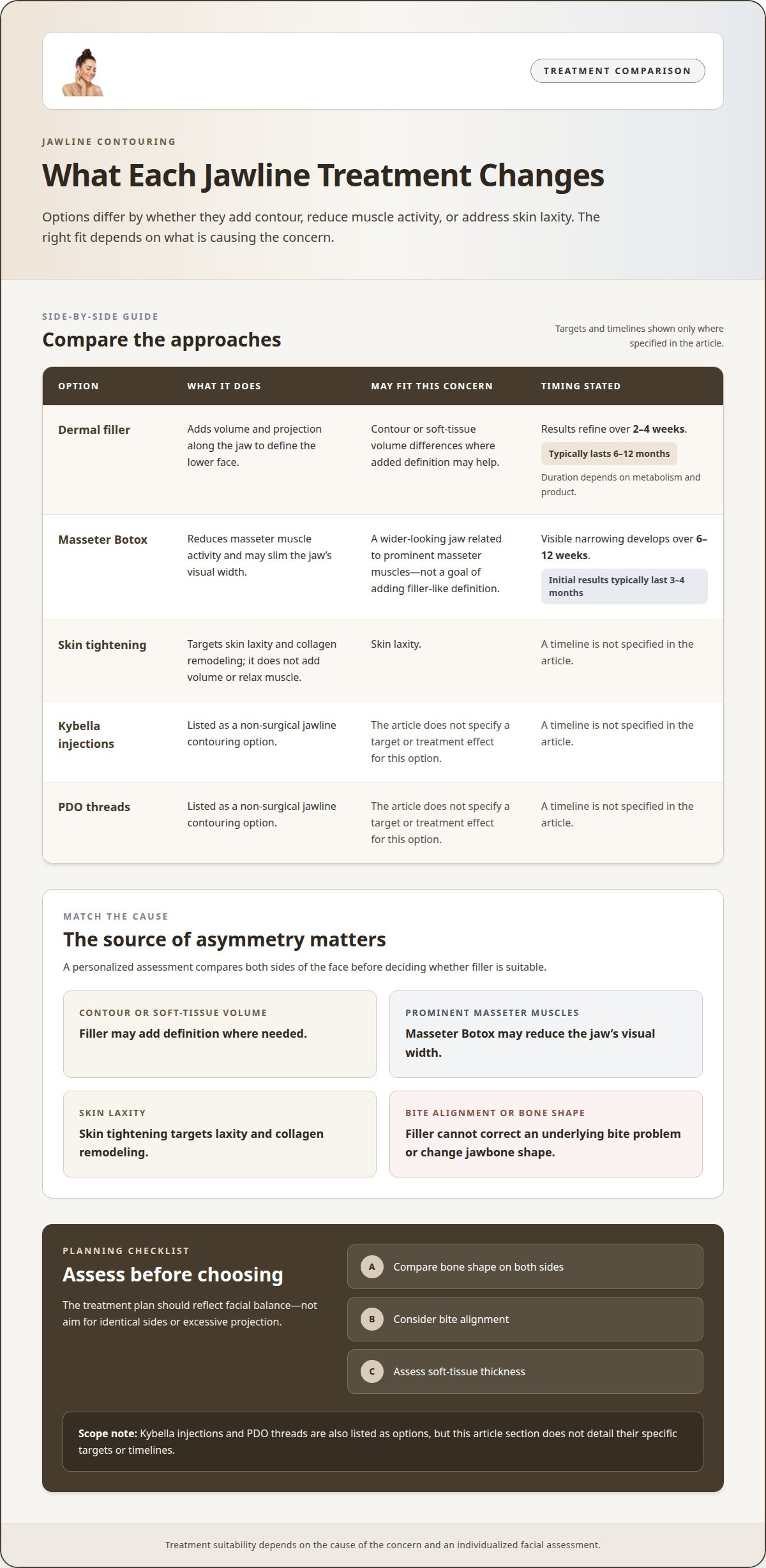
Filler adds volume and projection along the jaw, while Botox reduces masseter muscle activity to slim the jaw’s visual width. Non-surgical skin tightening targets skin laxity and collagen remodeling rather than adding volume or relaxing muscle.
Options discussed for non-surgical jawline contouring in Henderson Nevada include dermal fillers, masseter Botox, Kybella injections, PDO threads, and skin-tightening treatments. The suitable option depends on whether the concern involves contour, muscle width, fullness beneath the chin, or skin laxity.
Botox blocks nerve signals to the masseter muscles, reducing their activity and potentially shrinking the muscles over time. It may suit someone whose jaw looks wider because of prominent masseters, rather than someone seeking the added definition filler provides. Visible narrowing develops over six to twelve weeks, and initial results typically last three to four months.
Jawline filler defines the lower face by adding volume and projection along the jawbone. Hyaluronic acid filler is placed deeply on the bone; results typically refine over two to four weeks as it integrates with surrounding tissue. Hyaluronic acid jawline and chin fillers last 6-12 months, depending on metabolism and product, so maintenance treatments may be considered as definition fades.
A complete liquid jawline plan may take two to six months from the first appointment to the final scheduled session. This staged timeline allows the treatment plan to account for how contours settle between appointments, rather than treating the first result as the endpoint.
Before injections, a clinician reviews facial anatomy and treatment goals. The area may be numbed with a local or topical anesthetic, then filler is placed to create the planned contours. Preparation instructions include avoiding NSAIDs and other blood thinners before non-surgical jawline contouring. A considered approach prioritizes facial balance and conservative placement, rather than identical sides or excessive projection.
Aftercare, swelling, bruising, and downtime
After dermal filler placement, mild swelling may occur and typically resolves within 48 hours. Mild bruising typically resolves within five to seven days. These temporary changes can briefly soften the jawline’s immediate definition, so assess your profile after the early recovery period rather than judging it during initial swelling. Non-surgical contouring requires virtually no downtime, but that doesn’t mean aftercare is irrelevant.
Plan the first twenty-four hours around the specific restrictions for filler placement. Avoid alcohol, intense exercise, and blood-thinning supplements during this period. These precautions help limit avoidable irritation and bruising around recently treated areas. If you have a demanding workout or evening event planned, schedule it outside this initial recovery window.
Henderson Nevada’s warm outdoor conditions call for particular attention to heat and sun exposure after treatment. Avoid outdoor heat for 24 hours after jawline filler treatment. Apply SPF 30+ daily after filler treatment in Henderson Nevada. These steps help you follow the stated aftercare guidance while the treated area settles. Choose a day when you can limit time outdoors during the first day, rather than planning prolonged heat exposure.
- First twenty-four hours: Avoid alcohol, intense exercise, and blood-thinning supplements after filler placement.
- First 24 hours: Avoid outdoor heat following jawline filler treatment.
- Daily in Henderson Nevada: Apply SPF 30+ after treatment.
- Early recovery: Allow mild swelling and bruising time to resolve before assessing the contour.
Recovery can differ from person to person, even when the same area is treated. Swelling and bruising are visible changes, and the final impression of the jawline depends on how they settle. Don’t use an early photograph as the sole measure of your result. Compare your profile after the expected swelling and bruising have passed.
Non-surgical contouring doesn’t involve a surgical recovery period, but post-treatment care still matters. Virtually no downtime doesn’t mean there can be no swelling or bruising. Keeping the first day clear of outdoor heat and strenuous activity can make it easier to follow the recommended restrictions without disrupting your routine.
Use the recovery timeline to plan social commitments, not to force a particular result by a deadline. Mild swelling typically resolves within 48 hours, while mild bruising typically resolves within five to seven days. If a planned photograph or event depends on a settled profile, allow for those recovery periods before scheduling it. Daily SPF 30+ remains part of aftercare in Henderson Nevada.
Limits of non-surgical contouring
A non-surgical approach has visual limits: it can refine an outline, but it can’t make a face perfectly symmetrical. Natural differences appear in the jaw, chin, and cheeks, and those features work together. A change that looks balanced from the front may seem too pronounced from the side. For non-invasive jawline contouring in Henderson Nevada, the practical goal is a harmonious appearance across views, not identical sides.
An assessment should consider how the contour looks from more than one position. A front-facing photograph may emphasize one difference, while a three-quarter view reveals how the chin and jaw relate. Facial expression can also change the appearance of the lower face. Discussing the concern across these views helps distinguish a consistent contour priority from an effect that appears only in one image or pose.
Some limits become clearer when defining the desired outcome:
- Perfect symmetry: A treatment plan can refine appearance, but natural facial differences remain.
- One-view changes: An adjustment that looks ideal from the front may not match the profile.
- Overcorrection: Pursuing a dramatic change can disrupt the relationship between the jaw, chin, and cheeks.
- Changing appearance: Expression, posture, and photographic angle can affect how the contour looks.
These considerations make the treatment goal as important as the method. Asking for a “perfectly even” jaw, for example, sets a different expectation from wanting one side to draw less attention. A useful consultation turns a broad concern into a specific visual priority, then considers whether that goal can be pursued without compromising the face’s overall proportions.
Another limitation is that treatment addresses appearance at a particular point in time. It doesn’t freeze facial expression or prevent ordinary changes in appearance. If your concern shifts between relaxed and smiling expressions, discuss which appearance matters most in daily life. That context keeps the desired result connected to real-world comfort, rather than a single posed image.
Non-invasive jawline contouring in Henderson Nevada should also be considered in the context of the whole face. A more prominent jaw can change how the chin appears, while a strong chin can make a subtle jawline seem less defined. The same adjustment may look different across faces, even when the concern sounds similar.
Before deciding, describe the specific view or situation that draws your attention, such as a front-facing photo or a relaxed profile. Then discuss what degree of change would still feel natural to you. This gives the treatment conversation a clear boundary and makes it easier to recognize when the desired result exceeds what non-surgical contouring can reasonably provide.
Safety around facial nerves and blood vessels
Injectable contouring involves a sensitive area of the lower face, where placement and treatment planning matter. A consultation should establish your goals, review facial structure, and identify the areas being considered before filler is placed. The aim is a sculpted contour that respects your natural proportions, not simply more volume along the jaw.
Filler migration is uncommon when gel is placed deeply and in modest volumes along stable bone. Planned depth, placement, and amount are therefore relevant parts of the discussion. Ask how the proposed approach relates to your jaw shape and the specific asymmetry you want to address. The treatment plan should explain the intended contour, rather than treating both sides as interchangeable.
During the consultation, describe the change you want in practical terms: a sharper edge, more projection on one side, or a more balanced profile. The clinician can assess whether filler addresses that concern. Adding volume may suit a contour difference, for example, while a concern arising from bite alignment or bone shape needs a different assessment. Clear goals help keep the plan focused.
Before proceeding, make sure the conversation covers these points:
- Placement: Which areas of the jawline are being treated, and why?
- Volume: How will the planned amount support a natural-looking result?
- Symmetry: How will the treatment account for differences between the left and right sides?
- Limits: What visible concern will fillers address, and what will remain unchanged?
These questions help distinguish careful contour planning from a one-size-fits-all approach. The lower face has individual proportions, so a balanced result may require different placement on each side. Matching the amount exactly does not necessarily create a visually even outcome. The goal is harmony across the face, not identical measurements.
Safety also depends on an honest discussion during consultation. Share relevant health details and any medicines or supplements you use, including blood thinners, because preparation guidance can affect injection planning. Don’t stop prescribed medication on your own. The treating professional can consider this information and explain appropriate next steps before the procedure.
After placement, follow the specific aftercare instructions you receive and note any changes in the treated area. Mild swelling and bruising can occur after filler injections, so the immediate appearance may not represent the settled contour. If a change concerns you, contact the treating professional promptly rather than pressing or manipulating the area without instruction. A clear follow-up plan supports attentive care.
Natural-looking results depend on matching the technique to facial anatomy, using modest volume where appropriate, and setting realistic goals. In Henderson Nevada, a jawline filler consultation should leave you understanding the planned placement, intended effect, and treatment limits before you decide whether to proceed.
Jawline definition and facial balance
A defined jawline contributes to facial balance, but a cosmetic plan should consider more than its outline. The chin, cheeks, lower face, and side-to-side contours all influence how the jaw appears. Adding projection to one area, for example, can change the visual relationship between the jaw and chin. The goal is a harmonious facial impression, not simply a sharper edge.
Hyaluronic acid filler can add structure along the jawline. Bone-hugging filler threads extend the jawline outward by millimeters, creating a more defined contour. That subtle shift may refine the profile without making both sides identical. A thoughtful plan considers where added volume supports the surrounding features and where more projection could look disproportionate.
Muscle width creates a different aesthetic concern. Masseter injections of Botox or Dysport reduce muscle activity by blocking nerve signals. As the muscle shrinks, the jaw may look slimmer. Visible narrowing develops over six to twelve weeks, so this approach doesn’t create the same effect as adding hyaluronic filler along the jawbone.
For facial balance, the treatment method should match the feature shaping the concern:
- Reduced definition: Filler may add structure where the jawline appears less defined.
- Wider lower face: Masseter treatment addresses muscle activity rather than adding volume.
- Uneven contour: A plan can account for each side’s shape instead of assuming identical placement.
These distinctions matter because a wide jaw and a soft jawline can look similar in a photograph, yet involve different tissues. Aesthetic planning should identify whether the main factor is contour, muscle, or another facial feature before selecting an injectable approach. This helps align the desired change with the treatment’s mechanism.
Natural-looking results also depend on restraint. Adding volume may sharpen one segment while drawing more attention to another. Emphasizing the jaw angle, for instance, can alter how the chin appears in relation to the lower face. A balanced cosmetic result considers the full facial profile rather than treating a single point in isolation.
Bring a clear description of your preferred outcome to the consultation. “More definition near the jaw angle” communicates a different goal from “a slimmer-looking lower face.” The clinician can assess your facial anatomy and explain whether filler, muscle treatment, or another approach aligns with that goal. This conversation also clarifies what treatment can and cannot change.
For a considered next step, explore personalized aesthetic care and discuss which concerns relate to contour, muscle, or facial proportions.
Exotica Skin Care
Exotica Skin Care can help you consider how skin quality and facial rejuvenation relate to your aesthetic goals. If your concerns include texture or overall skin appearance alongside jawline definition, a conversation can clarify which approach best fits each goal. Skin-focused treatments such as Scarlet SRF, BioRePeelCl3® Peel, PRX Derm Perfexion, and AquafirmeXS address different aesthetic needs and should not be presented as substitutes for jawline filler.
Bring your priorities to a consultation, such as improving skin texture while keeping your contour natural-looking. Discussing each concern separately helps create a considered treatment plan and clearer expectations about what each option is intended to address.
Contact Exotica Skin Care to discuss your aesthetic goals.
Choose a Next Step That Fits Your Goals
Use your treatment priorities to guide the next conversation. If your concern is jaw projection or asymmetry, bring that specific goal forward and distinguish a contour change from a skin-quality concern. For non-invasive jawline contouring in Summerlin, an informed decision begins with a clear understanding of what you want to change and which professional can address that goal.
Exotica Skin Care offers aesthetic services and skin-focused care in Henderson Nevada. The right direction depends on the concern you want addressed, so keep your expectations specific and your questions focused on suitability and scope. A thoughtful conversation can help you identify a practical next step without assuming that every aesthetic concern calls for the same approach.
Contact Exotica Skin Care to discuss your aesthetic goals and explore a suitable next step. You deserve a considered plan that reflects your priorities.
Frequently Asked Questions
Can liquid jawline contouring minimize early jowls?
Liquid contouring may make early jowls less noticeable by adding definition near the jawline, but it doesn’t remove loose skin. The visible effect depends on whether the concern comes mainly from reduced contour or skin laxity. For example, adding structure near the jaw angle may sharpen the outline, while laxity extending down the neck requires a different assessment. Discuss the cause of the change before choosing an injectable treatment.
Can the liquid jawline approach replace a neck lift?
No, liquid jawline contouring isn’t a substitute for a neck lift. Filler can add contour or projection, but it doesn’t remove excess skin or surgically reposition tissue. If your main concern is pronounced looseness beneath the chin or across the neck, filler may not create the change you’re seeking. Describe the area that bothers you during consultation so the proposed approach matches your goal.
How much does non-surgical jawline contouring cost?
The cost depends on the individual treatment plan and is provided after a quote request; factors include the treatment area, product, planned volume, and number of sessions. A plan for subtle contour refinement may differ from one addressing several areas. Ask for a clear explanation of what the proposed quote includes, such as planned treatment areas and any scheduled follow-up, before deciding how to proceed.
What is the average cost of non-invasive jawline contouring in Henderson Nevada?
There isn’t a single average that reliably represents every Henderson Nevada treatment plan. The total depends on the injectable selected, the areas addressed, and the amount needed to pursue the intended contour. A quote request is the practical way to understand your plan’s cost. Compare what each proposed plan includes rather than relying on a headline estimate that may describe a different treatment or goal.
Which Henderson Nevada clinics offer jawline contouring, and what are their reviews and credentials?
Exotica Skin Care displays a 4.9/5 rating based on 351 reviews and identifies its team as licensed, trained estheticians. Its stated credentials include Face Reality Skin Care certification and Oncology Spa Solutions training, which don’t establish injector qualifications. For an injectable procedure, confirm who performs it and review that person’s relevant credentials and experience. Don’t assume general skin-care qualifications are the same as injectable training.
What should I expect during a non-surgical jawline contouring appointment?
Expect a discussion of your goals and facial anatomy before any treatment decision. The assessment can consider bone shape, bite alignment, and soft-tissue thickness to determine whether filler fits your concern. If injections proceed, the area may be numbed with topical or local anesthetic. For example, tell the clinician whether you want more projection on one side or a sharper overall outline, rather than requesting symmetry alone.
How long is recovery after non-invasive jawline contouring?
Recovery is usually brief, though temporary swelling or bruising can affect the treated area’s appearance. Plan important photographs or events with some flexibility, since an early appearance may not reflect the settled result. Follow the specific aftercare instructions you receive, and contact the treating professional if a change concerns you. Recovery expectations also differ between filler and other non-surgical approaches, so clarify the plan before treatment.
How do I choose a qualified injector for jawline contouring in Henderson Nevada?
During consultation, ask who will perform the injections, what relevant training and experience they have, and how they plan placement for your facial anatomy. A qualified discussion should address your goals, the intended product and treatment areas, possible risks, aftercare, and what filler cannot correct. Ask how the plan accounts for asymmetry rather than assuming equal placement on both sides. Understand the proposed approach before agreeing to treatment.