
A complete medical-grade skincare routine doesn’t need a crowded shelf. Building a medical grade skincare routine means starting with four to six essentials: cleansing, one or two targeted treatments, moisturizer, and daily broad-spectrum sunscreen with SPF 30 or higher. The right choices depend on your skin’s current condition and your main goals.
It’s tempting to add several high-performance ingredients at once, especially when addressing breakouts, uneven tone, or visible signs of aging. A more effective approach is to introduce treatments gradually, observe how your skin responds, and stay consistent. This guide explains how to build morning and evening care, choose ingredients for specific concerns, and adapt your routine to your skin’s needs, so it stays manageable and purposeful.
Key Takeaways
- Build morning care around targeted protection, ending with broad-spectrum SPF 30 or higher, and keep evening care focused on cleansing, treatment, and moisture.
- Choose one or two treatment ingredients for your main concern, introduce them gradually, and avoid layering too many active products at once.
- Adjust cleanser and moisturizer choices to your skin’s condition, and simplify your routine if your skin feels sensitive or reactive.
- Give products time to work: consistent use over several weeks makes it easier to assess your skin’s response.
- Consider professional treatments when your goals need more than daily products, and follow personalized guidance on how they fit into your routine.
What Should a Complete Medical-Grade Skincare Routine Include?
In the United States, the phrase “medical-grade” alone does not determine whether a prescription is needed. That depends on the specific product and ingredient. You do not automatically need a dermatologist to build a routine, though professional guidance can help assess persistent or complex concerns.
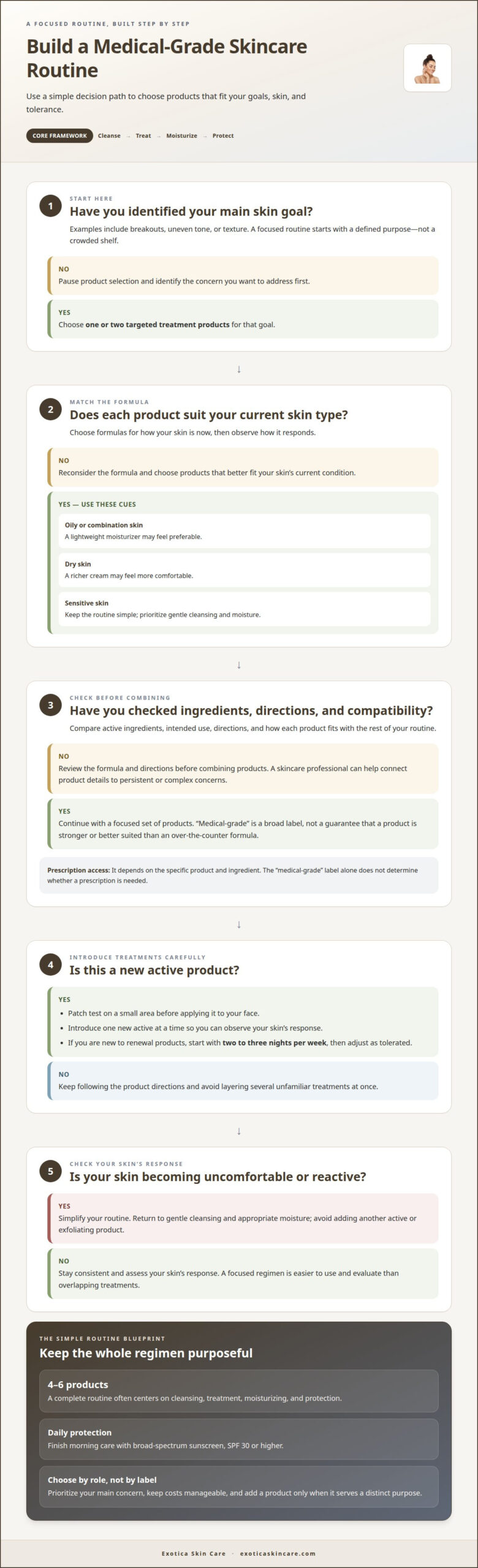
Use these steps to create a focused regimen. A complete routine often includes four to six products, organized around cleansing, treatment, moisturizing, and protection.
- Start with your main goal and choose one or two treatment products. “Medical-grade” is a broad label, not a guarantee that a product is stronger or better suited to your skin than an over-the-counter formula. Compare active ingredients, intended use, directions, and compatibility with the rest of your routine. A skincare professional can help connect those details to concerns such as breakouts, uneven tone, or texture.
-
Match Products to Skin Type
Choose formulas for your current skin type, then observe how your skin responds. Oily or combination skin may prefer a lightweight moisturizer, while dry skin may feel more comfortable with a richer cream. For sensitive skin, keep the routine simple and prioritize gentle cleansing and moisture. More treatment products do not necessarily improve balance; irritation can make a routine harder to maintain.
-
Evaluate Formulations and Compatibility
Read each formula’s active ingredients and directions before combining products. Introduce one new active at a time so you can see how your skin responds, rather than layering several unfamiliar treatments. If you are new to renewal products, start by using them two to three nights per week, then adjust as tolerated. Patch test an unfamiliar product on a small area before applying it to your face.
-
Consider Product Benefits, Costs, and Access
- Limit treatment products to keep your routine balanced. A focused regimen built around one or two treatments is easier to use consistently and assess than a shelf of overlapping actives. If your skin becomes uncomfortable, simplify your steps and avoid adding another exfoliating product. When building a medical-grade skincare routine, compatibility and gradual introduction matter more than using every available ingredient.
Setting realistic expectations for long-term skin health
Use products consistently, following each formula’s directions and paying attention to your skin’s response. Hydration and comfort may improve within days, while visible changes in texture, pigmentation, acne, or fine lines can take weeks to months.
Build a long-term approach around barrier support, gentle cleansing, and adjustments as your skin changes.
- Track one concern and your skin’s response. Note changes in hydration, comfort, texture, or breakouts as you follow your routine. A simple record can help distinguish a temporary change from a pattern, especially when you introduce a product or adjust your regimen. Avoid changing several steps at once, or it may be difficult to tell which ingredients are helping or causing discomfort.
-
Recognize Irritation and Protect the Skin Barrier
Pause and simplify your routine if products leave your skin increasingly uncomfortable or reactive. If your skin barrier is compromised, return to gentle cleansing, appropriate moisturization, and daily sun protection rather than adding active ingredients. Moisturizer supports the barrier and may help reduce irritation. Once your skin feels comfortable, reintroduce treatments carefully, one at a time.
-
Adjust for Seasonal and Skin Changes
Review your routine as the seasons and your skin change. A lightweight, gel-based moisturizer may feel comfortable in summer, while a richer, barrier-supporting cream can suit winter dryness. If your skin becomes less tolerant of exfoliation, reduce or rotate exfoliating products instead of pushing through discomfort. Your routine should respond to current concerns, not stay fixed just because it once worked.
-
Set Expectations for Use and Results
Use a new product consistently for at least six to eight weeks before judging its effect. Early improvements in hydration and texture may appear within four to six weeks; more noticeable changes in tone, firmness, and clarity may take three to six months. Keep your routine steady during that period unless irritation develops. Skin responds at different speeds, so compare progress with your original concern rather than expecting an overnight transformation.
- Choose professional skincare for a defined goal rather than expecting the label alone to determine results. Targeted products can complement daily care, while consistency and ingredient compatibility remain central to long-term skin health. Collagen production naturally declines approximately one percent per year, so a sustainable routine focuses on ongoing care rather than a single product or quick fix.
- Select a cleanser that matches your concern. For oily or acne-prone skin, choose one that helps remove excess oil and debris; for dry or sensitive skin, favor a gentle formula that cleans without disrupting the barrier. If acne remains a central concern, the Face Reality Acne Clinic may be a relevant next step for focused acne care.
Daily sunscreen use
Make sunscreen a consistent part of morning care, not a step reserved for sunny days. Daily protection supports your skin goals by helping limit UV damage, premature aging, and uneven pigmentation.
-
Choose Daily Broad-Spectrum Sunscreen
Consider making broad-spectrum sunscreen the final step in your morning skincare routine. Apply it after cleansing, serums, and moisturizer, giving it a clear place in your daily sequence. Select a formula you can use consistently; if you’re considering a mineral sunscreen, make sure it suits your skin and routine. Sunscreen is part of ongoing protection, not a replacement for targeted care.
-
Build Sun Protection Into Daily Habits
Apply sunscreen every morning and reapply when you’re outdoors. Keep it with your everyday essentials so outdoor plans don’t leave a gap in your routine. Make reapplication part of the transition from indoor to outdoor activities instead of waiting until your skin feels warm. In summer, plan to reapply more often than in winter, while maintaining daily use in both seasons.
- Consider how treatment ingredients affect your sun-protection plan. Retinoids and exfoliating treatments can make skin more sensitive to the sun, so pair their use with diligent morning sunscreen. Sunscreen remains important even on evenings when you use an active ingredient. A consistent morning step supports your skin goals while your evening routine addresses concerns such as texture or visible aging.
- Layer morning products in a practical order. Cleanse first, apply an antioxidant or targeted serum, add moisturizer if needed, and finish with SPF 30 or higher. This sequence places sunscreen last among your skincare products, where it can serve as the final protective layer. If you use vitamin C, the morning routine is a suitable place for it alongside daily sun protection.
- Keep your routine reliable on ordinary days, too. Daily exposure can happen during errands, a commute, or time outdoors, so don’t reserve sunscreen for extended sunbathing. If you’re addressing uneven pigmentation or early signs of aging, treat this step as ongoing care. Consistent use supports protection, while skipping mornings can make the rest of a carefully chosen regimen less cohesive.
- Choose a formula that fits comfortably with the rest of your products. A sunscreen that works with your moisturizer and targeted serum is easier to apply every morning. If a combination feels unpleasant, adjust the product pairing rather than abandoning protection. Keep the central rule simple: apply broad-spectrum SPF 30 or higher each morning, and reapply when outdoors.
Targeted treatments for acne, hyperpigmentation, aging, redness, and dullness
Match active ingredients to a specific concern, then build them into a simple routine. Cleansing, treatment, moisturizer, and daily sun protection provide a practical framework.
-
Select Active Ingredients for Targeted Concerns
Choose an active ingredient based on your primary goal. Salicylic acid or benzoyl peroxide may suit acne-prone skin; vitamin C and azelaic acid can address uneven tone or dullness. Niacinamide is often considered for redness and overall skin resilience, while retinoids may support improvements in texture, fine lines, and visible aging. Peptides are commonly included in formulas intended to support the appearance of firmness. Start with one targeted ingredient rather than combining several right away.
- Keep the basic sequence consistent: cleanse, apply treatment, moisturize, then protect during the day. A hydrating serum can support a smoother, more comfortable feel, while moisturizer helps maintain the skin barrier. In the morning, an antioxidant serum such as vitamin C can complement daily sun protection. In the evening, make room for one corrective product rather than layering every active ingredient you own.
-
Introduce Retinoids and Corrective Treatments
Introduce a retinoid gradually, beginning two nights per week and increasing only if your skin remains comfortable. Apply it in the evening, and avoid using AHAs or BHAs on the same night. These exfoliating acids are generally used at night, on separate evenings from retinoids. If irritation appears, reduce treatment frequency and simplify your routine instead of adding another corrective product.
- Separate ingredients by time of day when that makes your routine easier to tolerate. For example, use vitamin C in the morning and a retinoid at night, with moisturizer supporting comfort between steps. For acne, salicylic acid or benzoyl peroxide may be options; avoid starting both alongside a retinoid at once. Introducing one active ingredient at a time makes it easier to see how your skin responds.
- Consider professional treatments as a complement to at-home care when your goals include texture, firmness, or a refreshed appearance. Professional skincare treatments may be scheduled monthly, quarterly, or seasonally, depending on the approach and your routine. For mature skin, growth factors and antioxidants may complement treatments focused on firmness. After a procedure, follow its aftercare instructions and wait for clearance before resuming strong active ingredients.
- Review your routine in light of your concern rather than adding products by default. If dullness is your priority, an antioxidant or exfoliating product may be more relevant than an acne-focused active. If redness or sensitivity is prominent, favor a simpler combination and introduce corrective treatments carefully. Keep daily sun protection in place, particularly when using retinoids or exfoliating treatments, which can increase sun sensitivity.
Personalized skincare routine building
Build your routine around your skin’s current condition, primary concerns, and realistic goals, not a fixed product template. A useful routine gives each product a defined function and leaves room to adjust as your skin responds.
- Identify your main concern before choosing formulas. For example, distinguish persistent breakouts from lingering pigmentation or general dryness, since each points to different priorities. Consider your skin’s current condition as well as its usual type; sensitivity can change how much treatment it comfortably tolerates. Choose a routine you can follow consistently instead of trying to address every concern at once.
- Set priorities for morning and evening. A morning routine can include cleanser, an antioxidant or targeted serum, moisturizer if needed, and sunscreen. In the evening, cleanse thoroughly, apply a treatment product, then moisturize. This division gives a vitamin C serum a clear role in morning antioxidant care, while leaving evening steps for a corrective ingredient suited to your goals.
- Apply products in a deliberate order. Start with cleanser, then apply serums to clean, dry skin before heavier creams. If you use toner or essence, apply it after cleansing and before targeted serums; finish with moisturizer, then morning SPF. Applying products from thinnest to thickest consistency keeps the sequence straightforward and gives each formula a distinct place.
- Use skin typing as a guide, not a diagnosis. The Baumann Skin Typing System groups skin into 16 Baumann Skin Types, illustrating why oiliness alone doesn’t determine a suitable routine. Consider hydration, sensitivity, pigmentation, and breakouts together. Someone with an oily surface and sensitivity, for instance, may need a different balance than someone with similar oiliness but no irritation.
- Choose only ingredients that serve a defined function. An antioxidant serum may support skin-protection strategies and address concerns related to environmental stress. A retinoid may be considered for texture or visible aging when appropriate. Keep a simple record of new products and any irritation, then assess one change at a time; several simultaneous additions make cause and effect harder to identify.
- Review your routine when your skin condition or goals shift. A regimen that once suited breakouts may need rebalancing when dryness or sensitivity becomes more prominent. Keep your priorities visible: cleanse, target the main concern, moisturize, and protect. For support aligning treatment choices with your goals, explore personalized skincare options.
Exotica Skin Care
Exotica Skin Care can help connect your skin goals with professional treatment options that complement a thoughtful at-home routine. If daily products aren’t addressing concerns such as texture, uneven tone, or overall skin appearance, explore options including Scarlet SRF, BioRePeelCl3® Peel, PRX Derm Perfexion, and AquafirmeXS. Each offers a different approach, so the relevant choice depends on your goals and how professional care fits alongside your existing skincare. Keep your daily routine consistent and follow treatment-specific aftercare instructions. Contact Exotica Skin Care to discuss your skincare goals and available treatment options.
Make Your Next Skincare Choice With Confidence
Your next step can be a thoughtful conversation about how professional care fits your personal goals. Building a medical-grade skincare routine is an ongoing process, and clarifying your priorities can help you decide whether at-home products are enough or whether professional treatment belongs in your plan.
Exotica Skin Care offers Scarlet SRF, BioRePeelCl3® Peel, and PRX Derm Perfexion as treatment options to discuss in relation to your skin goals. Each is a distinct offering, so the right conversation starts with what you hope to address and how professional care might complement your current approach. There’s no need to overhaul everything at once. A considered next step can bring more intention to your skincare decisions.
Contact Exotica Skin Care to talk about your goals and explore your options. Your routine can evolve with you, one considered choice at a time.
Frequently Asked Questions
How Does SPF Fit into a Routine System, Especially in Summer?
SPF belongs at the end of your morning skincare steps, before makeup. Choose broad-spectrum SPF 30 or higher, and reapply when you’re outdoors. In summer, make reapplication easier by keeping sunscreen with your daily essentials and pairing it with shade or protective clothing. A morning application supports your routine, but extended time outside calls for renewed protection rather than relying on that first layer alone.
How Should Your Routine Change Between Summer and Winter?
Adjust moisturizer and treatment frequency to how your skin feels in each season. In summer, a lightweight gel moisturizer may feel more comfortable; winter dryness may call for a richer, barrier-supporting cream. If your skin becomes more reactive, reduce exfoliating products rather than adding more hydration and actives at once. Keep cleansing and sun protection consistent while adapting products that affect comfort.
How do I choose the right medical-grade skincare products for my skin?
Start with one priority, such as persistent breakouts, dryness, or uneven pigmentation, and choose a product with a clear role in addressing it. Read the ingredient list and directions, then consider how the formula fits with products you already use. “Medical-grade” by itself does not establish that a product is right for you. If a concern is persistent or difficult to manage, discuss options with a qualified skincare professional at Exotica Skin Care.
What does medical-grade skincare mean, and is it regulated by the FDA?
“Medical-grade” is a marketing term, not a single FDA designation that guarantees a product’s strength or performance. FDA oversight depends on how a product is categorized and marketed; cosmetics and products making drug claims are treated differently. Don’t use the label alone to judge suitability or approval. Review the stated ingredients and intended use, and seek professional guidance from Exotica Skin Care for prescription products or ongoing skin concerns.
What are the essential steps in a medical-grade skincare routine?
A practical routine has four functions: cleanse, treat a specific concern, moisturize, and protect your skin during the day. For example, someone addressing dullness might use a cleanser, a targeted antioxidant, moisturizer if needed, and sunscreen in the morning. At night, cleansing, one treatment, and moisturizer may be enough. Choose steps according to your skin’s needs rather than adding products simply to make the routine longer.
How do you choose medical-grade skincare products for your skin type and concerns?
Match the formula to both your skin type and its current condition. For example, someone with combination skin and sensitivity may prefer lightweight moisture while limiting exfoliating treatments. Consider whether your main concern is acne, redness, dryness, or pigmentation, then select products with complementary functions. In Las Vegas, outdoor routines can shape daily sun exposure, so choose protection that fits your lifestyle as well as your skin.
How should retinoids, vitamin C, exfoliating acids, and other actives be introduced safely?
Introduce one active ingredient at a time so you can assess your skin’s response. Vitamin C can fit into a morning regimen, while retinoids are commonly used at night; avoid applying exfoliating acids on the same night as a retinoid. Start retinoids on two nights per week, then increase only if your skin stays comfortable. If irritation develops, pause the new active and simplify your routine.
What is the correct order to apply medical-grade skincare products morning and night?
Apply products from thinner to thicker textures. In the morning, cleanse, apply an antioxidant or targeted serum, use moisturizer if needed, and finish with sunscreen. At night, cleanse thoroughly, apply your treatment to clean, dry skin, then moisturize. If you use toner or essence, apply it after cleansing and before serums. Follow product directions if they specify a different application method.