
The strongest vitamin C serum isn’t automatically the best choice for intense desert sun. If you’re comparing formulas and wondering which vitamin C serum for Las Vegas sun will suit your skin, look at how well the formula fits your routine, feels on your skin, and can be stored according to its directions.
It’s sensible to want extra support against daily sun exposure, but vitamin C doesn’t block UV rays or replace sunscreen. Used beneath broad-spectrum sunscreen, it can provide antioxidant support against free radicals associated with UV exposure. The right formula depends on more than the percentage on the label: the form of vitamin C, packaging, potential irritation, and the products you layer with it all matter.
In this guide, you’ll learn what vitamin C can and can’t contribute in Las Vegas sun, how to compare common forms and practical formula details, and how to introduce a serum thoughtfully. We’ll also cover routine basics that keep sun protection at the center, so you can choose a formula that suits your skin instead of chasing the strongest claim.
Key Takeaways
- Choose a vitamin C serum for Las Vegas sun by weighing formula stability, skin tolerance, and routine fit, not concentration alone.
- Compare L-ascorbic acid and vitamin C derivatives as distinct formula options rather than assuming they work the same way.
- Use product-specific directions to guide layering, and keep sun protection separate from a serum’s cosmetic role.
- Personalized skincare guidance can help connect your formula choice with your skin goals and existing home-care routine.
What Can Vitamin C Serum Do for Skin in Las Vegas Sun?
Topical vitamin C is an antioxidant skincare ingredient. In a routine, it may help support a brighter, more even-looking complexion, but it isn’t a treatment for medical skin conditions and can’t guarantee a particular cosmetic result. Its potential contribution depends on the formula, how your skin responds, the rest of your routine, and consistent use.
Antioxidants help address free radicals, unstable molecules that can form through normal processes and environmental exposure. A topical serum is designed to deliver vitamin C to the skin; that role is distinct from vitamin C’s functions in the body. For a general overview of the nutrient and its antioxidant properties, see Vitamin C. This reference describes vitamin C broadly, so it shouldn’t be read as evidence that every topical formula has the same effect.
What does vitamin C serum do in a skincare routine?
Think of serum as an optional cosmetic step, not a shield. It may complement a routine focused on a more radiant-looking complexion, while sunscreen is the product intended to protect skin from UV radiation. Vitamin C serum doesn’t block UV rays, prevent sunburn, or replace sun-protective habits. A formula that suits one person may irritate someone else or otherwise be a poor fit.
Keep expectations measured. A serum can’t erase the effects of sun exposure or take the place of medical evaluation for a changing spot, persistent irritation, or another skin concern. If your goal is cosmetic brightness, introduce any new product thoughtfully and follow its label. Comfort and consistency matter more than forcing a product into your routine when your skin doesn’t tolerate it.
Why does sun-conscious skincare matter in Las Vegas?
In Las Vegas, outdoor plans can add up across everyday activities, from walking between errands to spending time outside. Plan sun protection as a regular habit rather than relying on a serum for extra coverage. Check current guidance from authoritative sources such as the American Academy of Dermatology or the CDC, and follow sunscreen product directions.
A practical routine can include broad-spectrum sunscreen, protective clothing, shade when available, and other habits recommended by current public-health guidance. Reapply sunscreen as directed, particularly during extended outdoor time. These steps serve a different purpose from a cosmetic serum, so one shouldn’t be treated as a substitute for the other.
Choosing a vitamin C serum for Las Vegas sun is one decision within a broader routine. Consider your skin’s comfort, the products you already use, and the habits you can sustain. Personalized skincare guidance can help you weigh those factors together. A measured approach keeps the focus on consistency, comfort, and realistic expectations.
Vitamin C Serum Forms and Formulas: What Should You Compare?
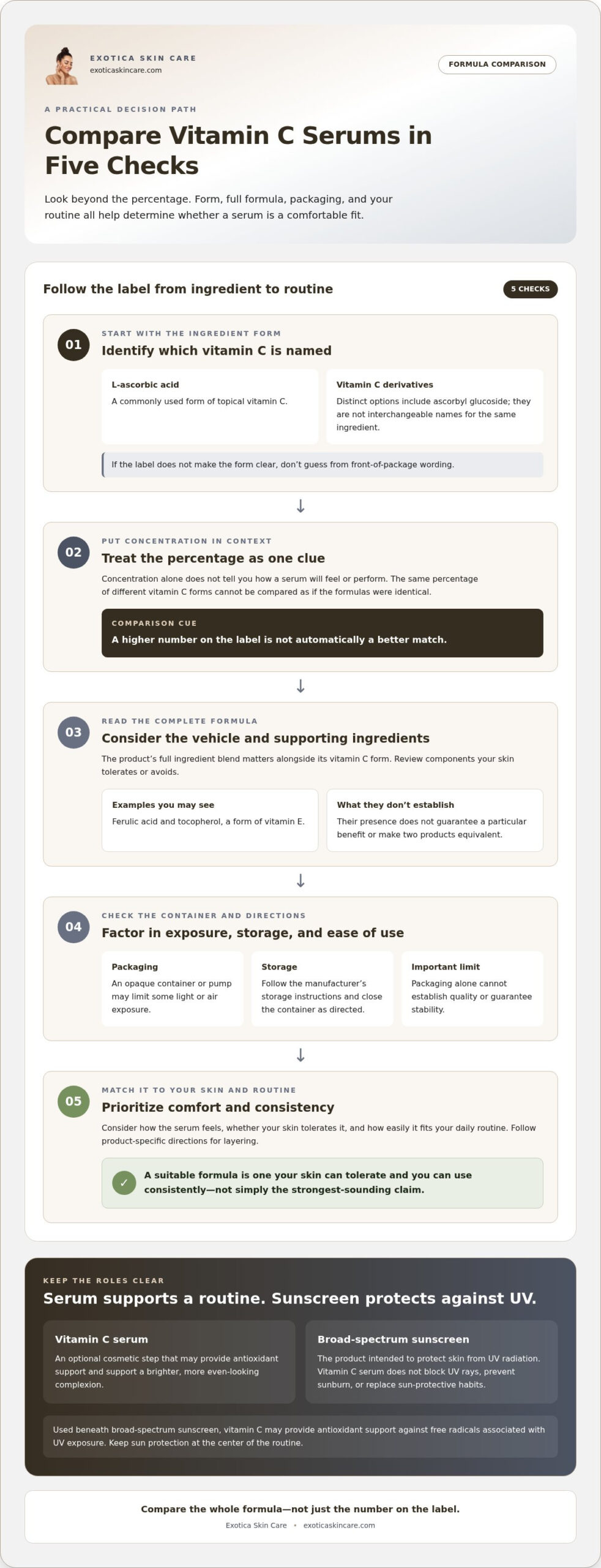
A serum’s ingredient label tells only part of the story. The form of vitamin C, the overall formulation, the packaging, and your skin’s tolerance all influence whether a product is a comfortable fit. Compare those details together rather than choosing by a prominent percentage or a broad claim about strength.
L-ascorbic acid versus vitamin C derivatives
L-ascorbic acid is a commonly used form of topical vitamin C. Derivatives, such as ascorbyl glucoside, are distinct formulation options, not interchangeable names for the same ingredient. Their properties and the evidence supporting particular products can differ. When comparing claims about stability or performance, look for reliable, formulation-specific evidence instead of assuming one form is universally superior.
Concentration is another factor, but it doesn’t tell you by itself how a serum will feel or perform. A percentage attached to one form can’t be directly compared with the same percentage of a different derivative as though the formulas were identical. The vehicle and the product’s full ingredient blend matter, too. A higher number on the label isn’t automatically a better match, especially if the product feels uncomfortable or is difficult to use consistently.
Use the ingredient list to identify the form of vitamin C and review the rest of the formula for components your skin tolerates or avoids. If the label doesn’t make the vitamin C form clear, don’t guess based on front-of-package wording. Product-specific claims need product-specific evidence.
How do packaging and supporting ingredients affect your choice?
Light- and air-conscious packaging can be a practical consideration for formulas that may be sensitive to exposure. An opaque container or a pump may limit some exposure during storage and use, but packaging alone can’t establish a product’s quality or guarantee its stability. Follow the manufacturer’s storage instructions, close the container as directed, and consider how easily the format fits your daily routine.
Supporting ingredients offer more context, not a shortcut to predicting results. Ferulic acid and tocopherol, a form of vitamin E, are examples you may encounter alongside vitamin C. Their presence doesn’t guarantee a particular benefit or make two products equivalent. Assess the complete ingredient list and choose a formula that fits your skin’s needs and other products.
- Vitamin C form: Identify whether the label names L-ascorbic acid or a derivative.
- Concentration: Treat the percentage as one clue, not a verdict on suitability.
- Packaging and storage: Consider exposure, ease of use, and the manufacturer’s directions.
- Supporting ingredients: Review the full blend and your skin’s known sensitivities.
For a vitamin C serum for Las Vegas sun, routine fit matters as much as the ingredient headline. If you’d value help weighing options against your skin goals and existing products, personalized skincare guidance can make the comparison more individual and considered.
How to Compare Vitamin C Serums for Your Skin and Routine
A useful comparison starts with your own skin, not the boldest claim on a package. A higher concentration isn’t automatically the best match: the vitamin C form, your tolerance, the packaging, and how the serum fits with products you already use all matter. Consider the full picture before adding a serum to a routine that’s working for you.
Compare four things: the vitamin C form, the packaging, your skin’s tolerance, and the serum’s compatibility with your current routine.
- Vitamin C form: Check the ingredient label for the stated form, such as L-ascorbic acid or a derivative. Don’t assume different forms or matching percentages mean equivalent formulas.
- Packaging: Note whether the container limits exposure to light or air, and whether its format is practical for regular use.
- Skin tolerance: Consider products you’ve previously found irritating and whether your skin tends to react to new additions.
- Routine compatibility: Look at your existing products and how many steps you’re already using. A serum should fit comfortably into your routine, not make it needlessly complicated.
Which formula may suit your skin tolerance?
If you already experience sensitivity, take a measured approach rather than choosing a formula based on strength alone. Follow the product’s directions, introduce it as instructed, and avoid adding several unfamiliar products at once. That makes it easier to notice how your skin responds. No label can guarantee that a particular formula will feel comfortable for everyone.
If significant irritation develops, stop using the serum. Persistent or concerning symptoms call for guidance from a qualified healthcare professional rather than experimenting with additional skincare products.
Which label and packaging details deserve attention?
On the ingredient list, look for the specific vitamin C name rather than relying only on front-label phrases such as “brightening.” Compare whether the container is opaque or designed to limit air exposure, but treat those features as practical considerations, not proof of guaranteed stability. Follow the manufacturer’s storage and expiration guidance, and don’t keep using a product beyond its stated instructions.
Routine compatibility deserves the same attention as the label. If you use several active products, consider whether another serum would make your regimen harder to follow or less comfortable. Keep the plan simple enough to use consistently, and follow each product’s directions for layering rather than assuming every combination is suitable. For a vitamin C serum for Las Vegas sun, a thoughtful match aligns with your preferences, tolerance, and routine, not necessarily the product with the highest percentage—whether you shop locally or explore everyday beauty essentials at Sk Store.
Adding Vitamin C Serum to a Las Vegas Sun Routine
A well-planned routine gives each product a clear role. Vitamin C serum is an optional skincare step; sunscreen and other sun-protective habits remain central when you spend time outdoors. Because formulas and directions differ, use the product label as your guide rather than assuming every serum layers the same way.
Where should serum fit in a daily routine?
A simple morning sequence is cleanse, apply serum as directed, moisturize if needed, then apply broad-spectrum sunscreen. This is a starting point, not a universal prescription: some products have specific layering instructions, and individual routines vary. Follow the serum and sunscreen labels, including directions for application and reapplication.
Keep the routine manageable. If you’re introducing a vitamin C serum, avoid changing several other products at the same time. That way, you can better notice whether the new step feels comfortable and fits your habits. If you already use active skincare products or have a routine tailored to your needs, account for those steps instead of layering by assumption.
Antioxidant skincare may complement a routine, but sunscreen is the step that protects against UV exposure. A serum doesn’t provide an SPF or replace sunscreen, protective clothing, shade, or other sun-safe habits. For outdoor time, current guidance commonly recommends broad-spectrum sunscreen with SPF 30 or higher and reapplication at least every two hours. Follow the product label and consult current authoritative guidance, such as the American Academy of Dermatology, for recommendations suited to your situation.
How can you keep a routine practical in desert sun?
Build around habits you can repeat: keep your morning steps straightforward, use sun protection as directed, and plan for it when your day includes time outside. Don’t judge a serum by an instant change in appearance. Pay attention to comfort, whether the routine is sustainable, and how your skin responds over time.
A simple sequence can help clarify each step:
- Cleanse according to your usual routine.
- Apply serum as its label directs, and avoid adding other unfamiliar products at the same time.
- Moisturize if it’s part of your routine and compatible with the product directions.
- Apply broad-spectrum sunscreen and follow its instructions for use and reapplication.
Layering details matter, especially when your home care includes several products. Our medical-grade skincare guidance can help you consider how products fit together and connect those choices with your skin goals and existing routine.
For a routine tailored to your preferences, explore personalized skincare guidance from Exotica Skin Care. Thoughtful product selection and steady sun-protective habits can work together without asking a serum to do sunscreen’s job.
Choose Vitamin C Skincare with Personalized Guidance in Henderson
Choosing a vitamin C serum can feel complicated when labels emphasize different forms, concentrations, and supporting ingredients. Start with your own skin: what you hope to support, what you already use, and whether your routine feels comfortable and manageable. Individualized guidance can connect those details, so formula selection feels considered rather than driven by a single headline claim.
When can professional skincare guidance help?
Guidance may be useful if you’re unsure how to compare formulas, have had difficulty tolerating new products, or find that your home-care routine has become hard to maintain. A licensed esthetician can discuss your skincare goals and existing habits, then help tailor a home-care protocol around them. This is cosmetic skincare guidance, not a diagnosis or medical treatment; persistent or concerning skin symptoms should be discussed with a qualified healthcare professional.
Bring the details that make your routine personal. Describe which products you use, what you’ve found comfortable, what you prefer to avoid, and how much time you realistically want to spend on skincare. That context can make the conversation more practical. The goal isn’t to add steps for their own sake, but to identify an approach you can follow consistently and adapt to your preferences.
For people comparing a vitamin C serum for Las Vegas sun, a thoughtful review can keep several considerations in view at once: cosmetic goals, product directions, skin tolerance, and the sun-protective habits that remain essential. No single formula is right for everyone, and guidance shouldn’t promise a particular result. It can help you understand how a product may fit within a broader home-care plan.
Explore personalized skincare support near Las Vegas
At Exotica Skin Care, licensed estheticians provide personalized skincare guidance and customized home-care protocols for clients in the Las Vegas area, including Henderson. They can take your existing routine and individual goals into account, helping you make informed skincare choices without treating a cosmetic product as a substitute for sun protection or medical care.
Exotica Skin Care is located at Exotica Skin Care, 2480 W. Horizon Ridge #130, Henderson, Nevada. If you’re also interested in the broader context of skin rejuvenation, explore the advanced skin rejuvenation guide as part of your skincare research. Consider how any new home-care step relates to your goals and established routine, rather than choosing based on a product claim alone.
For a more tailored perspective on your skincare routine, explore personalized skincare support at Exotica Skin Care. A thoughtful conversation can help you compare options with your needs in mind and shape a home-care approach that feels clear, comfortable, and sustainable.
Make Your Next Skincare Choice with Confidence
Let your next step be a thoughtful decision, not a race to find the most powerful-sounding formula. Before choosing a vitamin C serum for Las Vegas sun, define what you want from your skincare, what feels comfortable on your skin, and how much time you can realistically give your routine. Those preferences create a useful filter when labels and claims compete for attention.
There’s no need to overhaul everything at once. A considered choice can be modest: understand the product’s directions, decide how it could fit your habits, and give yourself room to notice how your skin responds. If you’d like support turning those questions into a routine that reflects your individual goals, explore personalized skincare at Exotica Skin Care.
Your skincare can evolve with you. Start with what feels clear and sustainable, then build from there with confidence.
Frequently Asked Questions
Can vitamin C serum replace sunscreen?
No. A topical antioxidant serum and sunscreen have different roles, and vitamin C serum should not be treated as protection from UV exposure. Even if you apply a vitamin C serum for Las Vegas sun, use sun-protective measures appropriate to your plans. Follow current guidance from authoritative sources such as the American Academy of Dermatology or CDC, and follow the directions on each product you use.
Is vitamin C serum suitable for sensitive skin?
It depends on the person, the specific formula, and its concentration. If your skin tends to react, introduce an unfamiliar serum cautiously and follow its label directions; stop using it if significant irritation develops. Avoid starting several new products together so you can better identify what your skin is responding to. Seek individualized professional guidance for persistent irritation or concerns about an existing skin condition.
Can you use vitamin C serum with retinol?
Compatibility depends on the particular products, their formulations, your skin’s tolerance, and the rest of your routine. Don’t assume the combination is always suitable or always incompatible. Read both product labels and introduce unfamiliar products thoughtfully rather than changing multiple steps at once. If you’re uncertain about layering or notice irritation, pause and seek personalized guidance before continuing the combination.
How can you tell if vitamin C serum has oxidized?
A change in appearance may signal that a formula has changed, but color alone can’t determine safety or effectiveness for every product. Compare the serum with the product’s guidance and check its expiration information and storage directions. If it looks or smells unexpectedly different, don’t use it while you’re unsure. Use product-specific guidance rather than relying on a universal color threshold.
Should vitamin C serum be refrigerated?
Not necessarily. Storage needs depend on the particular formula and packaging, so follow the product label and storage instructions instead of assuming refrigeration is required or beneficial. Store the serum as directed and close its container properly after use. Refrigeration shouldn’t be treated as a guarantee against formula changes.
How long does vitamin C serum take to show results?
There’s no universal timeline for visible changes. What you notice can vary with the product, your skin, your goals, and how consistently the serum fits into your routine. Follow the label and give yourself time to assess comfort and routine fit without expecting an instant transformation. A serum shouldn’t be relied on to reverse sun damage. For persistent skin concerns, seek professional guidance.