
Credentials matter more than polished marketing. To understand how to choose a medical spa in Las Vegas, verify the medical director, supervising physician, and provider who would perform your treatment, then ask about their training and experience with that specific procedure. A thorough consultation should also cover your health history, goals, risks, expected results, and costs before you book.
You deserve more than an appealing treatment menu: clear pricing, thoughtful answers, clean surroundings, and time to decide without pressure. Reviews and before-and-after images can offer useful context, but they don’t replace a conversation about your treatment plan, safety, and follow-up.
This guide explains how to assess pricing, patient feedback, credentials and physician oversight, facility cleanliness, equipment, and informed consent. You’ll have a practical framework for weighing each detail and deciding whether a medical spa feels like the right fit for your goals.
Key Takeaways
- Look for a treatment plan tied to your goals, with clear costs and an explanation of benefits and risks before you book.
- Use reviews and before-and-after images as context, paying attention to comments about provider skill, cleanliness, results, and follow-up.
- Understand who will perform your treatment and what training and physician oversight support their work.
- Notice whether the facility feels clinically prepared, the equipment and products are explained, and consent includes risks and aftercare.
- Distinguish medical treatments from traditional spa services so you can assess the level of training and oversight your chosen procedure calls for.
1. Are prices clear and transparent?
Medical spas in Las Vegas differ in treatments, provider qualifications, patient feedback, and pricing. When comparing the same service, such as a chemical peel, consider who performs it, what the plan includes, and whether the cost is explained clearly. A lower quote alone doesn’t show whether a treatment suits your skin or goals.
Treatments such as Botox injections and dermal fillers can carry risks, including infection, scarring, and unsatisfactory results. Before treatment, the provider should explain potential complications, how they would be handled, and what aftercare involves.
A useful consultation starts with your health history, not a sales package. Share relevant conditions, medications, allergies, previous treatments, and skin sensitivities. Then describe your goals, such as improving uneven texture or addressing acne. This information helps shape a personalized plan and identify when a recommendation may not be suitable.
The plan should name the proposed treatment and explain its benefits, risks, expected results, and recovery needs. Ask how each step relates to your goal. If you’re concerned about uneven skin tone, for example, the provider should explain why the recommended approach addresses it. A treatment menu alone doesn’t establish that a procedure is right for you.
Ask for an itemized quote that separates the treatment from any included follow-up, products, or aftercare. Pricing depends on the treatment, treatment area, provider, and recommended plan, and is given after a quote request. Clarify whether a package includes the same treatment each time, whether visits are optional, and what happens if the plan changes. Memberships also need clear terms, including eligible treatments and any commitment or cancellation conditions.
Compare offers by matching their scope, not just their headline price. One chemical peel quote may not include the same preparation, product, or follow-up as another. Ask the provider to explain each difference plainly. Be cautious if a price seems unusually low, and make sure the recommendation still accounts for product quality and the provider’s relevant experience.
Before booking, discuss the procedure’s setting and anesthesia. Medical spas generally suit nonsurgical treatments such as peels or microneedling. Procedures requiring more than local anesthesia or light sedation should generally be avoided in a medical spa. If a proposed treatment involves deeper sedation, reconsider whether the setting is appropriate. A sound consultation leaves you with a clear plan, written cost breakdown, and time to decide without pressure.
2. Patient reviews, referrals, and before-and-after images
To find a reputable medical spa near you in Las Vegas or Summerlin, compare patient reviews for treatment-specific details, provider credentials, cleanliness, results, and follow-up. A nearby address is convenient, but thoughtful feedback about care and communication offers more useful context than location alone.
Read several reviews rather than relying on one glowing testimonial. Look for specific details: Did staff explain preparation, answer questions, and provide aftercare instructions? Reviews mentioning the same provider or treatment can reveal patterns. Pay attention to recurring comments about rushed appointments, unclear instructions, or difficulty reaching the practice afterward.
Before-and-after photos can help you understand a provider’s approach, but examine them carefully. Compare images of similar concerns, treatment areas, and skin characteristics. Consistent lighting, camera angles, expressions, and framing make comparisons more meaningful. Ask whether the photos show the treatment you’re considering and how much time passed between them. One dramatic image can’t predict another patient’s results.
A referral is most useful when it comes from someone who received the same treatment you’re considering. Ask what the consultation covered, whether the provider listened to their goals, and how the practice handled questions afterward. A friend’s positive experience with a facial, for instance, may not tell you much about their experience with microneedling. Match the referral to the procedure and provider whenever possible.
Reviews can also describe how a practice handles health history. A careful intake gathers relevant medical information before treatment begins. Look for patient accounts mentioning questions about medications, allergies, previous procedures, or skin sensitivities. These details can show whether the care process considers individual circumstances rather than treating every appointment alike.
Notice comments about cleanliness, including treatment rooms, surfaces, and equipment preparation. Patient accounts can’t replace seeing the facility yourself, but recurring descriptions may reveal patterns. Look for feedback about whether staff explain what they’re doing and maintain a calm, orderly treatment environment.
Follow-up matters, especially if concerns arise after an appointment. Reviews mentioning clear aftercare guidance and a practical way to reach the practice can offer insight into support beyond treatment. Consider how the location fits your routine, but weigh convenience alongside treatment-specific feedback. Reviews describing attentive communication, clean rooms, and appropriate follow-through offer more useful evidence than a nearby address alone.
3. Physician oversight and provider credentials
To check a Las Vegas med spa’s providers and disciplinary history, get the full name and professional credential of the medical director, supervising physician, and person performing your procedure. Search the relevant licensing authority’s public records for each person’s license status and disciplinary history, then confirm the provider’s training matches your treatment.
A title on a website doesn’t explain who is responsible for your care. Ask how the physician participates in treatment planning, reviews health history, and responds to complications. A medical director may have a different role from a physician involved directly in patient care. Clear answers should identify who evaluates you, who performs or supervises the procedure, and whom to contact with concerns.
Match credentials to the treatment. Providers administering neuromodulators or dermal fillers should hold a medical credential, such as registered nurse, nurse practitioner, physician assistant, or physician. Ask about hands-on training and experience with the specific procedure, not only general aesthetics. For example, experience with chemical peels doesn’t by itself demonstrate training in injectable treatments.
In the United States, cosmetic injections, soft-tissue fillers, laser skin procedures, and hair transplants are classified as the practice of medicine. Who may administer injectables varies by state, so Las Vegas patients should establish which licensed professional performs each procedure and what physician oversight applies. Ask how the practice follows the requirements relevant to that treatment, rather than assuming every service has the same supervision model.
Check a provider’s license through the public records of the authority responsible for that credential. Search by full name and license type, then review the status and any disciplinary information shown. If names or roles don’t match the practice’s explanation, ask for clarification before booking. A thorough intake that records relevant health history also helps show whether medical oversight is connected to patient care.
Specialty training matters too. Plastic surgery, facial plastic surgery, and dermatology involve comprehensive training relevant to common aesthetic procedures. Ask what training the physician and treating provider have for your specific concern, and how long they’ve performed that procedure. A medical director’s specialty alone doesn’t establish the treating provider’s experience. Evaluate the person who will perform the treatment, their credentials, and the oversight structure together.
Before booking, make sure you understand who assesses your health history, who performs the procedure, and who handles follow-up concerns. If the answers remain unclear or you feel pressured, take time to consider your options. A second opinion can help you assess the proposed treatment and provider.
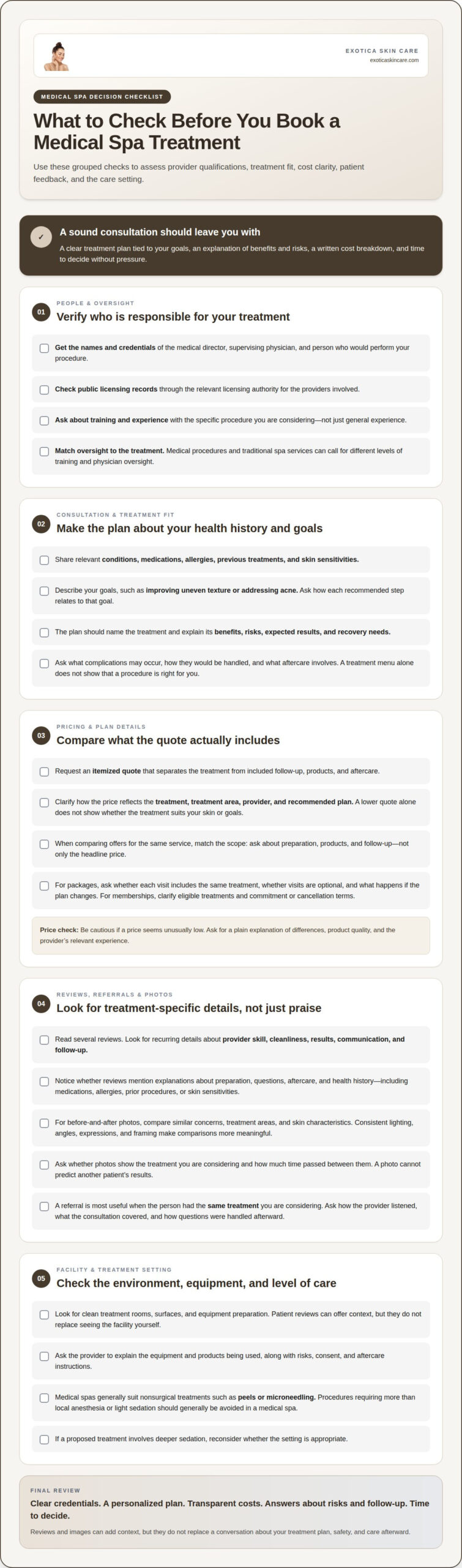
4. Facility cleanliness, equipment, and informed consent
Look beyond a polished reception area. A medical spa should maintain health and safety standards appropriate for medical treatments. Notice whether treatment rooms look orderly, staff prepare equipment carefully, and products are handled in a clean environment. Positive reviews may mention cleanliness, but they don’t replace observing how the facility operates during your visit.
Ask which device or product will be used and how it fits your treatment plan. Check whether equipment and products are FDA-approved and whether the facility complies with applicable health and safety laws. A clear explanation should identify what the treatment involves, rather than relying on broad claims about advanced technology. If a medical director oversees the practice, ask how that oversight relates to the procedures performed.
Licensing is distinct from professional memberships. An association membership may show professional involvement, but it doesn’t substitute for state and local licenses required for a facility’s services. Ask which licenses apply to the practice and treatment. Appearance, online reputation, or association membership alone doesn’t establish that a facility meets the requirements relevant to its services.
Informed consent should happen before the procedure, not while treatment is underway. Read the form and make sure it describes the treatment, risks, possible side effects, expected recovery, and aftercare. For fillers, for example, ask the provider to explain potential complications and how the practice would respond. You should have time to ask questions and decline without pressure.
Consent is meaningful only when the conversation is specific. The provider should explain what they’ll do, what outcomes are realistic, and which signs after treatment require attention. Ask who handles concerns if a complication arises and how follow-up works. These details connect written consent to a practical care plan, rather than leaving you with a signature and unanswered questions.
Match the procedure to an appropriate setting. Medical spas are generally intended for nonsurgical aesthetic treatments, not procedures requiring general anesthesia, regional anesthesia, or moderate-to-deep sedation. Those procedures should be performed in a licensed surgical center or hospital, not a medical spa. A procedure requiring more than local anesthesia or light sedation is a reason to reconsider whether a spa setting is suitable. Clear answers about cleanliness, equipment, licensing, and consent help you assess the facility before treatment.
5. How can patients verify a medical spa’s credentials before booking?
Start by identifying the service you’re considering, because a traditional facial and a cosmetic injectable involve different levels of clinical care. Traditional spas generally offer facials, massages, and body treatments that don’t require a medical license. Medical spas may provide injectables, prescription-strength products, or treatments using energy-based devices under medical supervision. The service helps determine which provider qualifications and oversight questions matter.
For injectables such as neuromodulators and dermal fillers, establish who performs the procedure and what professional credential they hold. A nurse, nurse practitioner, physician assistant, or physician may administer injectables, subject to state rules. Ask about treatment-specific training and experience. A general cosmetic background doesn’t explain someone’s preparation for a particular procedure.
Ask treatment-specific questions about laser procedures and other energy-based treatments. Find out which device or technology is used, what it is intended to address, and who operates it. The provider should explain how it fits your concern, such as skin texture or tone, and describe relevant risks and aftercare. A broad label such as “skin rejuvenation” doesn’t tell you what procedure will actually be performed.
Wellness services can involve medical oversight too. IV therapy, for example, is a common medical-spa service, and qualified medical staff should oversee its ingredients and administration. Ask who reviews the relevant health history and who responds if a concern arises. The title of medical director is only one part of the picture; clarify how the director or supervising physician participates in care and how that relates to your specific service.
Credentials should match the clinical focus. Dermatology, plastic surgery, and facial plastic surgery are specialties with comprehensive training relevant to common medical-spa procedures. That doesn’t replace asking about the treating provider’s own training and experience. A practice offering several services may have different professionals performing different procedures, so identify the person responsible for yours rather than relying on the spa’s general description.
Before booking, make a short service-specific checklist: the procedure, the person performing it, their professional credential, relevant training, and the physician oversight involved. Confirm that the health history intake addresses your circumstances and that the proposed treatment has a clear purpose. A facial at a traditional spa and an injectable treatment at a medical spa shouldn’t be assessed as interchangeable services. Matching the service to its clinical requirements makes your decision more informed.
Exotica Skin Care
Exotica Skin Care can help you connect your skin concerns with a focused aesthetic treatment plan. If you’re considering options for skin texture, tone, or overall rejuvenation, its offerings include Scarlet SRF, BioRePeelCl3® Peel, PRX Derm Perfexion, and AquafirmeXS. Each is a distinct option, so the right conversation starts with your goals, relevant skin history, and questions about risks and aftercare.
Use the points in this guide to shape your conversation: understand the proposed treatment, what it includes, and how it fits your priorities before deciding. Exotica Skin Care offers personalized skin care and advanced aesthetic treatments, including Scarlet SRF radiofrequency microneedling, chemical peels, and facial rejuvenation. Contact Exotica Skin Care to discuss your skin care goals and treatment options.
Make Your Next Skin Care Decision With Clarity
Turn your priorities into a focused conversation about the care you want. Knowing how to choose a medical spa in Las Vegas can help you set clear expectations and decide which questions matter most for your skin and goals.
Exotica Skin Care offers Scarlet SRF, BioRePeelCl3® Peel, and PRX Derm Perfexion among its aesthetic treatment options. Each treatment is distinct, so a discussion can help connect your concerns with an option that fits the care you’re considering. You can bring your goals and questions to that conversation, then take the time you need to decide what feels right.
Ready to discuss your skin care goals and explore your options? Contact Exotica Skin Care to start the conversation and take your next step with confidence.
Frequently Asked Questions
How can patients verify a medical spa’s credentials before booking?
Get the name and professional credential of the person who will perform your treatment, then use the relevant licensing board’s public lookup to review license status and disciplinary information. Confirm that the credential fits the procedure and ask about specific training. The person performing an injectable treatment, for example, may differ from the physician listed as medical director, so clarify everyone’s role before scheduling.
What questions should I ask during a medical spa consultation?
Ask what the treatment is intended to address, what alternatives may suit your goals, and what preparation or aftercare it involves. If you have sensitive skin or a previous reaction, explain that and ask how it affects the plan. You can also ask what might lead the provider to postpone or adjust treatment. These questions make a general recommendation more specific to your circumstances.
Are prices clear and transparent?
They should be explained before you commit, with the treatment and included services clearly described. Cost depends on the procedure, technology used, and complexity of the personalized treatment plan; the amount is provided after a quote request. Ask whether a quoted package includes every planned session or only some services. If the recommendation changes, request an updated breakdown before agreeing to the revised plan.
Credentials: Who Is Treating You?
Know the name, professional credential, and role of the person who will provide your treatment. A medical director, supervising physician, and treating provider may be different people. Ask who conducts your assessment, who performs the procedure, and who handles follow-up concerns. A provider’s experience with facials, for example, doesn’t establish their training for injectables, so connect qualifications to the service you’re considering.
Do they customize treatments for you?
A personalized plan should connect the recommended service to your concern and relevant health history. Ask why that approach suits you better than an alternative. If acne is your main concern, for instance, the discussion should address your skin condition and routine rather than automatically adding unrelated cosmetic treatments. A clear rationale helps you decide whether the plan reflects your priorities.
Do they offer a consultation?
A consultation should give you time to discuss your goals and health history before deciding. Describe previous procedures, sensitivities, medications, and the changes you hope to see. The provider can then explain options, risks, and aftercare relevant to your circumstances. You should leave understanding the recommendation and its purpose, not feeling obligated to proceed during the same visit.
How can I verify a medical spa’s safety standards?
Ask how the facility keeps treatment areas clean, what equipment or products the procedure uses, and whether those items are FDA-approved. Find out which state and local licenses apply to the facility’s services. Before proceeding, read the consent form and make sure it covers relevant risks, side effects, and aftercare. If staff can’t clearly explain the procedure or safety process, pause before agreeing to treatment.
How do I choose the right med spa in Las Vegas?
Start with the treatment you’re considering, then assess the provider’s relevant qualifications, the consultation, and how clearly the practice explains the plan. Consider whether the location makes follow-up practical for your schedule. Knowing how to choose a medical spa in Las Vegas means weighing the full care experience, not just a treatment menu or attractive photos. Choose a setting that gives you the information you need to make an informed decision.