
The strongest facial isn’t automatically the best match for your skin. The most useful questions to ask your esthetician cover their experience, your skin’s condition and goals, treatment and peel options, medications and supplements, and how your skin may respond to exfoliation. Their answers should help you understand why a treatment suits your needs and what to expect afterward.
It’s reasonable to want visible results while feeling confident that a facial suits your skin and routine. A thoughtful consultation makes room for both: your esthetician should learn about your skin before recommending an approach, explain the differences between options, and discuss preparation and aftercare.
Read on for questions about training and experience, treatment choices and peels, medications and supplements, exfoliation reactions, and the products used during your facial. You’ll have a clearer framework for discussing your priorities and choosing a treatment with confidence.
Key Takeaways
- Ask about your esthetician’s training and experience with concerns like yours, and share your current skin-care routine.
- Discuss your goals, skin condition, and comfort with downtime before choosing a facial or peel.
- Share your allergies and any medications, vitamins, or supplements you take so they can be considered when planning treatment.
- Ask what skin responses may follow exfoliation and which aftercare steps can help protect your skin.
- Find out which products and ingredients will be used, and how to adjust your routine if your skin feels irritated or results are limited.
1. Esthetician training and experience
Before choosing a facial, ask about your esthetician’s training and hands-on experience with your skin concern. Experience with acne, sensitivity, uneven tone, or mature skin can shape the techniques and products selected. Ask what treatments they’ve performed for concerns like yours and how they decide whether a facial suits your current skin condition.
Specific answers are more useful than a general claim of experience. Ask how they assess your skin, what they look for before recommending a treatment, and how they adapt their approach if your skin feels sensitive. For example, if you’re concerned about clogged pores, ask how they decide whether extractions are appropriate and how they limit irritation.
- What training have you completed related to the facial I’m considering?
- How do you adapt the treatment to my skin type and current concerns?
- What signs would lead you to change the treatment plan?
- What should I expect during the appointment and in my aftercare?
Notice whether the discussion covers your routine, not just the treatment menu. Share which products you use, how often you moisturize, and whether you exfoliate at home. Mention if you moisturize twice a day, since that helps describe your current routine. Also explain whether your skin tends to feel tight, oily, or easily irritated after cleansing.
Give practical context before your appointment. Tell the esthetician about recent hair removal, since shaving, waxing, or other hair removal on the day of a facial may affect the treatment plan. If you have an upcoming event, such as a wedding in six weeks, mention it early. Skin changes may take longer than that to reach your desired result, so timing matters.
Ask how the esthetician handles treatment steps that can affect different skin types in different ways. Oily skin can have follicles that appear more open, while extractions may irritate sensitive skin or contribute to scarring, broken capillaries, or discoloration. Understanding the approach lets you discuss comfort and alternatives before treatment begins.
Finally, ask for clear aftercare instructions and explain what you can realistically follow. After a facial, daily sun-care products with SPF 30 or higher are recommended. Ask whether you should avoid makeup or certain exfoliating products afterward, and what signs of irritation merit a call to the practice. A specific plan makes it easier to care for your skin once you leave.
2. Facial treatment options and peels
Ask how the recommended facial suits your skin type, current condition, and goals. A useful explanation connects each treatment step with a specific concern, such as congestion, dullness, or uneven texture. It should also clarify how the approach changes if your skin becomes irritated.
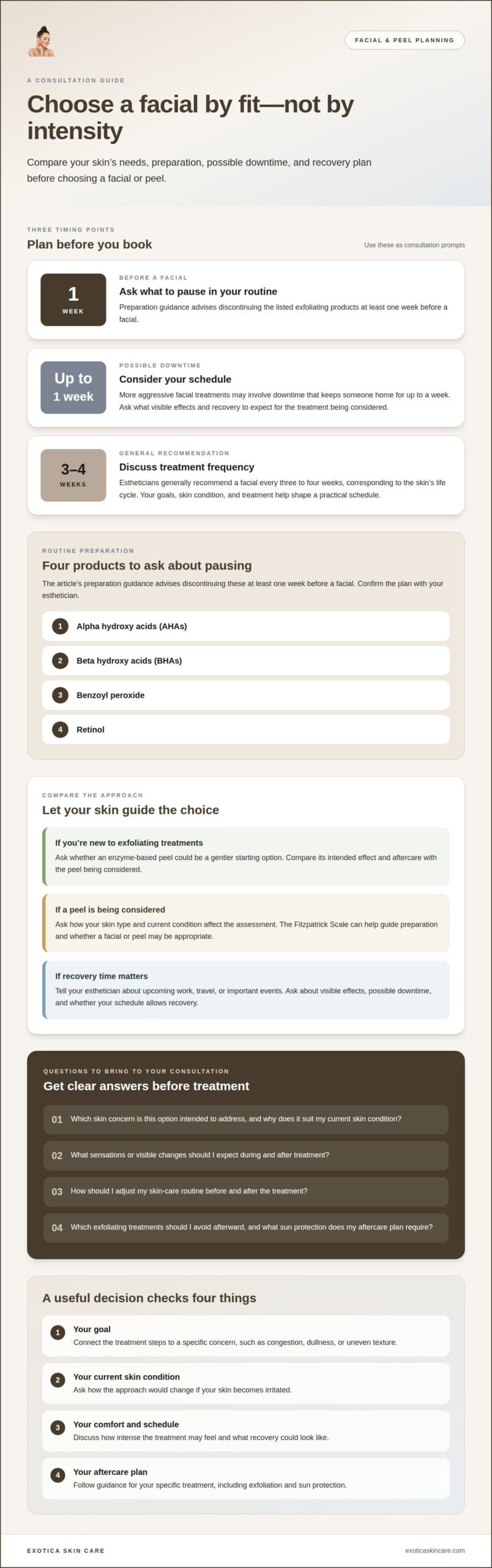
To prepare, review your routine and ask which products to pause before treatment. Preparation guidance advises discontinuing alpha hydroxy acids, beta hydroxy acids, benzoyl peroxide, and retinol at least one week before a facial.
Ask what the treatment involves, how intense it may feel, and what recovery could look like. The Fitzpatrick Scale can help guide preparation and whether a facial or peel may be appropriate. Ask how your skin type and condition affect that assessment, rather than choosing a peel based on its name or a trend.
- Which skin concern is this option intended to address?
- Why does it suit my current skin condition?
- What sensations or visible changes should I expect?
- How should I adjust my routine before and after treatment?
If you’re new to exfoliating treatments, ask whether an enzyme-based peel could be a gentler starting option. Discuss how it compares with the peel being considered, including its intended effect and aftercare. The right comparison is about your skin’s needs, not simply choosing the strongest treatment.
Recovery matters, especially before work, travel, or an important event. More aggressive facial treatments may involve downtime that keeps someone home for up to a week. Ask what visible effects might occur and whether your schedule allows time to recover before committing.
Discuss treatment frequency rather than assuming every facial follows the same schedule. Estheticians generally recommend a facial every three to four weeks, corresponding to the skin’s life cycle. Your goals, skin condition, and selected treatment help shape a practical schedule.
For a chemical peel, ask which exfoliating treatments to avoid afterward and what sun protection the aftercare plan requires. Follow the instructions for your specific peel, since recovery guidance is part of choosing the treatment, not an afterthought.
Before your appointment, write down your goals, current products, and recent changes to your routine. Bring the list to your consultation, then ask the esthetician to explain the proposed steps in order. Clear answers help you compare facial options, understand potential downtime, and choose an approach that fits your skin and schedule.
3. Medications, supplements, and vitamins
Before choosing a treatment, tell your esthetician about allergies and every medication, vitamin, and supplement you take. Include recent changes, such as starting or changing birth control. This context can help frame a conversation about your skin and the facial being considered.
Some medications can trigger acne breakouts or other skin issues. Changes in birth control and some other prescription medications may be linked to acne flare-ups, dryness, or skin sensitivity. These connections don’t establish the cause of a skin change, but they’re useful details to raise during your consultation.
Prepare a clear list before your appointment. Write down medication and supplement names, note any recent changes, and describe when you noticed a skin concern. For example, mention whether dryness appeared after a prescription change or breakouts followed a change in birth control. A simple timeline gives the esthetician more useful context than saying your skin has “been different.”
Use direct questions to guide the discussion:
- Could any medication I take affect my skin or the facial you recommend?
- Should a recent prescription or birth-control change influence treatment selection?
- Could my vitamins or supplements be relevant to oiliness or breakouts?
- What skin changes should I mention before we begin?
Include vitamins and supplements, even if you take them for general wellness rather than skin. B vitamins and other dietary supplements may affect sebum production, the oil produced by the skin. If you’ve noticed a change in oiliness after adding a supplement, share that observation. Don’t assume a product is irrelevant because it isn’t a prescription.
Be specific about allergies, too. Name the substance when you know it, and describe the reaction you’ve experienced. For instance, distinguish a known allergy from a product that simply leaves your skin feeling uncomfortable. That difference helps the esthetician understand what you’ve observed and consider it when planning treatment.
Keep the conversation focused on your own experience. Explain what changed, when you noticed it, and whether it followed a medication or supplement adjustment. Then ask how those details affect the treatment options under consideration. An esthetician can use this information to discuss the facial plan and identify relevant skin sensitivities.
Finish by repeating the key details you shared, especially any allergy or recent prescription change. Ask whether the planned treatment takes those details into account and what to do if your skin behaves differently afterward. A concise medication and supplement list can make the consultation more complete and help keep important information from slipping your mind.
4. Redness and skin response after exfoliation
After an esthetician treatment, follow the specific aftercare plan for your facial or peel. Keep your routine gentle: cleanse, moisturize, and protect your skin. After a chemical peel, avoid exfoliating treatments and use diligent sun protection.
Ask how your skin’s response may differ from another person’s. Hypervascular skin tends to flush easily, may remain flushed throughout the day, and heals faster than normal skin. Hypovascular skin is less reactive to exfoliation and heals more slowly than normal skin. These terms describe different response patterns, not a reason to assume every treatment will feel the same.
Before exfoliation, describe how your skin usually responds after cleansing or using active products. For example, explain whether your cheeks flush readily or irritation tends to linger. Ask the esthetician what response they anticipate from the planned treatment and what changes would be unexpected for your skin.
Use clear questions to understand the aftercare plan:
- What level of redness or sensitivity should I expect after this treatment?
- How should I adjust cleansing and moisturizing afterward?
- Which exfoliating products or treatments should I pause?
- What changes should I record as my skin recovers?
A simple observation log can make your skin’s response easier to describe. Note the treatment received, where redness appears, whether flushing continues through the day, and how your skin feels during cleansing. Compare those notes with your usual baseline, such as whether your face normally flushes easily or feels reactive after exfoliation.
Don’t judge the result by redness alone. Hypervascular skin can remain flushed throughout the day while healing faster than normal skin, whereas hypovascular skin may show less reaction and heal more slowly. Ask how those patterns relate to your treatment plan, and avoid comparing your recovery with someone else’s experience.
Follow the aftercare instructions for your treatment rather than adding extra active products to your routine. After a peel, avoid additional exfoliating treatments as directed and maintain sun protection. If your routine includes a scrub or deep exfoliator, clarify whether to pause it during recovery.
Make the plan practical before leaving your appointment. Repeat the cleansing, moisturizing, and protection steps in your own words, then note which products to avoid after exfoliation. If your treatment is a chemical peel, write down its specific restrictions separately from your usual routine. These steps help you care for freshly treated skin without confusing ordinary flushing with your normal baseline.
5. What products and ingredients will the esthetician use?
Ask for the product names and the role each one plays in your facial. A cleanser, exfoliant, mask, and moisturizer serve different purposes, so ask why each is included. If an ingredient name is unfamiliar, ask what it does in the treatment and whether it suits your skin concern. Understanding the sequence helps you compare in-room products with your home routine.
Your current products matter, too. Skin concerns or disappointing results may relate to unsuitable products, incorrect use, or using products too infrequently. Describe what you apply, how often you use it, and what changes you’ve noticed. For example, if a product intended for dryness hasn’t helped, explain how often you apply it and whether your skin feels different afterward.
Ask how the esthetician’s product choices relate to your goals, rather than relying on broad labels like “brightening” or “hydrating.” Ask which step addresses your concern, what result it is intended to support, and how you’ll know whether the routine suits you. A clear explanation should connect the ingredient or product to the treatment plan without promising a particular outcome.
Use these prompts during the consultation:
- Which products and key ingredients will you apply?
- What purpose does each product serve in this facial?
- How should I use the recommended products at home?
- How often should I use each product in my existing routine?
- Which products should I avoid combining with this plan?
Ask for practical instructions, not just a list of ingredients. If the esthetician recommends a home product, clarify how much to use, where to apply it, and how often. If you already use a similar product, mention its name and frequency. This helps distinguish a useful addition from unnecessary overlap in your routine.
Keep a simple record after the appointment. Note the product name, when you used it, how often you applied it, and any change you observed. If dryness, oiliness, or irritation appears, those details give you a concrete starting point for discussing whether the product or its use needs adjustment. When possible, change one routine step at a time so you can identify what changed.
Clear product guidance can make a facial plan easier to follow at home. Explore facial-care options as you consider which approach aligns with your skin goals and routine.
Exotica Skin Care: Scarlet SRF
Exotica Skin Care offers Scarlet SRF as an option to discuss when you’re considering a treatment tailored to your skin goals. Bring your questions about your skin concerns, current routine, and preferred level of treatment to the conversation. That context can help you understand whether Scarlet SRF or another facial option aligns with what you’re seeking.
Exotica Skin Care also offers BioRePeelCl3® Peel, PRX Derm Perfexion, and AquafirmeXS. Each is a distinct option to discuss in relation to your priorities and the questions covered in this guide. A clear conversation can help you understand the choices before deciding on a next step.
Contact Exotica Skin Care to discuss your skin-care goals and treatment options.
Choose a facial plan that feels right for you
Your next step is to turn your priorities into an open conversation. The questions to ask your esthetician can help you describe what you want from a facial, what matters in your routine, and what kind of treatment experience feels comfortable. Bring up the concerns you most want addressed, then give yourself space to consider the options without rushing your decision.
If you’re exploring Scarlet SRF, BioRePeelCl3® Peel, or PRX Derm Perfexion, discuss how each option relates to your goals and what you should understand before choosing. Exotica Skin Care can help you consider these treatment paths in the context of your skin-care priorities.
Contact Exotica Skin Care to continue the conversation and explore a thoughtful next step for your skin. With clear questions and a plan that reflects your needs, you can move forward feeling informed and confident.
Frequently Asked Questions
How do you determine what facial treatments are best for my skin?
The best match depends on your skin’s current condition, concerns, and treatment goals. Share what you hope to address, such as acne, dryness, or pigmentation, and mention how your skin reacts to products. Ask how those details shape the recommendation. In a Las Vegas consultation, discuss your usual sun exposure and routine, too, so the esthetician can consider your day-to-day skin-care context.
How often should I get a facial?
Estheticians generally recommend a facial every three to four weeks, corresponding to the skin’s life cycle. Your treatment type, skin condition, and goals also matter. Ask whether the suggested interval applies to the specific facial you’re considering and how your skin’s response should guide future appointments. If your routine or skin concerns change, revisit the schedule rather than relying on a fixed calendar indefinitely.
How will my skin look today, tomorrow, and next week?
Your appearance depends on the treatment and your skin’s response. Ask about likely immediate changes, such as temporary redness, and what to expect as your skin recovers. More aggressive facial treatments may involve downtime that keeps someone home for up to a week. Discuss upcoming plans before treatment, and ask which visible changes should prompt you to follow up with the practice.
What is your extraction method?
Ask how extractions are performed, which blemishes may be treated, and how the esthetician decides when to stop. Extraction methods can cause irritation, scarring, broken capillaries, or discoloration, especially for people with sensitive skin. Share any history of lingering marks or reactivity before the procedure. You can also ask what alternatives they consider if an extraction seems unsuitable for a particular area.
What is your training or experience?
Ask about training related to the treatment you’re considering and experience with skin concerns like yours. For example, if acne is your priority, ask how the esthetician approaches acne-prone skin and what factors guide treatment choices. You can also ask how they keep their knowledge current and whether they have experience adapting techniques for sensitivity. Specific examples help clarify how their background relates to your needs.
What skincare treatments do you offer?
Ask which options address your main concern and how their approaches differ. Exotica Skin Care offers Scarlet SRF, BioRePeelCl3® Peel, PRX Derm Perfexion, and AquafirmeXS. Its other listed treatments include DE|RIVE, SQT Bio-Microneedling, EXO|E, Face Reality Acne Clinic, and Carbon Peel. Ask which treatment aligns with your goals and what preparation or aftercare each option involves.
What take-home products do you recommend?
Ask for product names, the purpose of each item, and clear directions for home use. A recommendation should suit your skin concern and existing routine, rather than duplicate products you already use. Mention how often you apply your current cleanser or moisturizer and whether you’ve noticed irritation or limited results. Exotica Skin Care also offers EXO|E, a plant-based serum skin-care line, as a take-home option to discuss.
What should you ask an esthetician before your first appointment?
Useful questions to ask your esthetician before your first appointment include what treatment they recommend for your goals, how they adapt it to your skin, and what recovery may involve. Bring a list of current products and note allergies, medications, and supplements. Ask what to pause beforehand, which aftercare steps matter most, and what signs should lead you to contact the practice after treatment.